


Shopping Cart
Remove All Your shopping cart is currently empty


Synonyms: PK-8165
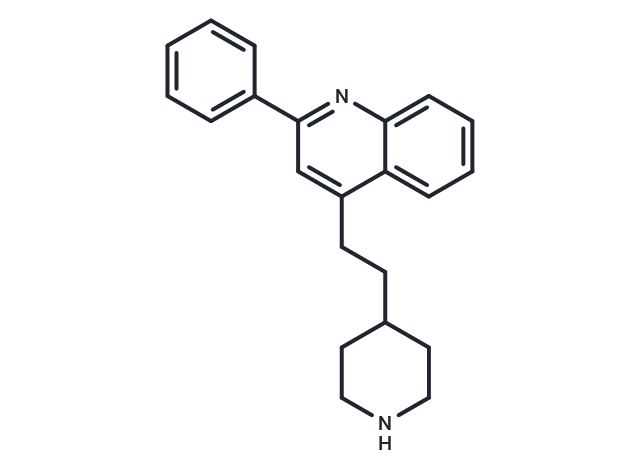

| Description | Pipequaline (PK-8165) is an anticonflict & anticonvulsant quinoline derivative. It is an anxiolytic drug that was never marketed. It possesses a novel chemical structure that is not closely related to other drugs of this type. The drug has a similar pharmacological profile to the benzodiazepine family of drugs, but with mainly anxiolytic properties and very little sedative, amnestic or anticonvulsant effects, and so is classified as a nonbenzodiazepine anxiolytic. |
| In vitro | Pipequaline is extensively bound to plasma proteins: i.e. human serum albumin (HSA), alpha-1-acid glycoprotein (AAG), lipoproteins and blood cells, mainly erythrocytes[1]. |
| In vivo | Intravenously administered pipequaline partially suppresses activations by kainate, glutamate, and acetylcholine. Microiontophoretic applications of pipequaline reduce neuronal activation by kainate[2]. In small intravenous doses, pipequaline potentiates the effect of microiontophoretically-applied flurazepam, whereas in larger doses, it suppresses the effects of microiontophoretically-applied flurazepam and intravenously administered lorazepam on kainate-induced activation. Pipequaline produces dose-related decreases in motor activity and significant dose-related decreases in the number of head-dips made[3]. |
| Synonyms | PK-8165 |
| Animal Research | Rats: Pipequaline is dissolved in water to give injection volumes of 2 mL/kg. Rats are injected with 5, 10, and 50 mg/kg pipequaline. Infrared cells in the walls of the box provided automated measures of locomotor activity and rearing, respectively[3]. |
| Molecular Weight | 316.44 |
| Formula | C22H24N2 |
| Cas No. | 77472-98-1 |
| Smiles | C(Cc1cc(nc2ccccc12)-c1ccccc1)C1CCNCC1 |
| Relative Density. | 1.078g/cm3 |
| Storage | Powder: -20°C for 3 years | In solvent: -80°C for 1 year Shipping with blue ice/Shipping at ambient temperature. | |||||||||||||||||||||||||||||||||||
| Solubility Information | DMSO: 32 mg/mL (101.13 mM), Sonication is recommended. | |||||||||||||||||||||||||||||||||||
Solution Preparation Table | ||||||||||||||||||||||||||||||||||||
DMSO
Note : The dilution table applies only to solid products. For liquid products, please calculate the stock solution based on the stated concentration and/or density. | ||||||||||||||||||||||||||||||||||||
 For example, if the intended dosage is 10 mg/kg for animals weighing 20 g , with a dosing volume of 100 μL per animal, and a total of 10 animals are to be administered, using a formulation of
  10% DMSO+ 40% PEG300+ 5% Tween 80+ 45% Saline/PBS/ddH2O , the resulting working solution concentration would be 2 mg/mL.
Dissolve 2 mg of the compound in 100 μL DMSO to obtain a stock solution at a concentration of 20 mg/mL . If the required concentration exceeds the compound's known solubility, please contact us for technical support before proceeding.
1) Add 100 μL of the DMSO stock solution to 400 µL PEG300 and mix thoroughly until the solution becomes clear.
2) Add 50 µL Tween 80 and mix well until fully clarified.
3) Add 450 µL Saline,PBS or ddH2O and mix thoroughly until a homogeneous solution is obtained.
| Size | Quantity | Unit Price | Amount | Operation |
|---|
 Feedback
 Hello! How can I help you today?
Copyright © 2015-2026 TargetMol Chemicals Inc. All Rights Reserved.
