


Shopping Cart
Remove All Your shopping cart is currently empty

Synonyms: OPBP1
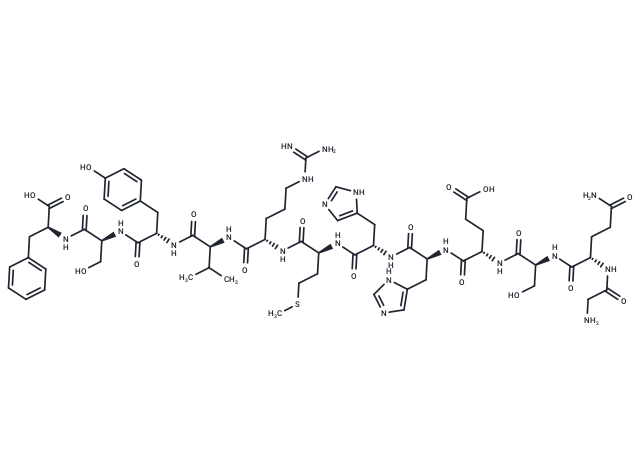
| Pack Size | Price | USA Stock | Global Stock | Quantity |
|---|---|---|---|---|
| 10 mg | Inquiry | Inquiry | Inquiry | |
| 50 mg | Inquiry | Inquiry | Inquiry |
| Description | OPBP-1 is a D-peptide identified through phage display screening, molecular docking, and molecular dynamics simulation. It possesses high stability, strong oral bioavailability, and significant antitumor activity. Its mechanism of action involves selectively binding to PD-L1, thereby effectively disrupting the PD-1/PD-L1 interaction. This disruption restores T cell function and downregulates the proportion of myeloid-derived suppressor cells (MDSCs), counteracting immune escape. Therefore, OPBP-1 is a candidate molecule for cancer immunotherapy research. |
| In vitro | Method: CHO-K1-hPD-L1 cells were co-cultured with PHA/PMA-pre-activated Jurkat T cells, followed by treatment with OPBP-1 (100 μM) or anti-PD-L1 antibody (10 μg/mL) for 48 hours. The percentage of IL-2-positive cells among CD45⁺ Jurkat T cells was detected by flow cytometry. Result: OPBP-1 (100 μM) significantly enhanced IL-2 secretion in CD45⁺ Jurkat T cells, showing an effect comparable to that of anti-PD-L1 antibody (10 μg/mL) and stronger than that of the parent peptide H12[1]. |
| In vivo | Method: BALB/c mice were subcutaneously inoculated with CT26 cells. When the tumor volume reached 40–70 mm³, OPBP-1 (0.2 or 0.5 mg/kg) was intraperitoneally injected once daily for two consecutive weeks, and tumor volume was measured. Result: OPBP-1 (0.5 mg/kg) significantly inhibited CT26 tumor growth without affecting body weight [1]. Method: CT26 tumor-bearing mice were treated with OPBP-1 (0.5 mg/kg, intraperitoneal injection) for two weeks. Tumor tissues were then collected to prepare single-cell suspensions, and the proportions of CD8⁺ T cells and IFN-γ⁺ CD8⁺ T cells were detected by flow cytometry. Result: OPBP-1 treatment significantly enhanced the infiltration ratio of CD8⁺ T cells and their IFN-γ secretion function in the tumor tissue [1]. |
| Synonyms | OPBP1 |
| Molecular Weight | 1477.62 |
| Formula | C64H92N20O19S |
| Cas No. | 2378606-21-2 |
| Smiles | [C@H](CC1=CN=CN1)(C(N[C@@H](CC2=CN=CN2)C(N[C@H](C(N[C@H](C(N[C@H](C(N[C@@H](CC3=CC=C(O)C=C3)C(N[C@H](C(N[C@@H](CC4=CC=CC=C4)C(O)=O)=O)CO)=O)=O)C(C)C)=O)CCCNC(=N)N)=O)CCSC)=O)=O)NC([C@@H](NC([C@@H](NC([C@@H](NC(CN)=O)CCC(N)=O)=O)CO)=O)CCC(O)=O)=O |
| Sequence | Gly-{D-Gln}-{D-Ser}-{D-Glu}-{D-His}-{D-His}-{D-Met}-{D-Arg}-{D-Val}-{D-Tyr}-{D-Ser}-{D-Phe} |
| Sequence Short | GQSEHHMRVYSF |
| Storage | Keep away from moisture, Powder: -20°C for 3 years | In solvent: -80°C for 1 year Shipping with blue ice/Shipping at ambient temperature. | ||||||||||
| Solubility Information | H2O: 4 mg/mL (2.71 mM), Sonication is recommended. | ||||||||||
Solution Preparation Table | |||||||||||
H2O
Note : The dilution table applies only to solid products. For liquid products, please calculate the stock solution based on the stated concentration and/or density. | |||||||||||
 For example, if the intended dosage is 10 mg/kg for animals weighing 20 g , with a dosing volume of 100 μL per animal, and a total of 10 animals are to be administered, using a formulation of
  10% DMSO+ 40% PEG300+ 5% Tween 80+ 45% Saline/PBS/ddH2O , the resulting working solution concentration would be 2 mg/mL.
Dissolve 2 mg of the compound in 100 μL DMSO to obtain a stock solution at a concentration of 20 mg/mL . If the required concentration exceeds the compound's known solubility, please contact us for technical support before proceeding.
1) Add 100 μL of the DMSO stock solution to 400 µL PEG300 and mix thoroughly until the solution becomes clear.
2) Add 50 µL Tween 80 and mix well until fully clarified.
3) Add 450 µL Saline,PBS or ddH2O and mix thoroughly until a homogeneous solution is obtained.
| Size | Quantity | Unit Price | Amount | Operation |
|---|
 Feedback
 Hello! How can I help you today?
Copyright © 2015-2026 TargetMol Chemicals Inc. All Rights Reserved.
