


Shopping Cart
Remove All Your shopping cart is currently empty

Synonyms:
| Pack Size | Price | USA Stock | Global Stock | Quantity |
|---|---|---|---|---|
| 25 mg | Inquiry | 10-14 weeks | 10-14 weeks | |
| 50 mg | Inquiry | 10-14 weeks | 10-14 weeks | |
| 100 mg | Inquiry | 10-14 weeks | 10-14 weeks |
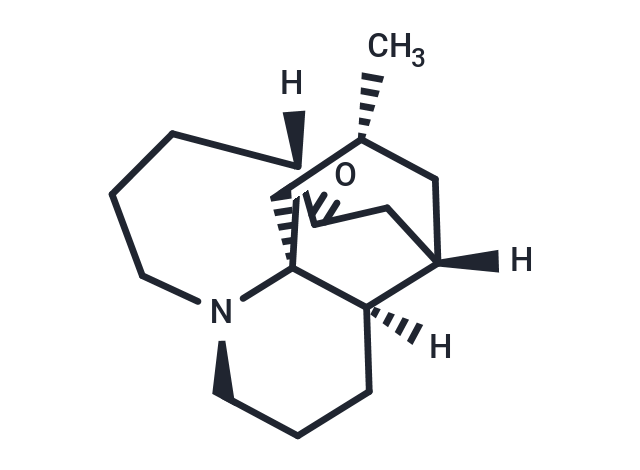
| Description | Lycopodine, a bioactive compound derived from Lycopodium clavatum spores, effectively inhibits the proliferation of HeLa cells through the induction of apoptosis. This process is mediated by caspase-3 activation. In refractory prostate cancer cells, Lycopodine triggers apoptosis by modulating 5-lipoxygenase and depolarizing the mitochondrial membrane potential, without altering p53 activity. |
| In vitro | Lycopodine (100, 200 μg/mL;?24 hours) increases level of Bax and decreases the mitochondrial cytochrome c. This is followed by an increase in expression of cytochrome c in cytosolic fraction.?Lycopodine also cleaves the caspase-3 in the total cell lysate, while the expression of Bcl-2 is down regulated[2].Lycopodine (5.22-78.3 μg/mL;?12 hours) has 50% viability at 57.62±0.086 μg/mL and 51.46±1.43 μg/mL for PC3 and LnCaP, respectively[1].?Treated with Lycopodine (74-222 mM;?12 hours), the apoptotic index is with respect to the gradual increase in doses for the PC3 and LnCaP cells[1].?Lycopodine (74-222 mM;?12 hours) induces cell cycle arrest at G0/G1 phase in PC3 and LnCaP cells[1].?Lycopodine (0-200 μg/mL;?48 hours) shows cytotoxicity to HeLa cells in a dose and time dependent manner.?However, Lycopodine shows minimal cytotoxic effects in normal peripheral blood mononuclear cells (PBMC) even at the highest dose (200 μg/mL)[2]. |
| Molecular Weight | 247.38 |
| Formula | C16H25NO |
| Cas No. | 466-61-5 |
| Smiles | O=C1[C@@]2([C@]34[C@@]([C@](C1)(C[C@@H](C)C3)[H])(CCC[N@]4CCC2)[H])[H] |
| Relative Density. | 1.106g/cm3 |
| Storage | Powder: -20°C for 3 years | In solvent: -80°C for 1 year Shipping with blue ice/Shipping at ambient temperature. |
 For example, if the intended dosage is 10 mg/kg for animals weighing 20 g , with a dosing volume of 100 μL per animal, and a total of 10 animals are to be administered, using a formulation of
  10% DMSO+ 40% PEG300+ 5% Tween 80+ 45% Saline/PBS/ddH2O , the resulting working solution concentration would be 2 mg/mL.
Dissolve 2 mg of the compound in 100 μL DMSO to obtain a stock solution at a concentration of 20 mg/mL . If the required concentration exceeds the compound's known solubility, please contact us for technical support before proceeding.
1) Add 100 μL of the DMSO stock solution to 400 µL PEG300 and mix thoroughly until the solution becomes clear.
2) Add 50 µL Tween 80 and mix well until fully clarified.
3) Add 450 µL Saline,PBS or ddH2O and mix thoroughly until a homogeneous solution is obtained.
| Size | Quantity | Unit Price | Amount | Operation |
|---|
 Feedback
 Hello! How can I help you today?
Copyright © 2015-2026 TargetMol Chemicals Inc. All Rights Reserved.
