


Shopping Cart
Remove All Your shopping cart is currently empty

Synonyms:

| Pack Size | Price | USA Stock | Global Stock | Quantity |
|---|---|---|---|---|
| 25 mg | $30 | - | In Stock | |
| 50 mg | $40 | - | In Stock | |
| 100 mg | $56 | - | In Stock | |
| 500 mg | $208 | - | In Stock | |
| 1 mL x 10 mM (in DMSO) | $62 | - | In Stock |
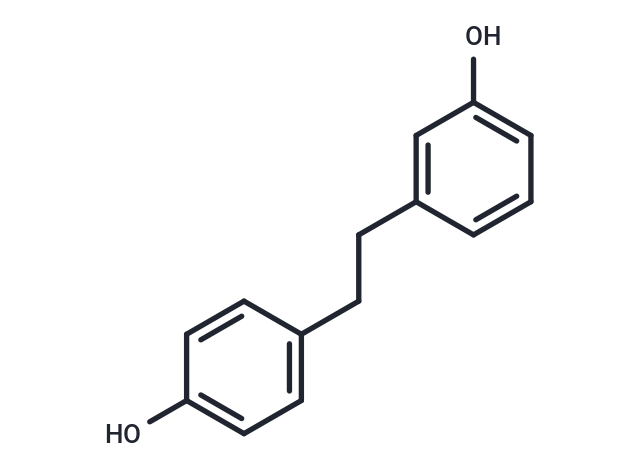
| Description | Lunularin is a naturally occurring bibenzyl compound widely distributed in liverworts (such as Conocephalum conicum) and is also a major gut microbiota-derived metabolite of resveratrol. Research indicates that Lunularin possesses significant antioxidant and anti-inflammatory properties and can selectively inhibit 11beta-hydroxysteroid dehydrogenase 1 (11beta-HSD1). Due to its role in regulating glucocorticoid activation and metabolic homeostasis, this molecule is of great interest in studies involving metabolic diseases, skin health, and neuroprotection. |
| In vitro | Lunularin demonstrates potent and selective inhibitory activity against human and rat 11beta-HSD1 in cell-based assays and exhibits strong radical scavenging capabilities to reduce oxidative stress [2][3]. |
| In vivo | In animal models, Lunularin contributes significantly to the health-promoting effects of resveratrol, showing the potential to regulate metabolic parameters and mitigate systemic inflammation [2]. |
| Molecular Weight | 214.26 |
| Formula | C14H14O2 |
| Cas No. | 37116-80-6 |
| Smiles | OC1=CC=CC(CCC2=CC=C(O)C=C2)=C1 |
| Relative Density. | 1.191g/cm3 |
| Storage | Powder: -20°C for 3 years | In solvent: -80°C for 1 year Shipping with blue ice/Shipping at ambient temperature. | |||||||||||||||||||||||||||||||||||
| Solubility Information | DMSO: 80 mg/mL (373.38 mM), Sonication is recommended. | |||||||||||||||||||||||||||||||||||
Solution Preparation Table | ||||||||||||||||||||||||||||||||||||
DMSO
Note : The dilution table applies only to solid products. For liquid products, please calculate the stock solution based on the stated concentration and/or density. | ||||||||||||||||||||||||||||||||||||
 For example, if the intended dosage is 10 mg/kg for animals weighing 20 g , with a dosing volume of 100 μL per animal, and a total of 10 animals are to be administered, using a formulation of
  10% DMSO+ 40% PEG300+ 5% Tween 80+ 45% Saline/PBS/ddH2O , the resulting working solution concentration would be 2 mg/mL.
Dissolve 2 mg of the compound in 100 μL DMSO to obtain a stock solution at a concentration of 20 mg/mL . If the required concentration exceeds the compound's known solubility, please contact us for technical support before proceeding.
1) Add 100 μL of the DMSO stock solution to 400 µL PEG300 and mix thoroughly until the solution becomes clear.
2) Add 50 µL Tween 80 and mix well until fully clarified.
3) Add 450 µL Saline,PBS or ddH2O and mix thoroughly until a homogeneous solution is obtained.
| Size | Quantity | Unit Price | Amount | Operation |
|---|
 Feedback
 Hello! How can I help you today?
Copyright © 2015-2026 TargetMol Chemicals Inc. All Rights Reserved.
