


Shopping Cart
Remove All Your shopping cart is currently empty

Synonyms:
| Pack Size | Price | USA Stock | Global Stock | Quantity |
|---|---|---|---|---|
| 25 mg | $2,300 | 10-14 weeks | 10-14 weeks | |
| 50 mg | $2,990 | 10-14 weeks | 10-14 weeks |
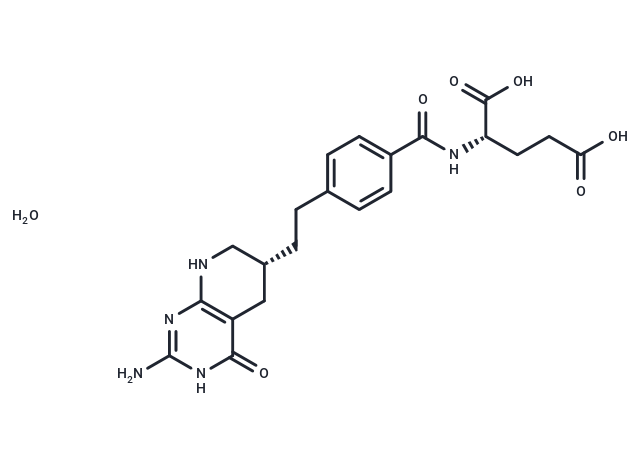
| Description | Lometrexol hydrate (DDATHF hydrate) is an antipurine antifolate compound that inhibits glycinamide ribonucleotide formyltransferase (GARFT) activity without inducing detectable DNA strand breaks. It further disrupts de novo purine synthesis, leading to abnormal cell proliferation, apoptosis, and cell cycle arrest, exhibiting anticancer activity [1] [2]. Additionally, it acts as a potent inhibitor of human Serine hydroxymethyltransferase1/2 (h SHMT1/2) [3]. |
| In vitro | Lometrexol hydrate (DDATHF hydrate) binds tightly to GART, causing a rapid and prolonged depletion of intracellular purine ribonucleotides [2]. Lometrexol hydrate (1-30 μM; 2-10 hours) induces rapid and complete growth inhibition in L1210 cells [2]. Lometrexol hydrate (1 μM; 2-24 hours) induces cell cycle arrest in murine leukemia L1210 cells [2]. Lometrexol hydrate induces abnormal proliferation and apoptosis exist in neural tube defects (NTDs) [1]. Cell Viability Assay [2] Cell Line: Mouse leukemia L1210 cells Concentration: 1, 30 μM Incubation Time: 2, 4, 6, 8, 10 hours Result: Induced rapid and complete growth inhibition. Cell Cycle Analysis [2] Cell Line: L1210 cells Concentration: 1 μM Incubation Time: 2, 4, 8, 12, 24 hours Result: Caused a rapid loss of the G2/M phase population of cells and an early S phase accumulation of cells by 8 hours. By 24 h, the S phase population appeared to be slowly shifting to higher DNA content, and hence, from mid-to-late S phase. |
| In vivo | Lometrexol hydrate (DDATHF hydrate; i.p.; 15-60 mg/kg; on gestation day 7.5) increases the rate of embryonic resorption and growth retardation in a dose-dependent manner [1]. Lometrexol hydrate (i.p.; 40 mg/kg) maximally inhibits GARFT activity after at 6 hours and thereafter gradually increases over time, but remains significantly lower than control even at 96 hours. Levels of ATP, GTP, dATP and dGTP of NTDs embryonic brain tissue decreases significantly at 6 h, and more significantly over time [1]. Animal Model: C57BL/6 mice (7-8 week, 18-20 g) [1] Dosage: 15, 30, 35, 40, 45 and 60 mg/kg Administration: Intraperitoneal injection; on gestation day 7.5 Result: Increased the rate of embryonic resorption and growth retardation in a dose-dependent manner. |
| Molecular Weight | 461.475 |
| Formula | C21H27N5O7 |
| Cas No. | 1435784-14-7 |
| Smiles | O.Nc1nc2NC[C@H](CCc3ccc(cc3)C(=O)N[C@@H](CCC(O)=O)C(O)=O)Cc2c(=O)[nH]1 |
| Storage | Powder: -20°C for 3 years | In solvent: -80°C for 1 year Shipping with blue ice/Shipping at ambient temperature. |
 For example, if the intended dosage is 10 mg/kg for animals weighing 20 g , with a dosing volume of 100 μL per animal, and a total of 10 animals are to be administered, using a formulation of
  10% DMSO+ 40% PEG300+ 5% Tween 80+ 45% Saline/PBS/ddH2O , the resulting working solution concentration would be 2 mg/mL.
Dissolve 2 mg of the compound in 100 μL DMSO to obtain a stock solution at a concentration of 20 mg/mL . If the required concentration exceeds the compound's known solubility, please contact us for technical support before proceeding.
1) Add 100 μL of the DMSO stock solution to 400 µL PEG300 and mix thoroughly until the solution becomes clear.
2) Add 50 µL Tween 80 and mix well until fully clarified.
3) Add 450 µL Saline,PBS or ddH2O and mix thoroughly until a homogeneous solution is obtained.
| Size | Quantity | Unit Price | Amount | Operation |
|---|
 Feedback
 Hello! How can I help you today?
Copyright © 2015-2026 TargetMol Chemicals Inc. All Rights Reserved.
