


Shopping Cart
Remove All Your shopping cart is currently empty

Synonyms: Quinol, 1,4-Dihydroxybenzene, 1,4-Benzenediol
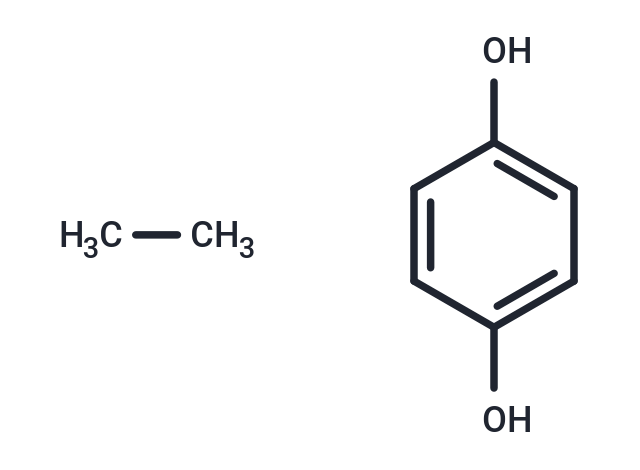
| Pack Size | Price | USA Stock | Global Stock | Quantity |
|---|---|---|---|---|
| 200 mg | $30 | - | In Stock | |
| 500 mg | $45 | - | In Stock | |
| 1 g | $64 | - | In Stock | |
| 5 g | $122 | - | In Stock | |
| 10 g | $133 | - | In Stock | |
| 25 g | $157 | - | In Stock |
| Description | Hydroquinone is a phenolic compound belonging to the hydroquinone class of reducing agents. It is used in organic synthesis, the preparation of antioxidants, as a polymerization inhibitor, and in analytical chemistry. By interfering with tyrosinase-related processes, hydroquinone reduces melanin formation and is used in research on skin pigmentation abnormalities such as hyperpigmentation and melasma. Hydroquinone exhibits strong redox activity and antioxidant properties. |
| Targets & IC50 | Melan-a cells:4.21 μM, SYF cells:37.5 μM, P388/ADR cells:2.2 μg/mL (ED50), A431 cells:23.3 μM |
| In vitro | Method: Human squamous cell carcinoma A431 cells (1×10⁶ cells/mL) were treated with Hydroquinone (0–100 μM) for 24, 48, and 72 h, and cell viability was assessed using the MTT assay. Result: Hydroquinone induced dose-dependent cell death in A431 cells at 48 h and 72 h, with an IC₅₀ of approximately 23.3 μM at 72 h [2]. Method: Mouse embryonic fibroblast SYF cells (1×10⁶ cells/mL) were treated with Hydroquinone (0–100 μM) for 24, 48, and 72 h, and cell viability was measured using the MTT assay. Result: Hydroquinone caused dose-dependent cell death in SYF cells at 48 h and 72 h, with an IC₅₀ of approximately 37.5 μM at 72 h [2]. Method: Mouse melanoma B16F10 cells and human breast cancer MDA-MB-231 cells were treated with Hydroquinone (50 μM) for 48 h, and morphological changes were observed under a light microscope. Result: Hydroquinone significantly induced cell shrinkage and death in both B16F10 and MDA-MB-231 cells [2]. |
| In vivo | Method: C57BL/6 mice were injected with B16F10 melanoma cells (1×10⁶ cells/mouse) via the tail vein to establish a pulmonary metastasis model. Mice were then intraperitoneally administered Hydroquinone (10 or 50 mg/kg) twice weekly for 18 days, and the number of melanoma metastatic foci in lung tissues was counted. Result: Hydroquinone (10 and 50 mg/kg) dose-dependently and significantly reduced the number of melanoma metastatic foci in mouse lung tissues, without causing body weight loss, indicating no apparent in vivo toxicity [2]. Method: C57BL/6 mice were subcutaneously injected with Azoxymethane (AOM, 10 mg/kg) and given drinking water containing Dextran Sodium Sulfate (DSS, 1.2%) to induce a colon cancer model. Mice were then intraperitoneally administered Hydroquinone (10 mg/kg) twice weekly for 4 weeks. The number of colon tumors was counted, and histopathological changes were examined by H&E staining. Result: Hydroquinone (10 mg/kg) effectively inhibited AOM/DSS-induced colon tumor formation, with a maximum reduction in tumor number of up to 50%, and significantly decreased colon tissue thickness [2]. |
| Synonyms | Quinol, 1,4-Dihydroxybenzene, 1,4-Benzenediol |
| Molecular Weight | 110.11 |
| Formula | C6H6O2 |
| Cas No. | 123-31-9 |
| Smiles | OC1=CC=C(O)C=C1 |
| Storage | Keep away from direct sunlight Powder: -20°C for 3 years | In solvent: -80°C for 1 year Shipping with blue ice/Shipping at ambient temperature. |
 For example, if the intended dosage is 10 mg/kg for animals weighing 20 g , with a dosing volume of 100 μL per animal, and a total of 10 animals are to be administered, using a formulation of
  10% DMSO+ 40% PEG300+ 5% Tween 80+ 45% Saline/PBS/ddH2O , the resulting working solution concentration would be 2 mg/mL.
Dissolve 2 mg of the compound in 100 μL DMSO to obtain a stock solution at a concentration of 20 mg/mL . If the required concentration exceeds the compound's known solubility, please contact us for technical support before proceeding.
1) Add 100 μL of the DMSO stock solution to 400 µL PEG300 and mix thoroughly until the solution becomes clear.
2) Add 50 µL Tween 80 and mix well until fully clarified.
3) Add 450 µL Saline,PBS or ddH2O and mix thoroughly until a homogeneous solution is obtained.
| Size | Quantity | Unit Price | Amount | Operation |
|---|
 Feedback
 Hello! How can I help you today?
Copyright © 2015-2026 TargetMol Chemicals Inc. All Rights Reserved.
