


Shopping Cart
Remove All Your shopping cart is currently empty


Synonyms: Huib-32, Huib 32
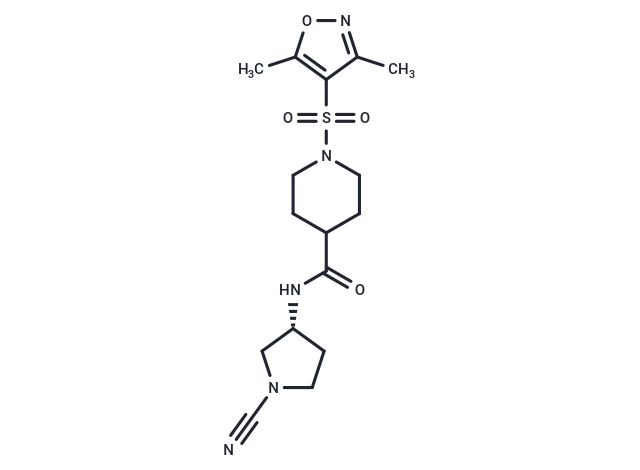

| Description | Huib32 is a potent small-molecule USP32 inhibitor with an IC₅₀ of 21.2 nM and high selectivity over closely related deubiquitinases (DUBs) including USP8/10/16, UCHL1, and OTUB2. It inhibits USP32 via reversible covalent binding to the active site Cys743, thereby increasing substrate ubiquitination, altering endosomal morphology, and producing biological phenotypes similar to USP32 knockout. It can be used in research on breast cancer, ovarian cancer, lung cancer, Alzheimer’s disease, Parkinson’s disease, and other diseases. |
| In vitro | Methods: Cells were treated with 0–50 μM Huib32 for 6–24 h to examine its selectivity against deubiquitinases. Target occupancy was assessed in MelJuSo cells. After treatment with 10 μM for 4–72 h, endosomal distribution, substrate ubiquitination, ubiquitin profiles, and effects on wild-type/mutant RAB7 were analyzed. Results: 1.Huib32 selectively inhibited USP32FL and USP32CD in a dose-dependent manner starting at 0.1 μM, with no significant effect on the other 16 DUBs tested. 2.It showed potent dose-dependent endogenous USP32 occupancy in MelJuSo cells with IC₅₀ ≈ 0.1 μM, demonstrating favorable cell permeability and intracellular targeting. 3.It induced dispersion of late endosomes and enhanced ubiquitination of substrates including RAB7, RAB6, RAB32, RAB11A/B, and TMEM192, suggesting involvement in membrane trafficking and revealing novel USP32 substrates. 4.It markedly altered the ubiquitin modification landscape, enriching and depleting specific Lys-ε-Gly-Gly peptides at 4 h and 72 h, respectively, acting on RAB11A/B and USP32 itself without changing total protein levels, indicating non-degradative ubiquitination regulation. 5.It specifically enhanced ubiquitination of wild-type GFP-RAB7 but not the GFP-RAB7 2KR mutant, validating targeted inhibition of a known USP32 substrate [1]. |
| Synonyms | Huib-32, Huib 32 |
| Molecular Weight | 381.45 |
| Formula | C16H23N5O4S |
| Smiles | O=S(N1CCC(C(N[C@@H]2CCN(C#N)C2)=O)CC1)(C3=C(C)ON=C3C)=O |
| Relative Density. | no data available |
| Storage | Powder: -20°C for 3 years | In solvent: -80°C for 1 year Shipping with blue ice/Shipping at ambient temperature. | |||||||||||||||||||||||||||||||||||
| Solubility Information | DMSO: 80 mg/mL (209.73 mM), Sonication is recommended. | |||||||||||||||||||||||||||||||||||
Solution Preparation Table | ||||||||||||||||||||||||||||||||||||
DMSO
Note : The dilution table applies only to solid products. For liquid products, please calculate the stock solution based on the stated concentration and/or density. | ||||||||||||||||||||||||||||||||||||
 For example, if the intended dosage is 10 mg/kg for animals weighing 20 g , with a dosing volume of 100 μL per animal, and a total of 10 animals are to be administered, using a formulation of
  10% DMSO+ 40% PEG300+ 5% Tween 80+ 45% Saline/PBS/ddH2O , the resulting working solution concentration would be 2 mg/mL.
Dissolve 2 mg of the compound in 100 μL DMSO to obtain a stock solution at a concentration of 20 mg/mL . If the required concentration exceeds the compound's known solubility, please contact us for technical support before proceeding.
1) Add 100 μL of the DMSO stock solution to 400 µL PEG300 and mix thoroughly until the solution becomes clear.
2) Add 50 µL Tween 80 and mix well until fully clarified.
3) Add 450 µL Saline,PBS or ddH2O and mix thoroughly until a homogeneous solution is obtained.
| Size | Quantity | Unit Price | Amount | Operation |
|---|
 Feedback
 Hello! How can I help you today?
Copyright © 2015-2026 TargetMol Chemicals Inc. All Rights Reserved.
