


Shopping Cart
Remove All Your shopping cart is currently empty

Synonyms: (S)-Glycerolphosphocholine
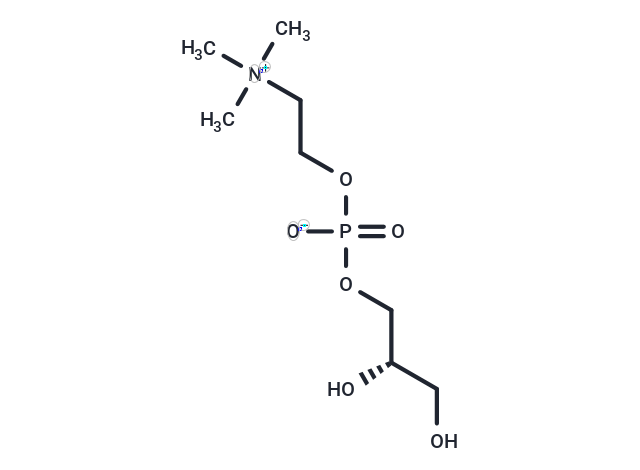
| Pack Size | Price | USA Stock | Global Stock | Quantity |
|---|---|---|---|---|
| 1 mg | $51 | - | In Stock | |
| 5 mg | $118 | - | In Stock | |
| 10 mg | $173 | - | In Stock | |
| 25 mg | $293 | - | In Stock | |
| 50 mg | $433 | - | In Stock | |
| 100 mg | $618 | - | In Stock |
| Description | Glycerophosphocholine is a naturally occurring, water-soluble source of choline. As a precursor for the biosynthesis of brain phospholipids, glycerophosphocholine efficiently crosses the blood-brain barrier and increases the availability of acetylcholine in neural tissue. Glycerophosphocholine is used in research on neurodegenerative diseases such as Alzheimer’s disease and dementia. It is also a potential biomarker for breast cancer. |
| In vitro | Methods: Caco-2 cells were seeded in Transwell chambers and cultured for 14 days to form a tight monolayer (TEER = 2234 ± 201 Ω·cm²). Different concentrations of Glycerophosphocholine (100 μM, 300 μM, 1 mM) were added to either the apical or basolateral side, After 20 hours of incubation, the apical medium, basal medium, and cell lysates were collected, and the concentrations of Glycerophosphocholine, choline, and betaine were quantified by LC-MS/MS. Results: Following the addition of Glycerophosphocholine to the apical side, the concentrations of choline on both the apical and basal sides increased significantly in a dose-dependent manner. [1] |
| In vivo | Methods: Six-week-old male C57BL/6J mice were administered Glycerophosphocholine (500 mg/kg) via oral gavage. Blood samples were collected from the tail vein at 0, 0.5, 1, 3, 6, and 10 hours post-administration, and the concentrations of TMAO, Glycerophosphocholine, choline, and betaine in the blood were quantified by LC-MS/MS. Results: Blood concentrations of Glycerophosphocholine and choline increased significantly as early as 0.5 hours post-administration (p < 0.001); TMAO and betaine concentrations peaked between 3 and 6 hours (p < 0.01), confirming that Glycerophosphocholine is rapidly metabolized into choline and subsequently into TMAO. [1] |
| Synonyms | (S)-Glycerolphosphocholine |
| Molecular Weight | 257.22 |
| Formula | C8H20NO6P |
| Cas No. | 4217-84-9 |
| Smiles | P(OC[C@H](CO)O)(OCC[N+](C)(C)C)(=O)[O-] |
| Storage | Keep away from moisture Powder: -20°C for 3 years | In solvent: -80°C for 1 year Shipping with blue ice/Shipping at ambient temperature. | |||||||||||||||
| Solubility Information | H2O: 2 mg/mL (7.78 mM), Sonication is recommended. | |||||||||||||||
Solution Preparation Table | ||||||||||||||||
H2O
Note : The dilution table applies only to solid products. For liquid products, please calculate the stock solution based on the stated concentration and/or density. | ||||||||||||||||
 For example, if the intended dosage is 10 mg/kg for animals weighing 20 g , with a dosing volume of 100 μL per animal, and a total of 10 animals are to be administered, using a formulation of
  10% DMSO+ 40% PEG300+ 5% Tween 80+ 45% Saline/PBS/ddH2O , the resulting working solution concentration would be 2 mg/mL.
Dissolve 2 mg of the compound in 100 μL DMSO to obtain a stock solution at a concentration of 20 mg/mL . If the required concentration exceeds the compound's known solubility, please contact us for technical support before proceeding.
1) Add 100 μL of the DMSO stock solution to 400 µL PEG300 and mix thoroughly until the solution becomes clear.
2) Add 50 µL Tween 80 and mix well until fully clarified.
3) Add 450 µL Saline,PBS or ddH2O and mix thoroughly until a homogeneous solution is obtained.
| Size | Quantity | Unit Price | Amount | Operation |
|---|
 Feedback
 Hello! How can I help you today?
Copyright © 2015-2026 TargetMol Chemicals Inc. All Rights Reserved.
