


Shopping Cart
Remove All Your shopping cart is currently empty

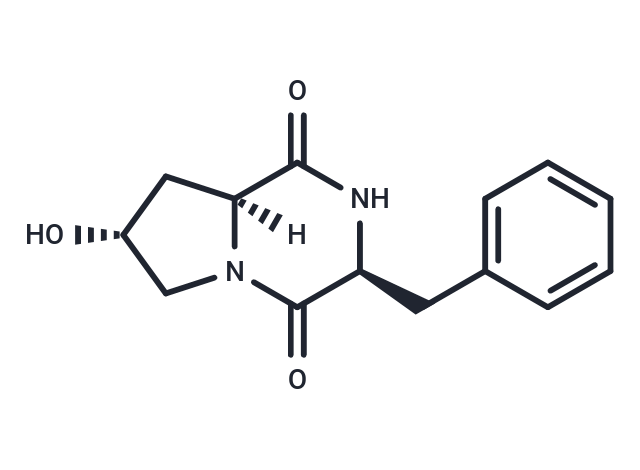
Synonyms: L-Phe-trans-4-hydroxy-L-Pro, Cyclo(L-phenylalanyl-trans-4-hydroxy-L-proline)

| Pack Size | Price | USA Stock | Global Stock | Quantity |
|---|---|---|---|---|
| 1 mg | $68 | In Stock | In Stock | |
| 5 mg | $159 | In Stock | In Stock | |
| 10 mg | $258 | In Stock | In Stock | |
| 25 mg | $436 | In Stock | In Stock | |
| 50 mg | $632 | In Stock | In Stock | |
| 100 mg | $888 | - | In Stock | |
| 1 mL x 10 mM (in DMSO) | $153 | In Stock | In Stock |
| Description | Cyclo(L-Phe-trans-4-hydroxy-L-Pro) (Cyclo(L-phenylalanyl-trans-4-hydroxy-L-proline)) is a natural product found in Phellinus igniarius. |
| In vitro | We previously identified Streptomyces griseus as an anti-cancer agent (Kim et al., 2014). In this study, we isolated compounds from S. griseus and evaluated their anticancer effect and toxicity in vitro and in vivo. METHODS AND RESULTS: Preparative centrifugal partition chromatography (CPC) was used to obtain three compounds, cyclo(L-[4-hydroxyprolinyl]- L -leucine], Cyclo(L-Phe-trans-4-hydroxy-L-Pro) and phenethyl acetate (PA). We chose PA, which had the highest anticancer activity, as a target compound for further experiments. PA induced the formation of apoptotic bodies, DNA fragmentation, DNA accumulation in G0/G1 phase, and reactive oxygen species (ROS) formation. Furthermore, PA treatment increased Bax/Bcl-xL expression, activated caspase-3, and cleaved poly-ADP-ribose polymerase (PARP) in HL-60 cells. Simultaneous evaluation in vitro and in vivo, revealed that PA exhibited no toxicity in Vero cells and zebrafish embryos. CONCLUSIONS: We revealed, for the first time, that PA generates ROS, and that this ROS accumulation induced the Bcl signaling pathway[1]. |
| Synonyms | L-Phe-trans-4-hydroxy-L-Pro, Cyclo(L-phenylalanyl-trans-4-hydroxy-L-proline) |
| Molecular Weight | 260.29 |
| Formula | C14H16N2O3 |
| Cas No. | 118477-06-8 |
| Smiles | O[C@@H]1C[C@@H]2N(C1)C(=O)[C@H](CC1=CC=CC=C1)NC2=O |
| Relative Density. | 1.35 g/cm3 (Predicted) |
| Storage | Powder: -20°C for 3 years | In solvent: -80°C for 1 year Shipping with blue ice/Shipping at ambient temperature. | |||||||||||||||||||||||||||||||||||
| Solubility Information | DMSO: 50 mg/mL (192.09 mM), Sonication is recommended.  | |||||||||||||||||||||||||||||||||||
Solution Preparation Table | ||||||||||||||||||||||||||||||||||||
DMSO
Note : The dilution table applies only to solid products. For liquid products, please calculate the stock solution based on the stated concentration and/or density. | ||||||||||||||||||||||||||||||||||||
 For example, if the intended dosage is 10 mg/kg for animals weighing 20 g , with a dosing volume of 100 μL per animal, and a total of 10 animals are to be administered, using a formulation of
  10% DMSO+ 40% PEG300+ 5% Tween 80+ 45% Saline/PBS/ddH2O , the resulting working solution concentration would be 2 mg/mL.
Dissolve 2 mg of the compound in 100 μL DMSO to obtain a stock solution at a concentration of 20 mg/mL . If the required concentration exceeds the compound's known solubility, please contact us for technical support before proceeding.
1) Add 100 μL of the DMSO stock solution to 400 µL PEG300 and mix thoroughly until the solution becomes clear.
2) Add 50 µL Tween 80 and mix well until fully clarified.
3) Add 450 µL Saline,PBS or ddH2O and mix thoroughly until a homogeneous solution is obtained.
| Size | Quantity | Unit Price | Amount | Operation |
|---|
 Feedback
 Hello! How can I help you today?
Copyright © 2015-2026 TargetMol Chemicals Inc. All Rights Reserved.
