


Shopping Cart
Remove All Your shopping cart is currently empty


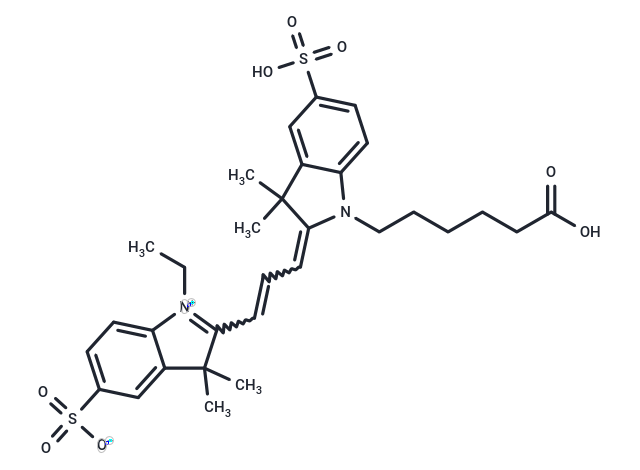
Synonyms: Sulfo-Cyanine3, Cy3
| Pack Size | Price | USA Stock | Global Stock | Quantity |
|---|---|---|---|---|
| 1 mg | $56 | In Stock | In Stock | |
| 2 mg | $79 | In Stock | In Stock | |
| 5 mg | $122 | In Stock | In Stock | |
| 10 mg | $172 | In Stock | In Stock | |
| 25 mg | $339 | In Stock | In Stock | |
| 50 mg | $493 | In Stock | In Stock | |
| 1 mL x 10 mM (in DMSO) | $163 | In Stock | In Stock |
| Description | Cy3 (Sulfo-Cyanine3) is an orange-fluorescent label for nucleic acids and proteins (λex=554, λem=568). |
| Synonyms | Sulfo-Cyanine3, Cy3 |
| Cell Research | 1. Protein labeling Experimental steps: 1. Prepare CY3 dye solution: Dissolve CY3 in an appropriate solvent (such as DMSO or PBS), at a concentration of usually between 1-10 μM. 2. Reaction with antibodies or proteins: Incubate CY3 dye (10 mg/ml) with the target protein or antibody. Incubate normally at room temperature for 30-60 minutes to ensure the dye binds to the target molecule. 3. Purification: Use dialysis or filtration to remove unbound dyes to ensure that only labeled proteins are present in the sample. 4. Fluorescence measurement: Use a fluorescence microscope or spectrophotometer to detect labeled proteins by selecting the appropriate excitation wavelength (λex = 554 nm) and emission wavelength (λem = 568 nm). 2. Nucleic acid labeling Experimental steps: 1. Prepare CY3-labeled probes or primers: Synthesize probes or primers with CY3-labeled, usually using conventional labeling chemistry. 2. Hybridization: Under appropriate reaction conditions, mix the CY3-labeled probe with the target nucleic acid (such as DNA or RNA) and perform a hybridization reaction. 3. Fluorescence imaging: Use a fluorescence microscope or real-time PCR system to select the appropriate wavelength to detect CY3-labeled nucleic acid signals. 3. Double marking experiment: Experimental steps: 1. Label multiple targets: Use CY3 and other fluorescent markers (such as FITC, Cy5, etc.) to label different target molecules separately. 2. Confocal imaging: Observe multiple labeled samples through confocal microscope or multi-channel microscope to perform spatial positioning of target molecules. Notes: 1. Photostability: CY3 dye may experience photobleaching under high-intensity light, so it is necessary to optimize the exposure time and light source intensity of fluorescence imaging experiments. 2. Solubility: CY3 has good solubility, but it is still necessary to avoid excessive concentration of dye solutions when used to prevent non-specific binding. 3. Cell permeability: CY3 has good cell permeability, but in some cases, it may be necessary to optimize experimental conditions, such as using penetrating reagents or performing cell membrane modification. The above information is based on published literature. Experimental procedures should be appropriately modified to meet specific research demands. |
| Molecular Weight | 630.78 |
| Formula | C31H38N2O8S2 |
| Cas No. | 146368-13-0 |
| Smiles | C(CCCCC(O)=O)N1C=2C(C(C)(C)C1=CC=CC3=[N+](CC)C=4C(C3(C)C)=CC(S(=O)(=O)[O-])=CC4)=CC(S(=O)(=O)O)=CC2 |
| Relative Density. | no data available |
| Storage | Keep away from direct sunlight Powder: -20°C for 3 years | In solvent: -80°C for 1 year Shipping with blue ice/Shipping at ambient temperature. | |||||||||||||||||||||||||
| Solubility Information | H2O: 25 mg/mL (39.63 mM), Sonication is recommended. | |||||||||||||||||||||||||
Solution Preparation Table | ||||||||||||||||||||||||||
H2O
Note : The dilution table applies only to solid products. For liquid products, please calculate the stock solution based on the stated concentration and/or density. | ||||||||||||||||||||||||||
 For example, if the intended dosage is 10 mg/kg for animals weighing 20 g , with a dosing volume of 100 μL per animal, and a total of 10 animals are to be administered, using a formulation of
  10% DMSO+ 40% PEG300+ 5% Tween 80+ 45% Saline/PBS/ddH2O , the resulting working solution concentration would be 2 mg/mL.
Dissolve 2 mg of the compound in 100 μL DMSO to obtain a stock solution at a concentration of 20 mg/mL . If the required concentration exceeds the compound's known solubility, please contact us for technical support before proceeding.
1) Add 100 μL of the DMSO stock solution to 400 µL PEG300 and mix thoroughly until the solution becomes clear.
2) Add 50 µL Tween 80 and mix well until fully clarified.
3) Add 450 µL Saline,PBS or ddH2O and mix thoroughly until a homogeneous solution is obtained.
| Size | Quantity | Unit Price | Amount | Operation |
|---|
 Feedback
 Hello! How can I help you today?
Copyright © 2015-2026 TargetMol Chemicals Inc. All Rights Reserved.
