


Shopping Cart
Remove All Your shopping cart is currently empty

Synonyms: NN-2344, NN2344, NN 2344, DRF-2593, DRF2593, DRF 2593
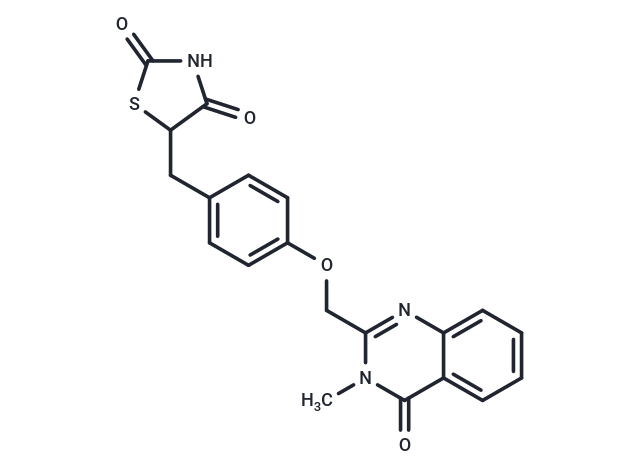
| Pack Size | Price | USA Stock | Global Stock | Quantity |
|---|---|---|---|---|
| 1 mg | $61 | - | In Stock | |
| 5 mg | Preferential | - | In Stock | |
| 10 mg | Preferential | - | In Stock |
| Description | Balaglitazone is a selective peroxisome proliferator-activated receptor (PPARγ) partial agonist with an EC50 value of 1.351 μM for human PPARγ.Balaglitazone can be used as a supplement to insulin therapy, regulates blood glucose, and can be used in studies of heart failure and myocardial infarction. |
| Targets & IC50 | PPARγ (human):351 μM (EC50) |
| In vitro | Balaglitazone exhibits equal cytotoxicity in K562 and K562/DOX cells, with IC50 values of 0.117 μM and 0.53 μM, respectively, and reduces the cytotoxicity of doxorubicin in these cells[2]. |
| In vivo | In male diet-induced obese rats, oral administration of Balaglitazone at 10 mg/kg suppresses overall blood glucose, reduces insulin levels, and increases body weight, with effects equivalent to 30 mg/kg pioglitazone[3]. |
| Synonyms | NN-2344, NN2344, NN 2344, DRF-2593, DRF2593, DRF 2593 |
| Cell Research | MTT assay is used for cell viability analyses. Briefly, K562 and K562/DOX cells are seeded in a 96-well plate in RPMI-1640 medium supplemented with 10% FBS at the density of 2 × 10⁴ cells/well. After 24 h incubation, various concentrations of doxorubicin (DOX) with or without balaglitazone are diluted in RPMI-1640 medium (without FBS) and added into each well. Experiments for each group are performed in triplicates and with a blank control. After 48 h of treatment, the medium is removed and 200 μL of RPMI-1640 medium supplemented with 10% FBS and 10% MTT (5 mg/mL) is added. After incubation for another 4 h, the reduced intracellular formazan product is dissolved by replacing 100 μL of RPMI-1640 medium with the same volume of dimethyl sulfoxide (DMSO). Absorbance values are measured at 570 nm with a microplate reader. The half-maximal inhibitory concentration (IC50) of each experiment is calculated. The resistance fold (RF) is calculated by dividing the IC50 value of treatment in resistant cells by the IC50 value of treatment in corresponding parental cells [2]. |
| Animal Research | Antihyperglycaemic effects of balaglitazone and rosiglitazone are assessed in adult male diabetic db/db mice. At 14 weeks of age, animals are randomized according to fasting blood glucose into 11 groups (n = 6). Mice are dosed orally once daily for 9 days with vehicle (0.2% carboxymethyl cellulose (CMC) + 0.4% Tween-80 in saline) or increasing doses of either balaglitazone (0.1; 0.3; 1.0; 3.0; 10.0 mg/kg/day) or rosiglitazone (0.2; 0.6; 2.0; 6.0 mg/kg/day). After 7 days of treatment, plasma samples obtained in the morning (between 8:00 and 10:00 AM) are analyzed for glucose and insulin. After 9 days of treatment, animals are exposed to an oral glucose tolerance test (OGTT; 3.0 g/kg). The resulting area under the curve is calculated for each of the doses [1]. |
| Molecular Weight | 395.43 |
| Formula | C20H17N3O4S |
| Cas No. | 199113-98-9 |
| Smiles | Cn1c(COc2ccc(CC3SC(=O)NC3=O)cc2)nc2ccccc2c1=O |
| Relative Density. | 1.45 g/cm3 (Predicted) |
| Storage | Store at low temperature Powder: -20°C for 3 years | In solvent: -80°C for 1 year Shipping with blue ice/Shipping at ambient temperature. | |||||||||||||||||||||||||||||||||||
| Solubility Information | DMSO: 80 mg/mL (202.31 mM), Sonication is recommended. | |||||||||||||||||||||||||||||||||||
| In Vivo Formulation | 10% DMSO+40% PEG300+5% Tween 80+45% Saline: 3.3 mg/mL (8.35 mM), Sonication is recommended. Please add the solvents sequentially, clarifying the solution as much as possible before adding the next one. Dissolve by heating and/or sonication if necessary. Working solution is recommended to be prepared and used immediately. The formulation provided above is for reference purposes only. In vivo formulations may vary and should be modified based on specific experimental conditions. | |||||||||||||||||||||||||||||||||||
Solution Preparation Table | ||||||||||||||||||||||||||||||||||||
DMSO
Note : The dilution table applies only to solid products. For liquid products, please calculate the stock solution based on the stated concentration and/or density. | ||||||||||||||||||||||||||||||||||||
 For example, if the intended dosage is 10 mg/kg for animals weighing 20 g , with a dosing volume of 100 μL per animal, and a total of 10 animals are to be administered, using a formulation of
  10% DMSO+ 40% PEG300+ 5% Tween 80+ 45% Saline/PBS/ddH2O , the resulting working solution concentration would be 2 mg/mL.
Dissolve 2 mg of the compound in 100 μL DMSO to obtain a stock solution at a concentration of 20 mg/mL . If the required concentration exceeds the compound's known solubility, please contact us for technical support before proceeding.
1) Add 100 μL of the DMSO stock solution to 400 µL PEG300 and mix thoroughly until the solution becomes clear.
2) Add 50 µL Tween 80 and mix well until fully clarified.
3) Add 450 µL Saline,PBS or ddH2O and mix thoroughly until a homogeneous solution is obtained.
| Size | Quantity | Unit Price | Amount | Operation |
|---|
 Feedback
 Hello! How can I help you today?
Copyright © 2015-2026 TargetMol Chemicals Inc. All Rights Reserved.
