


Shopping Cart
Remove All Your shopping cart is currently empty

Synonyms:
| Pack Size | Price | USA Stock | Global Stock | Quantity |
|---|---|---|---|---|
| 2 mg | $142 | 5 days | 5 days | |
| 5 mg | $247 | 5 days | 5 days | |
| 10 mg | $377 | 5 days | 5 days | |
| 1 mL x 10 mM (in DMSO) | $329 | 5 days | 5 days |
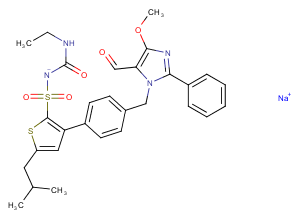
| Description | AVE 0991 competes for high-affinity binding of [125I]-Ang-(1-7) to bovine aortic endothelial cell membranes, with IC50 of 21±35 nM. AVE 0991 sodium salt is a nonpeptide and orally active Ang-(1-7) receptor Mas agonist. |
| Targets & IC50 | Ang (1-7) receptor:21±35 nM |
| In vitro | AVE 0991 is a nonpeptide compound that elicits effects similar to Ang-(1-7) on the endothelium. The peak concentrations of NO and O2- release by AVE 0991 sodium salt and Ang-(1-7) (both 10 μM) are not significantly different (NO: 295±20 and 270±25 nM; O2-: 18±2 and 20±4 nM), but the amount of bioactive NO released is approximately five times higher for AVE 0991. Both AVE 0991 and unlabeled Ang-(1-7) compete for high-affinity binding of [125I]-Ang-(1-7) to bovine aortic endothelial cell membranes, with IC50s of 21±35 and 220±280 nM, respectively[1]. |
| In vivo | AVE 0991 (AVE) demonstrates an antidiuretic effect marked by an elevated urine osmolality (1669±231.0 mOsm/KgH2O compared to 681.1±165.8 mOsm/KgH2O in vehicle-treated mice; P<0.01) and significantly reduces water diuresis in WT mice (0.06±0.03 mL versus 0.27±0.05 mL; n=9 per group; P<0.01). Similarly, in water-loaded Swiss mice, AVE 0991 administration (0.58 nmol/g) significantly lowers urinary volume (0.13±0.05 mL [n=16] versus 0.51±0.04 mL [n=40]; P<0.01). However, the antidiuretic effect is negated by the genetic deletion of Mas (0.37±0.10 mL [n=9] versus 0.27±0.03 mL [n=11] in AVE 0991-treated mice). Furthermore, a week-long treatment with AVE-0991 notably decreases perfusion pressure (56.55±0.86 vs. 68.73±0.69 mmHg in vehicle-treated rats), enhances systolic tension (11.40±0.05 vs. 9.84±0.15 g), increases both the rate of tension rise (+dT/dt; 184.30±0.50 vs. 155.20±1.97 g/s) and fall (−dT/dt; 179.60±1.39 vs. 150.80±2.42 g/s), and slightly raises heart rate (220.40±0.71 vs. 214.20±0.74 beats/min in vehicle-treated rats). |
| Molecular Weight | 602.7 |
| Formula | C29H31N4NaO5S2 |
| Cas No. | 306288-04-0 |
| Smiles | [Na].CCNC(=O)NS(=O)(=O)c1sc(CC(C)C)cc1-c1ccc(Cn2c(C=O)c(OC)nc2-c2ccccc2)cc1jcExt:v:0:0 |
| Relative Density. | no data available |
| Storage | Powder: -20°C for 3 years | In solvent: -80°C for 1 year Shipping with blue ice/Shipping at ambient temperature. | ||||||||||||||||||||||||||||||
| Solubility Information | DMSO: 55 mg/mL (91.26 mM), Sonication is recommended. | ||||||||||||||||||||||||||||||
| In Vivo Formulation | 10% DMSO+40% PEG300+5% Tween-80+45% Saline: 2.5 mg/mL (4.15 mM), Sonication is recommended. Please add the solvents sequentially, clarifying the solution as much as possible before adding the next one. Dissolve by heating and/or sonication if necessary. Working solution is recommended to be prepared and used immediately. The formulation provided above is for reference purposes only. In vivo formulations may vary and should be modified based on specific experimental conditions. | ||||||||||||||||||||||||||||||
Solution Preparation Table | |||||||||||||||||||||||||||||||
DMSO
Note : The dilution table applies only to solid products. For liquid products, please calculate the stock solution based on the stated concentration and/or density. | |||||||||||||||||||||||||||||||
 For example, if the intended dosage is 10 mg/kg for animals weighing 20 g , with a dosing volume of 100 μL per animal, and a total of 10 animals are to be administered, using a formulation of
  10% DMSO+ 40% PEG300+ 5% Tween 80+ 45% Saline/PBS/ddH2O , the resulting working solution concentration would be 2 mg/mL.
Dissolve 2 mg of the compound in 100 μL DMSO to obtain a stock solution at a concentration of 20 mg/mL . If the required concentration exceeds the compound's known solubility, please contact us for technical support before proceeding.
1) Add 100 μL of the DMSO stock solution to 400 µL PEG300 and mix thoroughly until the solution becomes clear.
2) Add 50 µL Tween 80 and mix well until fully clarified.
3) Add 450 µL Saline,PBS or ddH2O and mix thoroughly until a homogeneous solution is obtained.
| Size | Quantity | Unit Price | Amount | Operation |
|---|
 Feedback
 Hello! How can I help you today?
Copyright © 2015-2026 TargetMol Chemicals Inc. All Rights Reserved.
