


Shopping Cart
Remove All Your shopping cart is currently empty

Synonyms:
| Pack Size | Price | USA Stock | Global Stock | Quantity |
|---|---|---|---|---|
| 1 mg | $183 | Inquiry | Inquiry |
| Description | APTSTAT3-9R-9R is a STAT3 inhibitor (Ki: 231 nmol/L). STAT3 has been reported to promote the proliferation, survival, metastasis, immune escape, as well as drug resistance of cancer cells, making it a promising target for various diseases. However, though multiple STAT3 inhibitors and its regulatory or effector pathway elements have been identified, bioactive agents are limited. |
| In vitro | In vitro: The previous study showed that APTSTAT3-9R bound to STAT3 with high specificity and affinity. Moreover, the addition of a cell-penetrating motif to the peptide to yield APTSTAT3-9R enabled uptake by murine B16F1 melanoma cells. In addition, treatment of various types of cancer cells with APTSTAT3-9R was able to inhibit STAT3 phosphorylation and reduce expression of STAT targets, such as Bcl-xL, cyclin D1, and survivin. As a result, APTSTAT3-9R could suppress the viability and proliferation of cancer cells [1]. |
| In vivo | In vivo: In a previous animal in vivo study, a human lung carcinoma xenograft model was prepared by subcutaneous implantation of A549 cancer cells. After tumors had reached a volume of approximately 50 mm3 after two weeks, APTSTAT3-9R was intratumorally injected every other day for a total of four injections. Results showed that the tumor burden was significantly reduced in the APTSTAT3-9R–treated group when compared with that in the control group; however, there was little difference in tumor size between APTscr-9R and control groups [1]. |
| Molecular Weight | 4947.51 |
| Formula | C223H330N80O51 |
| Smiles | NC(CC1=CNC=N1)C(NC([H])C(NC(CC2=CC=CC=C2)C(NC(CCC(N)=O)C(NC(CC3=CNC4=C3C=CC=C4)C(N5C(C(NC([H])C(NC(CO)C(NC(CC6=CNC7=C6C=CC=C7)C(NC([C@@H](C)O)C(NC(CC8=CNC9=C8C=CC=C9)C(NC(CCC(O)=O)C(NC(CC(N)=O)C(NC([H])C(NC(CCCCN)C(NC(CC%10=CNC%11=C%10C=CC=C%11)C(NC([C@@H |
| Relative Density. | no data available |
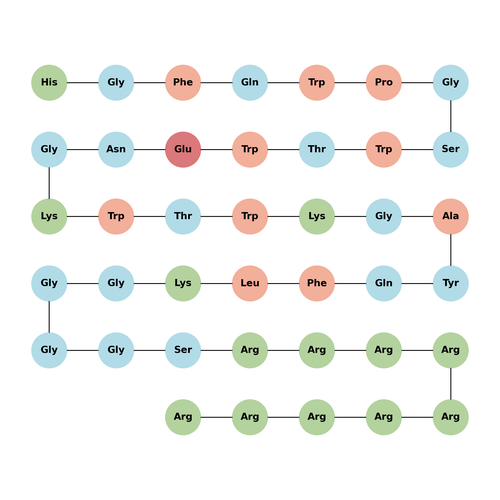
| Sequence | His-Gly-Phe-Gln-Trp-Pro-Gly-Ser-Trp-Thr-Trp-Glu-Asn-Gly-Lys-Trp-Thr-Trp-Lys-Gly-Ala-Tyr-Gln-Phe-Leu-Lys-Gly-Gly-Gly-Gly-Ser-Arg-Arg-Arg-Arg-Arg-Arg-Arg-Arg-Arg |
| Sequence Short | HGFQWPGSWTWENGKWTWKGAYQFLKGGGGSRRRRRRRRR |
| Storage | Keep away from moisture Powder: -20°C for 3 years | In solvent: -80°C for 1 year Shipping with blue ice/Shipping at ambient temperature. |
| Solubility Information | DMSO: Soluble |
 For example, if the intended dosage is 10 mg/kg for animals weighing 20 g , with a dosing volume of 100 μL per animal, and a total of 10 animals are to be administered, using a formulation of
  10% DMSO+ 40% PEG300+ 5% Tween 80+ 45% Saline/PBS/ddH2O , the resulting working solution concentration would be 2 mg/mL.
Dissolve 2 mg of the compound in 100 μL DMSO to obtain a stock solution at a concentration of 20 mg/mL . If the required concentration exceeds the compound's known solubility, please contact us for technical support before proceeding.
1) Add 100 μL of the DMSO stock solution to 400 µL PEG300 and mix thoroughly until the solution becomes clear.
2) Add 50 µL Tween 80 and mix well until fully clarified.
3) Add 450 µL Saline,PBS or ddH2O and mix thoroughly until a homogeneous solution is obtained.
| Size | Quantity | Unit Price | Amount | Operation |
|---|
 Feedback
 Hello! How can I help you today?
Copyright © 2015-2026 TargetMol Chemicals Inc. All Rights Reserved.
