


Shopping Cart
Remove All Your shopping cart is currently empty

Synonyms: SR-58611A, SR58611A, SR 58611A
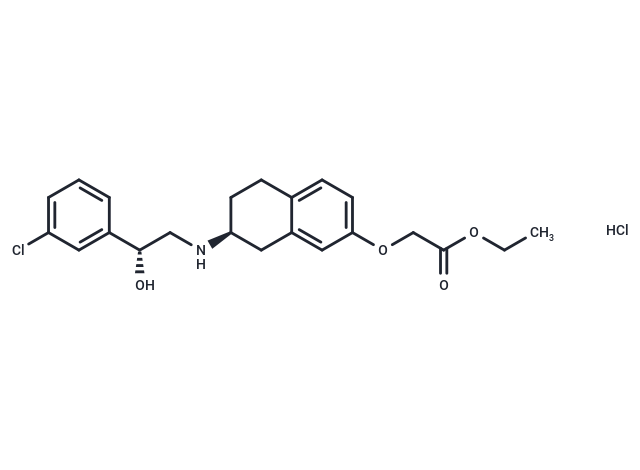
| Pack Size | Price | USA Stock | Global Stock | Quantity |
|---|---|---|---|---|
| 1 mg | $97 | - | In Stock | |
| 5 mg | $238 | - | In Stock | |
| 10 mg | $353 | - | In Stock | |
| 25 mg | $589 | - | In Stock | |
| 50 mg | $839 | - | In Stock | |
| 100 mg | $1,130 | - | In Stock | |
| 1 mL x 10 mM (in DMSO) | $273 | - | In Stock |
| Description | Amibegron hydrochloride is a selective β3-adrenergic receptor (β3AR) agonist that increases energy expenditure and fat oxidation by activating β3ARs in brown adipose tissue; Amibegron hydrochloride is commonly used in research on metabolic disorders. Amibegron hydrochloride exhibits anxiolytic and antidepressant activity. |
| Targets & IC50 | β-adrenoceptor:3.5 nM (EC50), β-adrenoceptor:499 nM |
| In vitro | Methods: Brain slices from SD rats (P14–P23) containing the prefrontal cortex (PFC) were perfused with 15 μM amibegron hydrochloride in a bath; the maximum effect was reached after approximately 5 minutes. Whole-cell patch-clamp recordings were used to measure AMPA receptor-mediated excitatory postsynaptic currents (AMPAR-EPSCs). Results: Amibegron hydrochloride (15 μM) significantly enhanced the amplitude of AMPAR-EPSCs (by approximately 30%). [1] Methods: Isolated brain slices from adult male Long-Evans rats were perfused with 5 μM amibegron hydrochloride (continuous) while being stimulated with LFS (1 Hz) for 15 minutes. Recordings of field excitatory postsynaptic potentials (fEPSPs) were performed continuously for 30 minutes following LFS. Results: In the presence of amibegron hydrochloride, LFS induced long-term depression of fEPSP. [2] |
| In vivo | Methods: Adult male Long-Evans rats underwent fear conditioning training. Prior to training, a microinjection of Amibegron hydrochloride (1 µg/0.5 µL per side) was administered bilaterally into the BLA. Fear-potentiated startle responses were assessed 24 hours later. Results: Fear learning was blocked in the Amibegron hydrochloride group compared to the control group. [2] |
| Synonyms | SR-58611A, SR58611A, SR 58611A |
| Molecular Weight | 440.36 |
| Formula | C22H27Cl2NO4 |
| Cas No. | 121524-09-2 |
| Smiles | N(C[C@H](O)C1=CC(Cl)=CC=C1)[C@@H]2CC=3C(=CC=C(OCC(OCC)=O)C3)CC2.Cl |
| Relative Density. | no data available |
| Storage | Keep away from moisture Powder: -20°C for 3 years | In solvent: -80°C for 1 year Shipping with blue ice/Shipping at ambient temperature. | |||||||||||||||||||||||||||||||||||
| Solubility Information | DMSO: 80 mg/mL (181.67 mM), Sonication is recommended. | |||||||||||||||||||||||||||||||||||
Solution Preparation Table | ||||||||||||||||||||||||||||||||||||
DMSO
Note : The dilution table applies only to solid products. For liquid products, please calculate the stock solution based on the stated concentration and/or density. | ||||||||||||||||||||||||||||||||||||
 For example, if the intended dosage is 10 mg/kg for animals weighing 20 g , with a dosing volume of 100 μL per animal, and a total of 10 animals are to be administered, using a formulation of
  10% DMSO+ 40% PEG300+ 5% Tween 80+ 45% Saline/PBS/ddH2O , the resulting working solution concentration would be 2 mg/mL.
Dissolve 2 mg of the compound in 100 μL DMSO to obtain a stock solution at a concentration of 20 mg/mL . If the required concentration exceeds the compound's known solubility, please contact us for technical support before proceeding.
1) Add 100 μL of the DMSO stock solution to 400 µL PEG300 and mix thoroughly until the solution becomes clear.
2) Add 50 µL Tween 80 and mix well until fully clarified.
3) Add 450 µL Saline,PBS or ddH2O and mix thoroughly until a homogeneous solution is obtained.
| Size | Quantity | Unit Price | Amount | Operation |
|---|
 Feedback
 Hello! How can I help you today?
Copyright © 2015-2026 TargetMol Chemicals Inc. All Rights Reserved.
