


Shopping Cart
Remove All Your shopping cart is currently empty

Synonyms:
| Pack Size | Price | USA Stock | Global Stock | Quantity |
|---|---|---|---|---|
| 5 mg | Inquiry | Inquiry | Inquiry | |
| 50 mg | Inquiry | Inquiry | Inquiry |
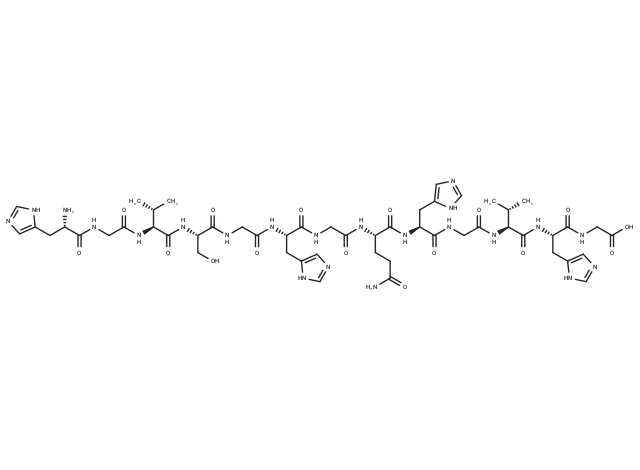
| Description | Alloferon 1 is a peptide with both antiviral and antitumor activities. It is capable of stimulating natural cytotoxicity of human peripheral blood lymphocytes, inducing the synthesis of interferon (IFN), and enhancing host resistance against viruses and tumors in mouse models. Additionally, Alloferon 1 exhibits anti-inflammatory effects in a λ-carrageenan-induced paw edema model. Alloferon 1 can be isolated from the blood of the dipteran blowfly Calliphora vicina. |
| In vitro | Method: Human peripheral blood lymphocytes were incubated with various concentrations of synthetic Alloferon 1 (0.05–0.5 ng/ml). NK cell activity was assessed using a [³H]uridine-labeled cytotoxicity assay with K562 tumor cells as targets. Result: Alloferon 1 significantly stimulated natural killer (NK) activity of human peripheral blood lymphocytes at concentrations ranging from 0.05 to 0.5 ng/ml, with an effect comparable to that of recombinant IFN-α2b [1]. Method: Whole blood cells from healthy humans were incubated with Alloferon 1 (0.4 μg/ml) at 37°C for 2–28 h. After centrifugation, the supernatant was added to human lung cancer cell line L-41. The cells were then infected with vesicular stomatitis virus (VSV), and IFN activity was determined by crystal violet staining. Result: Alloferon 1 induced IFN production in human leukocytes, showing an inducing capacity similar to that of staphylococcal enterotoxin A (SEA) and superior to that of the approved inducer cycloferon [1]. |
| In vivo | Method: NMR1 mice were intranasally administered Alloferon 1 (25 μg, approximately 1.25 mg/kg). Blood samples were collected at various time points (0–48 h), and IFN activity in plasma was measured using a cytopathic effect inhibition assay (L-929 cells + VSV). Result: Following intranasal administration, Alloferon 1 induced two peaks of IFN concentration in mouse plasma, occurring at 6 h and 24 h post-administration, suggesting its ability to induce IFN synthesis in vivo [1]. Method: NMR1 mice were intranasally inoculated with influenza virus A (Aichi/2/68) or B (Lee/1/40). Alloferon 1 (25 μg) was administered intranasally or subcutaneously one day before viral infection and on days 1, 2, 4, 6, and 8 post-infection. Mortality was observed over a 10-day period. Result: Alloferon 1 significantly reduced the mortality rate of mice infected with influenza virus A and B. Its antiviral effect was comparable to that of ribavirin (200 μg) and slightly inferior to that of Remantadin (1 mg), although the latter was used at a dose approximately 40 times higher than that of Alloferon 1 [1]. Method: Male BALB/c mice were intraperitoneally injected with Alloferon-1 (22 mg/kg) 6 h prior to λ-carrageenan-induced paw edema. After induction, paw thickness, vascular permeability (Evans blue extravasation), histopathological changes, peripheral blood leukocyte counts, and serum expression of inflammatory factors (Luminex array, Western blot) were measured. Result: Alloferon-1 significantly reduced λ-carrageenan-induced paw swelling in mice (23.03% inhibition rate), decreased neutrophil infiltration, reduced total leukocyte and neutrophil counts, inhibited vascular permeability (19.63% inhibition rate), and downregulated the serum expression of inflammatory factors such as IL-1β, IL-2, IL-4, IL-5, IL-12(P40), MIP-1α, MIP-1β, MCP-1, GM-CSF, and TNF-α [2]. |
| Molecular Weight | 1265.3 |
| Formula | C52H76N22O16 |
| Cas No. | 347884-61-1 |
| Smiles | [C@@H](CC1=CN=CN1)(NC([C@@H](NC(CNC([C@H](CC2=CN=CN2)NC(CNC([C@@H](NC([C@@H](NC(CNC([C@H](CC3=CN=CN3)N)=O)=O)[C@H](C)C)=O)CO)=O)=O)=O)=O)CCC(N)=O)=O)C(NCC(N[C@H](C(N[C@@H](CC4=CN=CN4)C(NCC(O)=O)=O)=O)[C@@H](C)C)=O)=O |
| Sequence | His-Gly-Val-Ser-Gly-His-Gly-Gln-His-Gly-Val-His-Gly |
| Sequence Short | HGVSGHGQHGVHG |
| Storage | Keep away from moisture,Keep away from direct sunlight, Powder: -20°C for 3 years | In solvent: -80°C for 1 year Shipping with blue ice/Shipping at ambient temperature. |
 For example, if the intended dosage is 10 mg/kg for animals weighing 20 g , with a dosing volume of 100 μL per animal, and a total of 10 animals are to be administered, using a formulation of
  10% DMSO+ 40% PEG300+ 5% Tween 80+ 45% Saline/PBS/ddH2O , the resulting working solution concentration would be 2 mg/mL.
Dissolve 2 mg of the compound in 100 μL DMSO to obtain a stock solution at a concentration of 20 mg/mL . If the required concentration exceeds the compound's known solubility, please contact us for technical support before proceeding.
1) Add 100 μL of the DMSO stock solution to 400 µL PEG300 and mix thoroughly until the solution becomes clear.
2) Add 50 µL Tween 80 and mix well until fully clarified.
3) Add 450 µL Saline,PBS or ddH2O and mix thoroughly until a homogeneous solution is obtained.
| Size | Quantity | Unit Price | Amount | Operation |
|---|
 Feedback
 Hello! How can I help you today?
Copyright © 2015-2026 TargetMol Chemicals Inc. All Rights Reserved.
