


Shopping Cart
Remove All Your shopping cart is currently empty

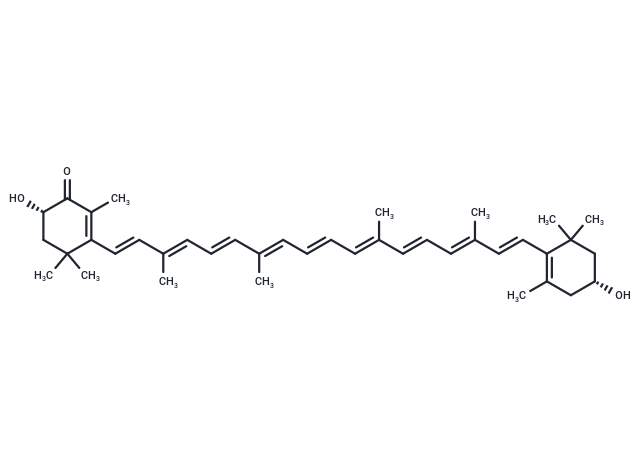
Synonyms: (3S,3′R)-Adonixanthin
| Pack Size | Price | USA Stock | Global Stock | Quantity |
|---|---|---|---|---|
| 10 mg | Inquiry | 10-14 weeks | 10-14 weeks | |
| 50 mg | Inquiry | 10-14 weeks | 10-14 weeks |
| Description | Adonixanthin ((3S,3'R)-Adonixanthin) is a carotenoid that acts as an orally active antioxidant and anticancer agent. It demonstrates the ability to inhibit the proliferation and migration of glioblastoma cells and provides cellular protection against various injuries, suppressing increased reactive oxygen species (ROS) production. Adonixanthin safeguards cells from photo-induced damage through antioxidative responses and Nrf2 activation. It can halt glioblastoma progression and improve blood-brain barrier permeability in autologous intracerebral hemorrhage (ICH) models. This compound is applicable in research related to glioblastoma (GBM) and intracerebral hemorrhage (ICH). |
| In vitro | Adonixanthin effectively inhibits the proliferation of mouse glioblastoma cell line GL261 and human glioblastoma cell line U251MG at concentrations of 0.1-10 μM for 96 hours. At a concentration of 10 μM for 72 hours, it reduces the proportion of BrdU-positive cells in GL261. Additionally, it inhibits cell migration in GL261 and U251MG at 10 μM for 48 hours. At 10 μM for 6 hours, adonixanthin decreases the phosphorylation levels of p-ERK1/2 and p-Akt within GL261 cells. It increases p-p38 phosphorylation, decreases cyclin D1 expression, elevates p27 expression, and reduces MMP-2, Nox4, and fibronectin expression over 6-48 hours, without impacting MMP-9 significantly. At 0.1-1 µM for 4 hours, adonixanthin significantly reduces hemoglobin-induced cell death and ROS production in human brain microvascular endothelial cells (HBMVECs), and upregulates HO-1 and VE-cadherin levels. For 28 hours at 0.1-1 µM, it considerably diminishes collagenase-induced cell death in HBMVECs, inhibits ERK1/2 phosphorylation, and increases VE-cadherin levels. Adonixanthin, at concentrations of 0.1-1 µM for 25 hours, reduces SH-SY5Y cell death induced by H2O2 and LPS in a dose-dependent manner. Furthermore, at a molar ratio/half inhibitory concentration of Hyptadienic acid (TPA) at 329, it suppresses activation of Epstein-Barr virus early antigen in Raji cells without significant cytotoxicity. At 167 μM, adonixanthin inhibits AMVN-induced peroxidation of methyl linoleate. It exhibits singlet oxygen quenching activity in a methylene blue-sensitized photooxidation system in ethanol with a half inhibitory concentration of 11.1 μM for 1-100 μM. Also, adonixanthin upregulates Nrf2-regulated gene mRNA expression in 661 W cells at 20 μM for 6 hours and increases Nrf2 in the nucleus. At 10 μM, it protects 661 W cells from light-induced cell death and reduces ROS production induced by light exposure, while Nrf2 silencing negates this protective effect. |
| In vivo | Adonixanthin, administered at a dose of 10-30 mg/kg orally once daily for 10 days, effectively inhibits the progression of orthotopic glioblastoma in C57BL/6J mice. In addition, at a dose of 100 mg/kg given orally once daily for 7 days, it enhances blood-brain barrier permeability in a mouse model of intracerebral hemorrhage induced by autologous blood injection. Furthermore, the application of Adonixanthin (50 μg [85 nmol] topically) one hour before each TPA treatment for 20 weeks significantly reduces the incidence and number of papillomas in a DMBA-initiated, Hyptadienic acid (TPA)-promoted mouse skin cancer model. |
| Synonyms | (3S,3′R)-Adonixanthin |
| Molecular Weight | 582.86 |
| Formula | C40H54O3 |
| Cas No. | 4418-73-9 |
| Smiles | C(=C/C(=C/C=C/C(=C/C=C/C=C(/C=C/C=C(/C=C/C=1C(C)(C)C[C@H](O)CC1C)\C)\C)/C)/C)\C=2C(C)(C)C[C@H](O)C(=O)C2C |
| Storage | Powder: -20°C for 3 years | In solvent: -80°C for 1 year Shipping with blue ice/Shipping at ambient temperature. |
 For example, if the intended dosage is 10 mg/kg for animals weighing 20 g , with a dosing volume of 100 μL per animal, and a total of 10 animals are to be administered, using a formulation of
  10% DMSO+ 40% PEG300+ 5% Tween 80+ 45% Saline/PBS/ddH2O , the resulting working solution concentration would be 2 mg/mL.
Dissolve 2 mg of the compound in 100 μL DMSO to obtain a stock solution at a concentration of 20 mg/mL . If the required concentration exceeds the compound's known solubility, please contact us for technical support before proceeding.
1) Add 100 μL of the DMSO stock solution to 400 µL PEG300 and mix thoroughly until the solution becomes clear.
2) Add 50 µL Tween 80 and mix well until fully clarified.
3) Add 450 µL Saline,PBS or ddH2O and mix thoroughly until a homogeneous solution is obtained.
| Size | Quantity | Unit Price | Amount | Operation |
|---|
 Feedback
 Hello! How can I help you today?
Copyright © 2015-2026 TargetMol Chemicals Inc. All Rights Reserved.
