Shopping Cart
Remove All
  • TargetMol
    Your shopping cart is currently empty

(±)9(10)-DiHOME

Copy Product Info
😃Good
Catalog No. T84633Cas No. 263399-34-4
Alias Leukotoxin diol

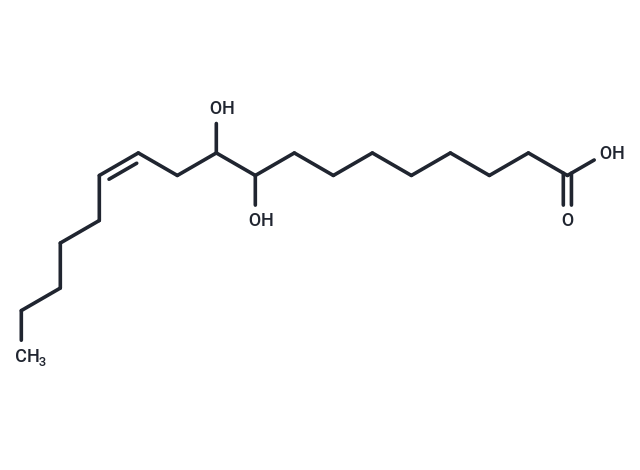
(±)9(10)-DiHOME, the diol derivative of (±)9(10)-EpOME—a cytochrome P450-derived epoxide of linoleic acid also known as leukotoxin—is formed through the action of soluble epoxide hydrolase (sEH) in neutrophils. It exhibits toxicity towards Sf21 cells expressing sEH as well as tolacZ-expressing control cells, differing from leukotoxin which only harms sEH-containing cells. Furthermore, combined exposure to 9(10)- and 12(13)-DiHOME leads to cell death in rabbit renal proximal tubule cells by disrupting mitochondrial respiration, and causes lung injury, respiratory distress, and mortality in mice, highlighting its role as a toxic lipid mediator. Specifically, 9(10)-DiHOME has been associated with acute respiratory distress syndrome (ARDS), a severe and often deadly complication in patients with major burns. Elevated levels of this compound have been detected in the bronchoalveolar lavage fluid (BALF) of women, but not men, with chronic obstructive pulmonary disease (COPD), and its levels are also increased in patients with allergic asthma, indicating its significance in respiratory conditions.

(±)9(10)-DiHOME

(±)9(10)-DiHOME

Copy Product Info
😃Good
Catalog No. T84633Alias Leukotoxin diolCas No. 263399-34-4
(±)9(10)-DiHOME, the diol derivative of (±)9(10)-EpOME—a cytochrome P450-derived epoxide of linoleic acid also known as leukotoxin—is formed through the action of soluble epoxide hydrolase (sEH) in neutrophils. It exhibits toxicity towards Sf21 cells expressing sEH as well as tolacZ-expressing control cells, differing from leukotoxin which only harms sEH-containing cells. Furthermore, combined exposure to 9(10)- and 12(13)-DiHOME leads to cell death in rabbit renal proximal tubule cells by disrupting mitochondrial respiration, and causes lung injury, respiratory distress, and mortality in mice, highlighting its role as a toxic lipid mediator. Specifically, 9(10)-DiHOME has been associated with acute respiratory distress syndrome (ARDS), a severe and often deadly complication in patients with major burns. Elevated levels of this compound have been detected in the bronchoalveolar lavage fluid (BALF) of women, but not men, with chronic obstructive pulmonary disease (COPD), and its levels are also increased in patients with allergic asthma, indicating its significance in respiratory conditions.
Pack SizePriceUSA WarehouseGlobal WarehouseQuantity
10 mgInquiry8-10 weeks8-10 weeks
50 mgInquiry8-10 weeks8-10 weeks
Add to Quotation
In Stock Estimated shipping dateUSA Warehouse[1-2 days] Global Warehouse[5-7 days]
All TargetMol products are for research purposes only and cannot be used for human consumption. We do not provide products or services to individuals. Please comply with the intended use and do not use TargetMol products for any other purpose.
Questions
TargetMol
View More

Resource Download

Product Introduction

Bioactivity
Description
(±)9(10)-DiHOME, the diol derivative of (±)9(10)-EpOME—a cytochrome P450-derived epoxide of linoleic acid also known as leukotoxin—is formed through the action of soluble epoxide hydrolase (sEH) in neutrophils. It exhibits toxicity towards Sf21 cells expressing sEH as well as tolacZ-expressing control cells, differing from leukotoxin which only harms sEH-containing cells. Furthermore, combined exposure to 9(10)- and 12(13)-DiHOME leads to cell death in rabbit renal proximal tubule cells by disrupting mitochondrial respiration, and causes lung injury, respiratory distress, and mortality in mice, highlighting its role as a toxic lipid mediator. Specifically, 9(10)-DiHOME has been associated with acute respiratory distress syndrome (ARDS), a severe and often deadly complication in patients with major burns. Elevated levels of this compound have been detected in the bronchoalveolar lavage fluid (BALF) of women, but not men, with chronic obstructive pulmonary disease (COPD), and its levels are also increased in patients with allergic asthma, indicating its significance in respiratory conditions.
SynonymsLeukotoxin diol
Chemical Properties
Molecular Weight314.5
FormulaC18H34O4
Cas No.263399-34-4
SmilesC(C(C/C=C\CCCCC)O)(CCCCCCCC(O)=O)O
Storage & Solubility Information
StoragePowder: -20°C for 3 years | In solvent: -80°C for 1 year | Shipping with blue ice/Shipping at ambient temperature.

Calculator

  • Molarity Calculator
  • Dilution Calculator
  • Reconstitution Calculator
  • Molecular Weight Calculator

In Vivo Formulation Calculator (Clear solution)

Please enter your animal experiment information in the following box and click Calculate to obtain the stock solution preparation method and in vivo formula preparation method:
TargetMol | Animal experiments For example, if the intended dosage is 10 mg/kg for animals weighing 20 g , with a dosing volume of 100 μL per animal, TargetMol | Animal experiments and a total of 10 animals are to be administered, using a formulation of TargetMol | reagent 10% DMSO+ 40% PEG300+ 5% Tween 80+ 45% Saline/PBS/ddH2O , the resulting working solution concentration would be 2 mg/mL.

Stock Solution Preparation:

Dissolve 2 mg of the compound in 100 μL DMSOTargetMol | reagent to obtain a stock solution at a concentration of 20 mg/mL . If the required concentration exceeds the compound's known solubility, please contact us for technical support before proceeding.

Preparation of the In Vivo Formulation:

1) Add 100 μL of the DMSOTargetMol | reagent stock solution to 400 μL PEG300TargetMol | reagent and mix thoroughly until the solution becomes clear.

2) Add 50 μL Tween 80 and mix well until fully clarified.

3) Add 450 μL Saline,PBS or ddH2OTargetMol | reagent and mix thoroughly until a homogeneous solution is obtained.

This example is provided solely to demonstrate the use of the In Vivo Formulation Calculator and does not constitute a recommended formulation for any specific compound. Please select an appropriate dissolution and formulation strategy based on your experimental model and route of administration.
All co-solvents required for this protocol, includingDMSO, PEG300/PEG400, Tween 80, SBE-β-CD, and Corn oil, are available for purchase on the TargetMol website.
1 Enter information below:
mg/kg
g
μL
2 Enter the in vivo formulation:
% DMSO
%
% Tween 80
% Saline/PBS/ddH2O

Dose Conversion

You can also refer to dose conversion for different animals. More Dose Conversion

Tech Support

Please see Inhibitor Handling Instructions for more frequently ask questions. Topics include: how to prepare stock solutions, how to store products, and cautions on cell-based assays & animal experiments, etc
Related Tags: buy (±)9(10)-DiHOME | purchase (±)9(10)-DiHOME | (±)9(10)-DiHOME cost | order (±)9(10)-DiHOME | (±)9(10)-DiHOME chemical structure | (±)9(10)-DiHOME formula | (±)9(10)-DiHOME molecular weight