


Shopping Cart
Remove All Your shopping cart is currently empty

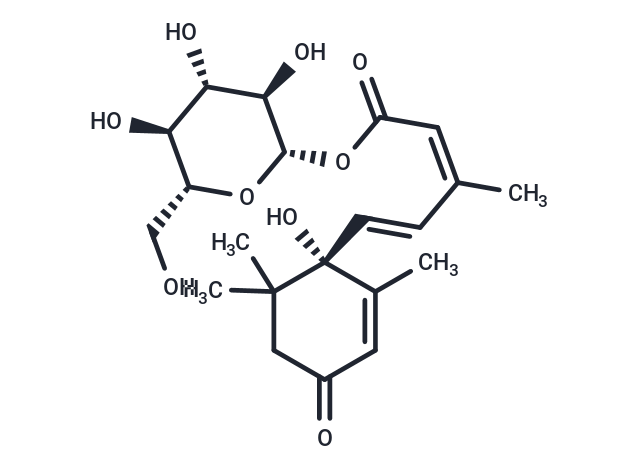
Synonyms: β-D-Glucopyranosyl abscisate, ABA-GE, (S)-cis,trans-Abscisicacidglucosylester
| Pack Size | Price | USA Stock | Global Stock | Quantity |
|---|---|---|---|---|
| 1 mg | $428 | 7-10 days | 7-10 days | |
| 5 mg | Inquiry | 7-10 days | 7-10 days |
| Description | β-D-Glucopyranosyl abscisate (ABA-GE) is a hydrolyzable conjugate of abscisic acid (ABA) that predominantly accumulates in the vacuole and likely in the endoplasmic reticulum. The deconjugation of β-D-Glucopyranosyl abscisate enables a swift release of free ABA in response to abiotic stress factors such as dehydration and salt stress, playing a crucial role in maintaining ABA homeostasis. |
| In vitro | Endoplasmic reticulum and vacuolar β-glucosidases catalyze the deconjugation of β-D-Glucopyranosyl abscisate (ABA-GE), facilitating swift production of free ABA under abiotic stress conditions like dehydration and salt stress. Additionally, β-D-Glucopyranosyl abscisate plays a pivotal role in ABA homeostasis by being the principal catabolite exported from the cytosol. In arabidopsis[1], its vacuolar transport involves ATP-binding cassette and proton-antiport mechanisms. |
| Synonyms | β-D-Glucopyranosyl abscisate, ABA-GE, (S)-cis,trans-Abscisicacidglucosylester |
| Molecular Weight | 426.46 |
| Formula | C21H30O9 |
| Cas No. | 21414-42-6 |
| Smiles | C\C(\C=C\[C@@]1(O)C(C)=CC(=O)CC1(C)C)=C\C(=O)O[C@@H]1O[C@H](CO)[C@@H](O)[C@H](O)[C@H]1O |
| Relative Density. | 1.36 g/cm3 (Predicted) |
| Storage | Powder: -20°C for 3 years | In solvent: -80°C for 1 year Shipping with blue ice/Shipping at ambient temperature. |
 For example, if the intended dosage is 10 mg/kg for animals weighing 20 g , with a dosing volume of 100 μL per animal, and a total of 10 animals are to be administered, using a formulation of
  10% DMSO+ 40% PEG300+ 5% Tween 80+ 45% Saline/PBS/ddH2O , the resulting working solution concentration would be 2 mg/mL.
Dissolve 2 mg of the compound in 100 μL DMSO to obtain a stock solution at a concentration of 20 mg/mL . If the required concentration exceeds the compound's known solubility, please contact us for technical support before proceeding.
1) Add 100 μL of the DMSO stock solution to 400 µL PEG300 and mix thoroughly until the solution becomes clear.
2) Add 50 µL Tween 80 and mix well until fully clarified.
3) Add 450 µL Saline,PBS or ddH2O and mix thoroughly until a homogeneous solution is obtained.
| Size | Quantity | Unit Price | Amount | Operation |
|---|
 Feedback
 Hello! How can I help you today?
Copyright © 2015-2026 TargetMol Chemicals Inc. All Rights Reserved.
