


Shopping Cart
Remove All Your shopping cart is currently empty

Synonyms:
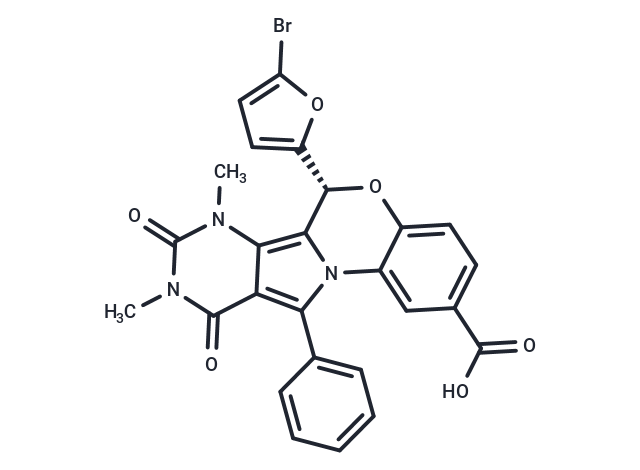
| Pack Size | Price | USA Stock | Global Stock | Quantity |
|---|---|---|---|---|
| 2 mg | $252 | - | In Stock |
| Description | (R)-BPO-27 is an orally active and potent ATP-competitive CFTR inhibitor (IC50: 4 nM) for the study of diarrhoea and polycystic kidney. |
| Targets & IC50 | forskolin-stimulated CFTR Cl-current:4 nM (in FRT cells) |
| In vitro | In HEK-293T cells, (R)-BPO-27 exhibits a dose-response inhibition and inhibits the CFTR current by 50% at 0.53 nM. Acting from the cytoplasmic side, (R)-BPO-27 has low membrane permeability[3].In a single-channel patch-clamp experiment with HEK-293T cells expressing human wild-type CFTR, (R)-BPO-27 reduces the channel open probability (NPo) from 0.29 to 0.08. It modestly reduces the mean channel open time and strongly increases the mean channel closed time. In contrast, (S)-BPO-27 does not affect any of these parameters[3].(R)-BPO-27 is directly applied to the cytoplasmic membrane surface and stabilizes the CFTR channel closed state with an IC50 of 600 pM in a single-channel electrophysiology assay[2].In CFTR-expressing FRT cells after CFTR stimulation by cAMP agonist, (R)-BPO-27 (10 μM, 10 min pretreatment) inhibits Cl- current with apparent IC50 values of 5 and 10 nM for CPT-cAMP and 8-Br-cGMP, respectively. It also shows an IC50 of 4 nM for inhibition of forskolin-stimulated CFTR Cl- current in FRT cells[1]. |
| In vivo | In a PK study, (R)-BPO-27 (intraperitoneal administration; 10 mg/kg) decays with a t1/2≈1.6 h and provides sustained therapeutic concentrations in the kidney[3]. Preventing fluid accumulation in closed midjejunal loops produced by cholera toxin, (R)-BPO-27 (intraperitoneal injection; 5 mg/kg; 30 min before abdominal surgery) yields an intestinal loop weight/length ratio similar to that in PBS-injected loops. This effect is dose-dependent, with an IC50 value of 0.1 mg/kg[1]. Administered via intraperitoneal injection or oral administration at 5 mg/kg, (R)-BPO-27 demonstrates slow metabolism and maintains sustained serum levels for at least 4 hours. Oral bioavailability of (R)-BPO-27 in mouse pharmacokinetics and toxicity study is approximately 94% based on AUC analysis[1]. |
| Molecular Weight | 548.34 |
| Formula | C26H18BrN3O6 |
| Cas No. | 1415390-47-4 |
| Smiles | Cn1c2c3[C@@H](Oc4ccc(cc4-n3c(-c3ccccc3)c2c(=O)n(C)c1=O)C(O)=O)c1ccc(Br)o1 |
| Relative Density. | 1.68 g/cm3 (Predicted) |
| Storage | Store at low temperature Powder: -20°C for 3 years | In solvent: -80°C for 1 year Shipping with blue ice/Shipping at ambient temperature. | ||||||||||||||||||||
| Solubility Information | DMSO: 10 mg/mL (18.24 mM), Sonication is recommended. | ||||||||||||||||||||
Solution Preparation Table | |||||||||||||||||||||
DMSO
Note : The dilution table applies only to solid products. For liquid products, please calculate the stock solution based on the stated concentration and/or density. | |||||||||||||||||||||
 For example, if the intended dosage is 10 mg/kg for animals weighing 20 g , with a dosing volume of 100 μL per animal, and a total of 10 animals are to be administered, using a formulation of
  10% DMSO+ 40% PEG300+ 5% Tween 80+ 45% Saline/PBS/ddH2O , the resulting working solution concentration would be 2 mg/mL.
Dissolve 2 mg of the compound in 100 μL DMSO to obtain a stock solution at a concentration of 20 mg/mL . If the required concentration exceeds the compound's known solubility, please contact us for technical support before proceeding.
1) Add 100 μL of the DMSO stock solution to 400 µL PEG300 and mix thoroughly until the solution becomes clear.
2) Add 50 µL Tween 80 and mix well until fully clarified.
3) Add 450 µL Saline,PBS or ddH2O and mix thoroughly until a homogeneous solution is obtained.
| Size | Quantity | Unit Price | Amount | Operation |
|---|
 Feedback
 Hello! How can I help you today?
Copyright © 2015-2026 TargetMol Chemicals Inc. All Rights Reserved.
