


Shopping Cart
Remove All Your shopping cart is currently empty


Synonyms:
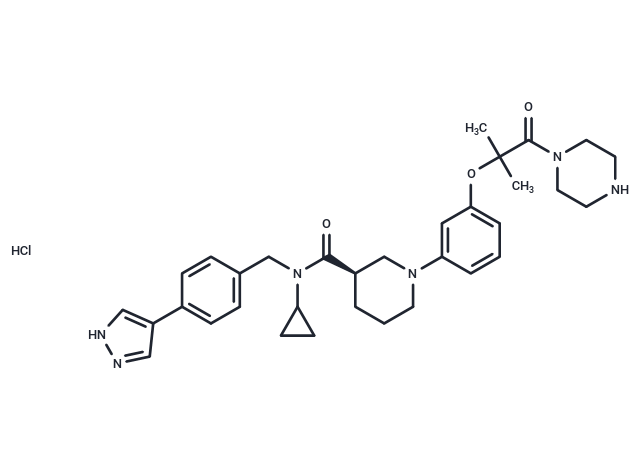

| Description | ZW4864 is a selective inhibitor of the β-catenin/B-Cell Lymphoma 9 protein (β-catenin/BCL9 PPI) interaction, demonstrating oral activity. It inhibits β-catenin/BCL9 PPI with a K_i value of 0.76 μM and an IC_50 value of 0.87 μM. |
| Targets & IC50 | β-catenin-BCL9:0.76 μM (Ki), β-catenin-BCL9:0.87 μM (IC50) |
| In vitro | ZW4864, at concentrations ranging from 10 to 40 μM over periods of 24 to 72 hours, has been demonstrated to modulate β-catenin signaling pathways selectively in various cell lines, including SW480, MDA-MB-231, MDA-MB-468, and MCF10A. Specifically, it lowers the levels of Axin2 and cyclin D1 proteins in SW480 and MDA-MD-231 cells, demonstrating a suppression of β-catenin target gene transcription without impacting the expression of the housekeeper gene HPRT. Furthermore, ZW4864 is effective in inducing rapid apoptosis in triple-negative breast cancer cells that exhibit hyperactive β-catenin signaling, leaving normal MCF10A mammary epithelial cells unaffected. Its mechanism of action includes binding to β-catenin, disrupting its interaction with B-cell lymphoma 9 (BCL9) but not with E-cadherin, thus inhibiting β-catenin signaling pathway activation, downregulating oncogenic target genes, and reducing cancer cell invasiveness. This compound also significantly diminishes TOPFlash luciferase activity in a dose-dependent manner in β-catenin-expressing cells, indicating a targeted suppression of β-catenin transactivation. These findings, validated through Western Blot Analysis, Apoptosis Analysis, and RT-PCR, underscore ZW4864's potential as a selective inhibitor of β-catenin signaling in cancer research. |
| In vivo | ZW4864, administered orally at a dosage of 20 mg/kg, demonstrates favorable pharmacokinetic properties, achieving an oral bioavailability (F) of 83%[1]. At a higher dosage of 90 mg/kg, the compound is observed to alter tumor growth in mice[1]. Furthermore, ZW4864 effectively inhibits β-catenin target gene expression within a patient-derived xenograft mouse model. These studies were conducted using C57BL/6 mice for pharmacokinetic analysis at 20 mg/kg dosage and general mice population at 90 mg/kg dosage, showcasing the compound's potential in moderating tumor progression and exhibiting excellent pharmacokinetic profiles[1]. |
| Molecular Weight | 607.2 |
| Formula | C33H43ClN6O3 |
| Cas No. | 2632259-93-7 |
| Smiles | Cl.CC(C)(Oc1cccc(c1)N1CCC[C@H](C1)C(=O)N(Cc1ccc(cc1)-c1cn[nH]c1)C1CC1)C(=O)N1CCNCC1 |
| Relative Density. | no data available |
| Storage | Powder: -20°C for 3 years | In solvent: -80°C for 1 year Shipping with blue ice/Shipping at ambient temperature. |
 For example, if the intended dosage is 10 mg/kg for animals weighing 20 g , with a dosing volume of 100 μL per animal, and a total of 10 animals are to be administered, using a formulation of
  10% DMSO+ 40% PEG300+ 5% Tween 80+ 45% Saline/PBS/ddH2O , the resulting working solution concentration would be 2 mg/mL.
Dissolve 2 mg of the compound in 100 μL DMSO to obtain a stock solution at a concentration of 20 mg/mL . If the required concentration exceeds the compound's known solubility, please contact us for technical support before proceeding.
1) Add 100 μL of the DMSO stock solution to 400 µL PEG300 and mix thoroughly until the solution becomes clear.
2) Add 50 µL Tween 80 and mix well until fully clarified.
3) Add 450 µL Saline,PBS or ddH2O and mix thoroughly until a homogeneous solution is obtained.
| Size | Quantity | Unit Price | Amount | Operation |
|---|
 Feedback
 Hello! How can I help you today?
Copyright © 2015-2026 TargetMol Chemicals Inc. All Rights Reserved.
