


Shopping Cart
Remove All Your shopping cart is currently empty

Synonyms: TKL-002, TKL 002
| Pack Size | Price | USA Stock | Global Stock | Quantity |
|---|---|---|---|---|
| 5 mg | $48 | Inquiry | Inquiry | |
| 10 mg | $70 | Inquiry | Inquiry | |
| 25 mg | $113 | Inquiry | Inquiry |
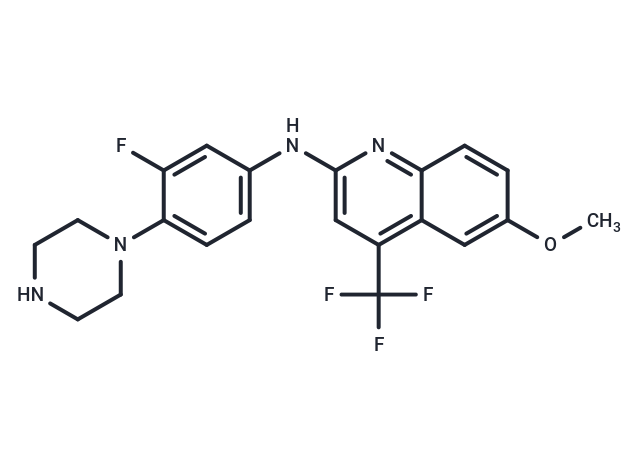
| Description | TKL002 is a blood-brain barrier-permeable inhibitor of the CTH/H₂S/NF-κB/EMT signaling axis. It induces G2/M phase cell cycle arrest and apoptosis in glioblastoma cells. TKL002 also inhibits the migration and invasion of glioblastoma cells by upregulating E-cadherin and downregulating N-cadherin and vimentin expression, and is used in glioblastoma research. |
| In vitro | Methods: U87MG, U118MG, U251MG glioblastoma cells and normal LX2 cells were treated with 0.625–10 μM TKL002 for 24–72 hours. Indicators related to proliferation, apoptosis, cell cycle, hydrogen sulfide metabolism, inflammatory pathways, migration and invasion were detected. Results: 1.TKL002 potently inhibited the proliferation of glioblastoma cells in a dose- and time-dependent manner, and showed selectivity for normal LX2 cells, with an IC₅₀ of 4.141–6.506 μM. 2.TKL002 (6 μM, 48 h) could induce late apoptosis of U87MG cells, which was achieved by up-regulating Bax and caspase-3, and down-regulating Bcl-2 and activated caspase-3. 3.TKL002 (2–6 μM, 24 h) induced G2/M phase cell cycle arrest in U87MG and U118MG cells in a concentration-dependent manner. 4.TKL002 (2–6 μM, 48 h) could reduce the levels of CTH, cysteine and H₂S, increase the level of GSH, and dose-dependently inhibit the NF-κB pathway and the expression of pro-inflammatory factors. 5.TKL002 (2–6 μM, 48 h) dose-dependently inhibited cell migration and invasion, and suppressed epithelial-mesenchymal transition by up-regulating E-cadherin and down-regulating N-cadherin and vimentin [1]. |
| In vivo | Methods: TKL002 was administered to glioblastoma model mice: in the subcutaneous xenograft model, 5–20 mg/kg was injected intraperitoneally once every other day for a total of 7 times; in the orthotopic model, 10–20 mg/kg was injected intravenously once every 3 days for a total of 5 times. Indicators such as tumor growth, blood-brain barrier penetration and toxicity were detected. Results: 1.TKL002 inhibited the growth of glioblastoma subcutaneous xenografts in a dose-dependent manner. 2.TKL002 could penetrate the blood-brain barrier, suppress the growth of orthotopic glioblastoma in a dose-dependent manner, reduce tumor burden, maintain the physical condition of mice, and showed no obvious organ toxicity [1]. |
| Synonyms | TKL-002, TKL 002 |
| Molecular Weight | 420.40 |
| Formula | C21H20F4N4O |
| Cas No. | 3098518-95-4 |
| Smiles | FC1=CC(=CC=C1N2CCNCC2)NC=3N=C4C=CC(OC)=CC4=C(C3)C(F)(F)F |
| Relative Density. | no data available |
| Storage | Powder: -20°C for 3 years | In solvent: -80°C for 1 year Shipping with blue ice/Shipping at ambient temperature. |
 For example, if the intended dosage is 10 mg/kg for animals weighing 20 g , with a dosing volume of 100 μL per animal, and a total of 10 animals are to be administered, using a formulation of
  10% DMSO+ 40% PEG300+ 5% Tween 80+ 45% Saline/PBS/ddH2O , the resulting working solution concentration would be 2 mg/mL.
Dissolve 2 mg of the compound in 100 μL DMSO to obtain a stock solution at a concentration of 20 mg/mL . If the required concentration exceeds the compound's known solubility, please contact us for technical support before proceeding.
1) Add 100 μL of the DMSO stock solution to 400 µL PEG300 and mix thoroughly until the solution becomes clear.
2) Add 50 µL Tween 80 and mix well until fully clarified.
3) Add 450 µL Saline,PBS or ddH2O and mix thoroughly until a homogeneous solution is obtained.
| Size | Quantity | Unit Price | Amount | Operation |
|---|
 Feedback
 Hello! How can I help you today?
Copyright © 2015-2026 TargetMol Chemicals Inc. All Rights Reserved.
