Shopping Cart
Remove All
  • TargetMol
    Your shopping cart is currently empty

Thioacetamide

Copy Product Info
😃Good
Catalog No. T35367Cas No. 62-55-5
Alias TAA

Thioacetamide (TAA) is an indirect hepatotoxin commonly used to induce experimental liver injury. It is metabolized by CYP2E1 into reactive metabolites that covalently bind to proteins and lipids, leading to oxidative stress and centrilobular necrosis, hepatocyte death, and M1/M2 macrophage-dominated inflammation. TAA is widely used to establish models of chronic liver fibrosis, hepatic encephalopathy, and liver cancer.

Thioacetamide

Thioacetamide

Copy Product Info
😃Good
Purity: 99.6%
Catalog No. T35367Alias TAACas No. 62-55-5
Thioacetamide (TAA) is an indirect hepatotoxin commonly used to induce experimental liver injury. It is metabolized by CYP2E1 into reactive metabolites that covalently bind to proteins and lipids, leading to oxidative stress and centrilobular necrosis, hepatocyte death, and M1/M2 macrophage-dominated inflammation. TAA is widely used to establish models of chronic liver fibrosis, hepatic encephalopathy, and liver cancer.
Pack SizePriceUSA WarehouseGlobal WarehouseQuantity
5 g$33-In Stock
10 g$44-In Stock
25 g$68-In Stock
50 g$97-In Stock
1 mL x 10 mM (in DMSO)$29In StockIn Stock
Add to Cart
Add to Quotation
In Stock Estimated shipping dateUSA Warehouse[1-2 days] Global Warehouse[5-7 days]
All TargetMol products are for research purposes only and cannot be used for human consumption. We do not provide products or services to individuals. Please comply with the intended use and do not use TargetMol products for any other purpose.
Questions
TargetMol
View More

Batch Information

Select Batch
Purity:99.6%
Appearance:Solid
Color:White
Contact us for more batch information

Resource Download

Product Introduction

Thioacetamide AI Summary
Thioacetamide exhibits hepatoprotective activity against thioacetamide-induced toxicity in rats, providing protection at a dose of 6 mg/kg administered orally for 7 days by maintaining lower levels of GOT, GPT, ALP, and bilirubin. Additionally, it shows bioactivity as an agonist at the human TAS2R38 receptor, demonstrating an activity threshold of 100.0 uM in assays conducted with HEK-293T-Galpha16-gustducin44 cells, indicating its ability to activate the receptor and elicit a calcium response as measured by the FLIPR assay..
Note: Summary generated by AI. Data source: ChEMBL
Bioactivity
Description
Thioacetamide (TAA) is an indirect hepatotoxin commonly used to induce experimental liver injury. It is metabolized by CYP2E1 into reactive metabolites that covalently bind to proteins and lipids, leading to oxidative stress and centrilobular necrosis, hepatocyte death, and M1/M2 macrophage-dominated inflammation. TAA is widely used to establish models of chronic liver fibrosis, hepatic encephalopathy, and liver cancer.
Disease Modeling Protocol
Liver Fibrosis Model
  • Modeling Mechanism:

    Thioacetamide (TAA), a potent hepatotoxic compound, is metabolized and activated in the liver of rats to produce thioacetamide S-oxide and sulfinic acid esters. Its thiosulfate group induces oxidative stress through oxidation, generating reactive oxygen species (ROS). ROS damages hepatocyte mitochondrial function, increases cell membrane permeability and intracellular Ca²⁺ concentration, leading to hepatocyte necrosis. At the same time, it activates Kupffer cells to release pro-inflammatory factors (TNF-α), induces the activation and differentiation of hepatic stellate cells (HSCs) into myofibroblasts, and synthesizes large amounts of extracellular matrix such as collagen, forming liver fibrosis. Long-term modeling can progress to cirrhosis, mimicking the pathological process of chronic liver injury-fibrosis-cirrhosis in humans.

  • Related Products:

    Thioacetamide (T35367)

  • Modeling Method:

    Experimental Subject:Rats, Male Wistar rats, body weight 150–175 g

    Dosage and Administration Route:① Core modelling: Thioacetamide (200 mg/kg) dissolved in sterile saline solution administered via intraperitoneal injection; ② Control treatment: Control group administered equal volume saline solution via intraperitoneal injection; all other housing and treatment conditions identical; ③ Intervention verification group (optional): Concurrent administration of hepatoprotective agent (e.g., Olivia aromatic plant extract TO-EtOH/TO-EtOAc), 200–400 mg/kg, Oral, Continuous for 4 weeks (administered 1 hour after Thioacetamide injection); ④ Supportive therapy: Subcutaneous injection of 10% glucose and lactated Ringer's solution (1:1)

    Dosing Frequency and Duration Model:Administered three times weekly for four consecutive weeks

  • Validation:

    1. Biochemical Indicators: - Liver Function: Serum ALT, AST, and ALP levels were significantly elevated (199%, 313%, and 235%, respectively), and total bilirubin was elevated by 289% (p<0.001), indicating hepatocellular damage; - Oxidative Stress: Liver tissue malondialdehyde (MDA) was elevated by 178%, and reduced glutathione (GSH) was decreased by 66% (p<0.001), reflecting oxidative damage; - Inflammatory Factors: Liver tissue TNF-α levels were elevated by 200% (p<0.001), indicating inflammatory activation; 2. Pathological Indicators: - HE Staining: Hepatocellular degeneration and necrosis, extensive mononuclear cell infiltration in the portal vein area, portal vein-portal vein bridging fibrosis, and destruction of liver lobule structure; - Sirius Red Staining: The proportion of collagen fiber area in liver tissue was significantly increased, and the fibrosis score (0-3 points) was significantly higher than that in the control group; 3. Immunohistochemical Indicators: - α- Smooth muscle actin (α-SMA): Strong positive expression in liver tissue (significantly increased area%), suggesting activation of hepatic stellate cells (p<0.001).

*Precautions:

*References:Ahmed RF,et,al. Phenolic-rich extracts of Teucrium oliverianum confer protection against thioacetamide-induced liver fibrosis in rats: Insights from metabolomics, biochemical and histopathological analysis. PLoS One. 2025 Sep 2;20(9):e0330595.

SynonymsTAA
Chemical Properties
Molecular Weight75.13
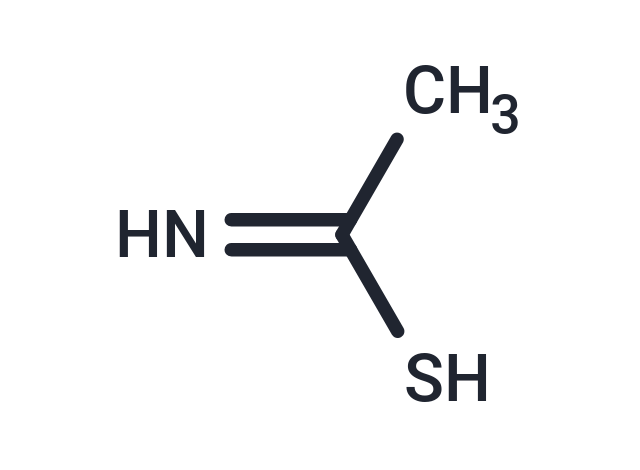
FormulaC2H5NS
Cas No.62-55-5
SmilesCC(S)=N
Relative Density.1.37
Storage & Solubility Information
StoragePowder: -20°C for 3 years | In solvent: -80°C for 1 year | Shipping with blue ice/Shipping at ambient temperature.
Solubility Information
DMSO: 55 mg/mL (732.06 mM), Sonication is recommended.
H2O: 16.3 g/100 mL (25 oC), Sonication and heating to 60℃ are recommended.
In Vivo Formulation
10% DMSO+40% PEG300+5% Tween 80+45% Saline: 2 mg/mL (26.62 mM), Sonication is recommended.
Please add the solvents sequentially, clarifying the solution as much as possible before adding the next one. Dissolve by heating and/or sonication if necessary. Working solution is recommended to be prepared and used immediately. The formulation provided above is for reference purposes only. In vivo formulations may vary and should be modified based on specific experimental conditions.
Solution Preparation Table
DMSO
1mg5mg10mg50mg
1 mM13.3103 mL66.5513 mL133.1026 mL665.5131 mL
5 mM2.6621 mL13.3103 mL26.6205 mL133.1026 mL
10 mM1.3310 mL6.6551 mL13.3103 mL66.5513 mL
20 mM0.6655 mL3.3276 mL6.6551 mL33.2757 mL
50 mM0.2662 mL1.3310 mL2.6621 mL13.3103 mL
100 mM0.1331 mL0.6655 mL1.3310 mL6.6551 mL

Calculator

  • Molarity Calculator
  • Dilution Calculator
  • Reconstitution Calculator
  • Molecular Weight Calculator

In Vivo Formulation Calculator (Clear solution)

Please enter your animal experiment information in the following box and click Calculate to obtain the stock solution preparation method and in vivo formula preparation method:
TargetMol | Animal experiments For example, if the intended dosage is 10 mg/kg for animals weighing 20 g , with a dosing volume of 100 μL per animal, TargetMol | Animal experiments and a total of 10 animals are to be administered, using a formulation of TargetMol | reagent 10% DMSO+ 40% PEG300+ 5% Tween 80+ 45% Saline/PBS/ddH2O , the resulting working solution concentration would be 2 mg/mL.

Stock Solution Preparation:

Dissolve 2 mg of the compound in 100 μL DMSOTargetMol | reagent to obtain a stock solution at a concentration of 20 mg/mL . If the required concentration exceeds the compound's known solubility, please contact us for technical support before proceeding.

Preparation of the In Vivo Formulation:

1) Add 100 μL of the DMSOTargetMol | reagent stock solution to 400 μL PEG300TargetMol | reagent and mix thoroughly until the solution becomes clear.

2) Add 50 μL Tween 80 and mix well until fully clarified.

3) Add 450 μL Saline,PBS or ddH2OTargetMol | reagent and mix thoroughly until a homogeneous solution is obtained.

This example is provided solely to demonstrate the use of the In Vivo Formulation Calculator and does not constitute a recommended formulation for any specific compound. Please select an appropriate dissolution and formulation strategy based on your experimental model and route of administration.
All co-solvents required for this protocol, includingDMSO, PEG300/PEG400, Tween 80, SBE-β-CD, and Corn oil, are available for purchase on the TargetMol website.
1 Enter information below:
mg/kg
g
μL
2 Enter the in vivo formulation:
% DMSO
%
% Tween 80
% Saline/PBS/ddH2O

Dose Conversion

You can also refer to dose conversion for different animals. More Dose Conversion

Tech Support

Please see Inhibitor Handling Instructions for more frequently ask questions. Topics include: how to prepare stock solutions, how to store products, and cautions on cell-based assays & animal experiments, etc

Keywords

Related Tags: buy Thioacetamide | purchase Thioacetamide | Thioacetamide cost | order Thioacetamide | Thioacetamide chemical structure | Thioacetamide formula | Thioacetamide molecular weight