


Shopping Cart
Remove All Your shopping cart is currently empty

Synonyms: SHU9119
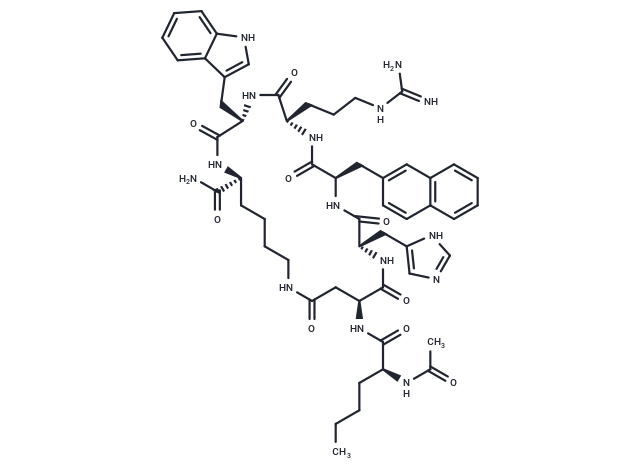
| Pack Size | Price | USA Stock | Global Stock | Quantity |
|---|---|---|---|---|
| 500 µg | $70 | - | In Stock | |
| 1 mg | $98 | - | In Stock |
| Description | SHU 9119 is a potent ligand of human melanocortin receptors, exhibiting dual pharmacological properties: it acts as an antagonist at MC3R and MC4R, while functioning as a partial agonist at MC5R. The IC50 values of SHU 9119 against MC3R, MC4R, and MC5R are 0.23, 0.06, and 0.09 nM, respectively. |
| Targets & IC50 | MC3R:0.23 nM, MC5R:0.23 nM, MC4R:0.23 nM |
| In vivo | Method: Rats received intracerebroventricular (i.c.v.) infusion of SHU9119 (24 nmol/day for 7 days). Primary adipocytes were isolated from epididymal white adipose tissue and incubated in vitro with [¹⁴C]acetate for 4 hours. [¹⁴C] incorporation into triglycerides (TAG) was measured by liquid scintillation counting. Result: The rate of TAG synthesis in adipocytes from the SHU9119-treated group was increased by approximately 100% compared with the control group, and this effect was consistent between ad libitum-fed and pair-fed groups [1]. Method: Rats received i.c.v. infusion of SHU9119 (24 nmol/day for 48 hours or 7 days). White adipose tissue and liver were collected for real-time quantitative PCR, Western blot, and enzyme activity assays to measure lipid metabolism-related gene expression and enzyme activities. Body composition was assessed by NMR imaging, respiratory quotient (RQ) was measured by indirect calorimetry, plasma biochemical parameters were measured, and hyperinsulinemic-euglycemic clamp experiments were performed to determine tissue glucose utilization. Result: SHU9119 rapidly upregulated the mRNA expression of FAS, ACCα, SCD1, and LPL in adipose tissue (2.7‑ to 19.7‑fold) within 48 hours. After 7 days, it significantly increased body fat content and TAG content in WAT (approximately 37 μg/mg vs. 22.2 μg/mg in controls) and upregulated FAS enzyme activity. SHU9119 also elevated RQ, reduced glucose utilization in muscle and BAT while increasing WAT glucose uptake, and upregulated hepatic FAS, ACCα, SCD1, and SREBP1c expression with a concomitant increase in hepatic TAG content. These effects were consistent between ad libitum-fed and pair-fed groups, with no significant changes in plasma glucose, FFA, or TAG levels [1]. Method: APOE*3-Leiden.CETP transgenic mice received i.c.v. infusion of SHU9119 (5 nmol/day for 14‑17 days). Brown adipose tissue (BAT) was collected for Western blot analysis of UCP‑1, TH, and p‑CREB protein expression, and H&E staining to observe lipid droplet morphology. BAT uptake of triglycerides (TG) was assessed by injection of ³H‑TO and ¹⁴C‑CO dual‑labeled VLDL‑like chylomicron particles. Result: SHU9119 significantly reduced BAT protein levels of UCP‑1 (‑60%), TH (‑53%), and p‑CREB (‑22%), induced large lipid droplet accumulation in BAT, and decreased BAT uptake of VLDL‑TG (‑57% in the pair‑fed group), indicating that SHU9119 directly suppresses BAT activity [2]. |
| Synonyms | SHU9119 |
| Molecular Weight | 1074.26 |
| Formula | C54H71N15O9 |
| Cas No. | 168482-23-3 |
| Smiles | C(C=1C=2C(NC1)=CC=CC2)[C@@H]3NC(=O)[C@H](CCCNC(=N)N)NC(=O)[C@@H](CC4=CC5=C(C=C4)C=CC=C5)NC(=O)[C@H](CC6=CN=CN6)NC(=O)[C@@H](NC([C@H](CCCC)NC(C)=O)=O)CC(=O)NCCCC[C@@H](C(N)=O)NC3=O |
| Relative Density. | 1.43 g/cm3 |
| Sequence | Ac-{Nle}-Asp-His-{D-Nal}-Arg-Trp-Lys |
| Sequence Short | XDHXRWK |
| Storage | Keep away from moisture,Keep away from direct sunlight, Powder: -20°C for 3 years | In solvent: -80°C for 1 year Shipping with blue ice/Shipping at ambient temperature. | |||||||||||||||||||||||||
| Solubility Information | DMSO: 8 mg/mL (7.45 mM), Sonication is recommended. H2O: 20.00 mg/mL (18.62 mM), Sonication is recommended. | |||||||||||||||||||||||||
Solution Preparation Table | ||||||||||||||||||||||||||
DMSO/H2O
H2O
Note : The dilution table applies only to solid products. For liquid products, please calculate the stock solution based on the stated concentration and/or density. | ||||||||||||||||||||||||||
 For example, if the intended dosage is 10 mg/kg for animals weighing 20 g , with a dosing volume of 100 μL per animal, and a total of 10 animals are to be administered, using a formulation of
  10% DMSO+ 40% PEG300+ 5% Tween 80+ 45% Saline/PBS/ddH2O , the resulting working solution concentration would be 2 mg/mL.
Dissolve 2 mg of the compound in 100 μL DMSO to obtain a stock solution at a concentration of 20 mg/mL . If the required concentration exceeds the compound's known solubility, please contact us for technical support before proceeding.
1) Add 100 μL of the DMSO stock solution to 400 µL PEG300 and mix thoroughly until the solution becomes clear.
2) Add 50 µL Tween 80 and mix well until fully clarified.
3) Add 450 µL Saline,PBS or ddH2O and mix thoroughly until a homogeneous solution is obtained.
| Size | Quantity | Unit Price | Amount | Operation |
|---|
 Feedback
 Hello! How can I help you today?
Copyright © 2015-2026 TargetMol Chemicals Inc. All Rights Reserved.
