


Shopping Cart
Remove All Your shopping cart is currently empty

Synonyms: BMS470539 dihydrochloride, BMS 470539 dihydrochloride
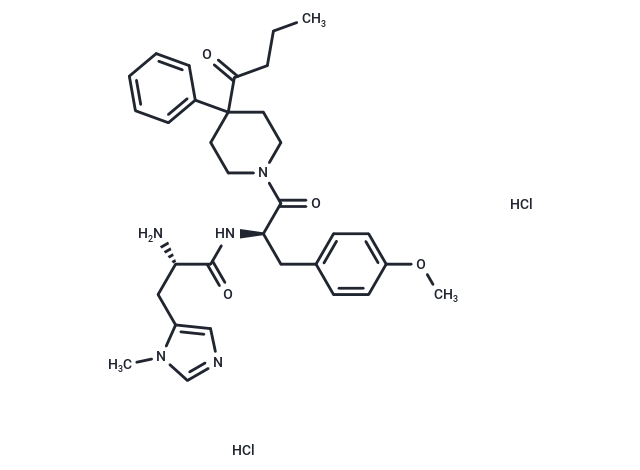

| Pack Size | Price | USA Stock | Global Stock | Quantity |
|---|---|---|---|---|
| 1 mg | $52 | In Stock | In Stock | |
| 5 mg | $123 | In Stock | In Stock | |
| 10 mg | $198 | In Stock | In Stock | |
| 25 mg | $455 | In Stock | In Stock | |
| 50 mg | $745 | In Stock | In Stock | |
| 100 mg | $1,180 | - | In Stock |
| Description | BMS-470539 dihydrochloride is a selective and highly potent melanocortin 1 receptor (MC-1 R) agonist with anti-inflammatory activity. BMS-470539 attenuates oxidative stress and neuronal apoptosis via the MC1R/cAMP/PKA/Nurr1 signaling pathway in a neonatal hypoxia-ischemia rat model. |
| Targets & IC50 | MC1R:120 nM, MC1R:28 nM (EC50) |
| In vitro | METHODS: BMS-470539 dihydrochloride (0-1μM, 15 minutes) was used to treat HBL cells stably transfected with NF-B luciferase reporter gene, and then treated with 0.5 ng/mL TNF-α for 4 hours to study its effect on stable transfection. Effects of NF-B luciferase reporter gene on TNF-α-stimulated luciferase activation in HBL cells. RESULTS:BMS-470539 dihydrochloride treatment of HBL cells with NF-B luciferase reporter gene caused a dose-dependent significant reduction in TNF-α-stimulated NF-B luciferase activity. [2] |
| In vivo | METHODS: BMS-470539 dihydrochloride (2.05-18.47 mg/kg, intravenous injection, 125 minutes) was used to treat WT and MC1 receptor-negative e/e mice to study its effects on mesenteric microcirculation. RESULTS:BMS-470539 dihydrochloride treatment of mice inhibited cell adhesion and migration, had no effect on cell rolling, and also inhibited the tissue expression of two chemokines, CXCL1 and CCL2. [3] |
| Synonyms | BMS470539 dihydrochloride, BMS 470539 dihydrochloride |
| Molecular Weight | 632.62 |
| Formula | C32H43Cl2N5O4 |
| Cas No. | 2341796-82-3 |
| Smiles | CCCC(C1(C2=CC=CC=C2)CCN(CC1)C([C@H](NC([C@@H](N)CC3=CN=CN3C)=O)CC4=CC=C(C=C4)OC)=O)=O.Cl.Cl |
| Relative Density. | no data available |
| Storage | Store at low temperature,Keep away from moisture Powder: -20°C for 3 years | In solvent: -80°C for 1 year Shipping with blue ice/Shipping at ambient temperature. |
 For example, if the intended dosage is 10 mg/kg for animals weighing 20 g , with a dosing volume of 100 μL per animal, and a total of 10 animals are to be administered, using a formulation of
  10% DMSO+ 40% PEG300+ 5% Tween 80+ 45% Saline/PBS/ddH2O , the resulting working solution concentration would be 2 mg/mL.
Dissolve 2 mg of the compound in 100 μL DMSO to obtain a stock solution at a concentration of 20 mg/mL . If the required concentration exceeds the compound's known solubility, please contact us for technical support before proceeding.
1) Add 100 μL of the DMSO stock solution to 400 µL PEG300 and mix thoroughly until the solution becomes clear.
2) Add 50 µL Tween 80 and mix well until fully clarified.
3) Add 450 µL Saline,PBS or ddH2O and mix thoroughly until a homogeneous solution is obtained.
| Size | Quantity | Unit Price | Amount | Operation |
|---|
 Feedback
 Hello! How can I help you today?
Copyright © 2015-2026 TargetMol Chemicals Inc. All Rights Reserved.
