


Shopping Cart
Remove All Your shopping cart is currently empty

Synonyms:
| Pack Size | Price | USA Stock | Global Stock | Quantity |
|---|---|---|---|---|
| 25 mg | $1,520 | 6-8 weeks | 6-8 weeks | |
| 50 mg | $1,980 | 6-8 weeks | 6-8 weeks | |
| 100 mg | $2,500 | 6-8 weeks | 6-8 weeks |
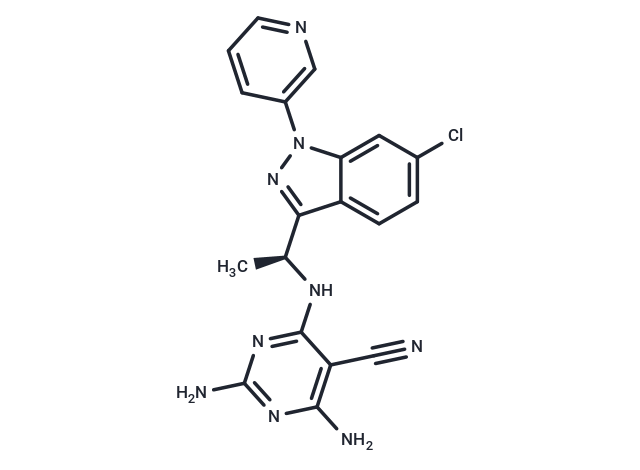
| Description | PI3Kδ-IN-10 is a highly potent and orally active PI3Kδ inhibitor (IC50 = 2 nM) that robustly suppresses the downstream AKT pathway to induce subsequent apoptosis in hepatocellular carcinoma models. |
| Targets & IC50 | PI3Kδ:2 nM |
| In vitro | PI3Kδ-IN-10 (compound 9x) significantly inhibits cell proliferation in HCC (Hepatocellular Carcinoma) cell lines (Bel-7402, HepG2, Hep3B) with IC50 values between 0.53 and 1.36 μM over 72 hours at concentrations up to 10 μM. At concentrations up to 50 μM for 24 hours, it also increases cleaved PARP and cleaved caspase-3 expression and decreases phosphorylation of Akt at Ser473 and Thr308 in a dose-dependent manner, indicating apoptosis induction and reduced Akt pathway activity in HCC cell lines. |
| In vivo | PI3Kδ-IN-10 demonstrated favorable pharmacokinetics and efficacy in female Balb/c (nu/nu) mice, achieving an acceptable half-life (T 1/2), moderate distribution volume, and oral bioavailability when administered at 5 mg/kg orally (PO) and 1 mg/kg intravenously (IV). Additionally, 12-day intravenous treatments at dosages of 40 mg/kg and 20 mg/kg effectively reduced the growth of liver cancer xenografts, with inhibition ratios of 76.02% and 59.15%, respectively. This compound's pharmacokinetic parameters further illustrate its potential, showing significant area under the curve (AUC), volume of distribution adjusted by bioavailability (Vz/F), and drug absorption times (T max) across the examined dosages and methods of administration, underscoring its efficacy in the tested animal model. |
| Molecular Weight | 405.84 |
| Formula | C19H16ClN9 |
| Cas No. | 2409725-49-9 |
| Smiles | [C@H](NC=1C(C#N)=C(N)N=C(N)N1)(C)C=2C=3C(N(N2)C=4C=CC=NC4)=CC(Cl)=CC3 |
| Storage | Powder: -20°C for 3 years | In solvent: -80°C for 1 year Shipping with blue ice/Shipping at ambient temperature. |
 For example, if the intended dosage is 10 mg/kg for animals weighing 20 g , with a dosing volume of 100 μL per animal, and a total of 10 animals are to be administered, using a formulation of
  10% DMSO+ 40% PEG300+ 5% Tween 80+ 45% Saline/PBS/ddH2O , the resulting working solution concentration would be 2 mg/mL.
Dissolve 2 mg of the compound in 100 μL DMSO to obtain a stock solution at a concentration of 20 mg/mL . If the required concentration exceeds the compound's known solubility, please contact us for technical support before proceeding.
1) Add 100 μL of the DMSO stock solution to 400 µL PEG300 and mix thoroughly until the solution becomes clear.
2) Add 50 µL Tween 80 and mix well until fully clarified.
3) Add 450 µL Saline,PBS or ddH2O and mix thoroughly until a homogeneous solution is obtained.
| Size | Quantity | Unit Price | Amount | Operation |
|---|
 Feedback
 Hello! How can I help you today?
Copyright © 2015-2026 TargetMol Chemicals Inc. All Rights Reserved.
