


Shopping Cart
Remove All Your shopping cart is currently empty

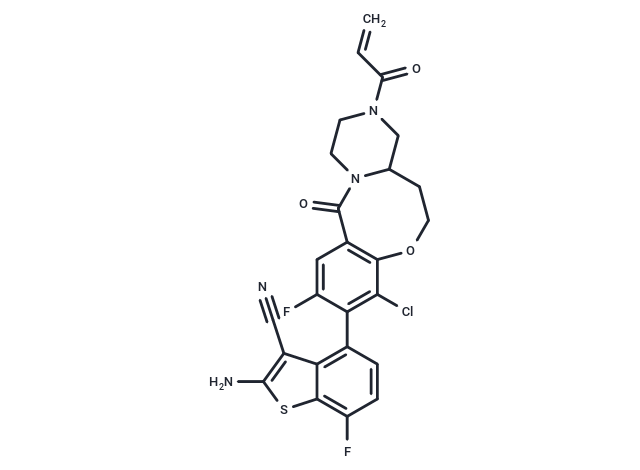
Synonyms: Olomorasibum, KRAS G12C inhibitor 19

| Pack Size | Price | USA Stock | Global Stock | Quantity |
|---|---|---|---|---|
| 1 mg | $115 | - | In Stock | |
| 5 mg | $279 | - | In Stock | |
| 10 mg | $413 | - | In Stock | |
| 25 mg | $688 | - | In Stock | |
| 50 mg | $1,170 | - | In Stock | |
| 100 mg | $1,730 | - | In Stock |
| Description | Olomorasib is an orally administered, covalent GDP-binding KRAS G12C inhibitor that covalently binds to the Cys12 residue of KRAS G12C, locking the Switch I/Switch II region in an inactive conformation and thereby blocking the interaction between KRAS and the downstream effector protein CRAF. In vitro and in vivo models of KRAS-mutated cancers, olomorasib effectively reduces RAS activity and pERK levels, thereby significantly inhibiting tumor growth. |
| Targets & IC50 | Ba/F3 cells:6 nM |
| In vitro | Method: Surface plasmon resonance measured Olomorasibum binding to KRAS variants; Rmax was reported for KRAS wild type, KRAS G12C, and KRAS G12C with second-site mutations (H95D, H95Q, H95R, Y96C). Result: Olomorasibum showed poor binding to KRAS wild type (Rmax <1) and high binding to KRAS G12C (Rmax 7.25). In second-site mutants, Rmax values were 7.02 (H95D), 6.78 (H95Q), 6.10 (H95R), and 7.81 (Y96C), indicating continued tight binding. [3] Method: Kinetic analysis of KRAS nucleotide cycling in the presence of Olomorasibum reported hydrolysis (khy), exchange (kex), and kinact/KI for engagement of RAS-GDP. Result: Olomorasibum-mediated rate of hydrolysis (khy) of RAS-GTP to RAS-GDP was 2.2 h^-1; the rate of exchange (kex) of RAS-GDP to RAS-GTP was 6.2 h^-1; kinact/KI for engagement of RAS-GDP was 522,000 M^-1 sec^-1. [3] Method: Mass spectrometry-based competitive chemical proteomics in KRAS G12C mutant H358 cells: cells were treated with 10 nM Olomorasibum or DMSO, incubated with isotope-labeled thiol-reactive Olomorasibum probes, enriched, and analyzed by LC-MS/MS to assess proteome-wide cysteine engagement. Result: At 10 nM, Olomorasibum produced potent and statistically significant (p<0.05) competition only for the peptide corresponding to KRAS G12C (LVVVGACGVGK), indicating high selectivity for KRAS G12C. [3] Method: Cellular ERK phosphorylation assay in MEF RASless cells expressing human wild-type KRAS, KRAS G12C, and non-KRAS G12C mutant forms; cells were treated with Olomorasibum and pERK was measured. Result: In cells expressing wild-type RAS (K/N/HRAS) and most mutant forms of KRAS, Olomorasibum did not significantly affect ERK phosphorylation; in cells harboring KRAS G12C, ERK phosphorylation was substantially decreased. [3] Method: KRAS G12C target occupancy and RAS activity measured in SW1463 cells after Olomorasibum treatment across doses and times; occupancy and RAS-GTP were quantified. Result: Target occupancy increased dose-dependently to 35%–70% within 30 min and 70%–95% within 2 h; RAS-GTP was substantially decreased in a dose- and time-dependent manner. [3] Method: Panel of cancer cell lines with KRAS G12C, non-KRAS G12C mutations, or wild-type KRAS were treated with increasing concentrations of Olomorasibum; IC50 values for cell proliferation, RAS activity, and pERK inhibition were determined. Result: Seven of 16 KRAS G12C-mutant cell lines were sensitive with IC50<100 nM; KRAS non-G12C-mutant cell lines were resistant. In KRAS non-G12C-mutant cells, active RAS and pERK were unaffected with IC50 > 1 µM. [3] Method: H358 and MIA PaCa-2 KRAS G12C mutant cells were treated with Olomorasibum at 10 nM, 100 nM, or 1 µM versus DMSO; RAS-regulated gene and protein expression, including pERK, pMEK, RAS-GTP, pS6, pRb, and cPARP, were assessed by expression analysis and Western blot. Result: All examined RAS-regulated genes decreased versus control; pERK, pMEK, and RAS-GTP decreased dose-dependently; pS6 and pRb decreased, and cleaved PARP increased in a dose- and time-dependent manner. These effects were not observed in cells with non-KRAS G12C (G12S or WT). [3] Method: Ba/F3 cells stably expressing KRAS G12C or KRAS G12C with second-site mutations were treated with Olomorasibum or adagrasib for 96 h; cell viability IC50 and pERK by Western blot were evaluated. Result: In KRAS G12C-expressing cells, Olomorasibum inhibited viability with IC50 = 6 nM (adagrasib 20 nM). In H95D/Q/R second-site mutations, Olomorasibum robustly decreased proliferation and pERK, whereas adagrasib had no such effects. In Y96C/D mutants, Olomorasibum decreased proliferation and pERK in a mutation-dependent manner; adagrasib did not affect these endpoints. [3] |
| In vivo | Method: In KRAS G12C-mutant xenograft models, mice received a single 30 mg/kg dose of Olomorasibum; tumors were analyzed at indicated time points for in vivo RAS activity and pERK. Result: Olomorasibum significantly (p<0.05) reduced in vivo RAS activity with peak inhibition of approximately 80% or greater in all three xenograft models; significant pERK inhibition was observed at most time points up to 24 h. [3] Method: Antitumor efficacy study in xenografts of NSCLC (H358, H1373), pancreatic (MIA-PaCa-2), and colorectal (SW1463) cancers; mice were dosed with Olomorasibum twice daily (BID) for 28 days at 10 mg/kg or 30 mg/kg; tumor volume and body weight were measured over time. Result: Dose-dependent responses with robust tumor growth inhibition and regression were observed at 10 mg/kg or 30 mg/kg BID. [3] Method: NSCLC PDX model harboring KRAS G12C was treated with Olomorasibum; tumor response was monitored. Result: Olomorasibum produced potent antitumor activity leading to near-complete tumor regression in the PDX model. [3] Method: Combination therapy in KRAS G12C mutant cancer xenograft models: Olomorasibum monotherapy and combinations with RMC-4550 (SHP2 inhibitor), abemaciclib, cetuximab, and PD-L1 or PD-1 antibodies; tumor volumes were measured; sample sizes included n=4–10 per group as indicated. Result: All combinations induced significant tumor regression; in the CT26 syngeneic model engineered with KRAS G12C, Olomorasibum plus anti-PD-L1 achieved complete regression in 4/9 animals and plus anti-PD-1 in 6/10 animals; body weight remained steady or increased across groups. [3] |
| Synonyms | Olomorasibum, KRAS G12C inhibitor 19 |
| Molecular Weight | 528.96 |
| Formula | C25H19ClF2N4O3S |
| Cas No. | 2771246-13-8 |
| Smiles | N#CC1=C(SC2=C(F)C=CC(C=3C(F)=CC=4C(=O)N5CCN(C(=O)C=C)CC5CCOC4C3Cl)=C12)N |
| Storage | Store at low temperature Powder: -20°C for 3 years | In solvent: -80°C for 1 year Shipping with blue ice/Shipping at ambient temperature. | |||||||||||||||||||||||||||||||||||
| Solubility Information | DMSO: 80 mg/mL (151.24 mM), Sonication is recommended. | |||||||||||||||||||||||||||||||||||
Solution Preparation Table | ||||||||||||||||||||||||||||||||||||
DMSO
Note : The dilution table applies only to solid products. For liquid products, please calculate the stock solution based on the stated concentration and/or density. | ||||||||||||||||||||||||||||||||||||
 For example, if the intended dosage is 10 mg/kg for animals weighing 20 g , with a dosing volume of 100 μL per animal, and a total of 10 animals are to be administered, using a formulation of
 10% DMSO+ 40% PEG300+ 5% Tween 80+ 45% Saline/PBS/ddH2O , the resulting working solution concentration would be 2 mg/mL.
Dissolve 2 mg of the compound in 100 μL DMSO to obtain a stock solution at a concentration of 20 mg/mL . If the required concentration exceeds the compound's known solubility, please contact us for technical support before proceeding.
1) Add 100 μL of the DMSO stock solution to 400 µL PEG300 and mix thoroughly until the solution becomes clear.
2) Add 50 µL Tween 80 and mix well until fully clarified.
3) Add 450 µL Saline,PBS or ddH2O and mix thoroughly until a homogeneous solution is obtained.
| Size | Quantity | Unit Price | Amount | Operation |
|---|
 Feedback
 Hello! How can I help you today?

Copyright © 2015-2026 TargetMol Chemicals Inc. All Rights Reserved.
