


Shopping Cart
Remove All Your shopping cart is currently empty

Synonyms:
| Pack Size | Price | USA Stock | Global Stock | Quantity |
|---|---|---|---|---|
| 10 mg | $397 | 35 days | 35 days | |
| 50 mg | $1,680 | 35 days | 35 days |
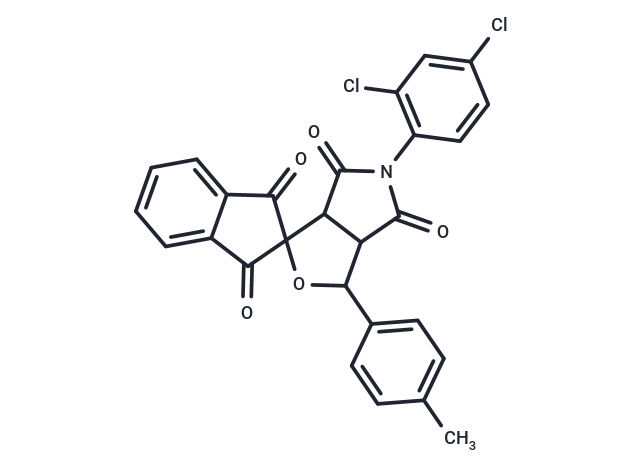
| Description | ML-T7, a powerful inhibitor of Tim-3, effectively disrupts its interactions with PtdSer and CEACAM1. This compound enhances the antitumor activity of adoptive transfer therapy involving cytotoxic T lymphocytes (CTLs) and CAR T cells, while also boosting T cell effector functions. Additionally, ML-T7 augments the killing activity of NK cells against tumor cells and improves the antigen-presenting capacity of dendritic cells (DCs). Demonstrating antitumor efficacy in preclinical models, ML-T7 shows potential either as a standalone treatment or in combination with Nivolumab for tumor immunotherapy research [1]. |
| In vitro | ML-T7 (10 μM, 0-6 days) enhances the TCR/STAT5 signaling pathway via Tim-3, thereby promoting the anti-tumor activity of CD8+ cells [1]. When applied at 10 μM for 24 hours, ML-T7 facilitates the maturation and function of dendritic cells (DCs) through Tim-3 and Tim-4, boosting their antigen-presenting capabilities [1]. Additionally, ML-T7 (10 μM, 24 h) enhances cytotoxic T lymphocyte (CTL) activation and cytokine production, while reducing CTL apoptosis [1]. At a concentration of 10 μM for 48 hours, ML-T7 significantly increases the production of IFN-γ, TNF-α, CD107a, and granzyme B in the human NK cell line NK92 [1]. Western blot analysis in CD8+ cells at 10 μM for 0-6 days showed increased phosphorylation of phospholipase C–γ1 (PLC-γ1), ZAP70, LCK, ERK1/2, and STAT5 in response to anti-CD3/CD28 stimulation. In a cell invasion assay using bone marrow cells and a 10 μM concentration for 24 hours, ML-T7 elevated the expression of DC maturation markers. |
| In vivo | ML-T7, administered intraperitoneally at 10-50 mg/kg every two days for 10 doses, has been shown to inhibit tumor growth and extend the survival of mice without adverse effects on mouse body weight. At a dose of 20 mg/kg, in combination with Nivolumab, ML-T7 enhances the antitumor activity of Nivolumab and significantly improves the survival rate in HCC mice. Additionally, ML-T7 at 50 mg/kg every two days for three weeks demonstrates good safety in mice. In 10-week-old mice with spontaneous orthotopic HCC, treatment leads to increased CD8+ T cells in tumors and spleen, reduction of T cell exhaustion, and improved function of CTLs, NK cells, and DCs. Furthermore, in 10-week-old mice with orthotopic Akt/c-Myc HCC, ML-T7 at 20 mg/kg exhibits enhanced antitumor activity alongside Nivolumab, rejuvenates NK cells, and inhibits the accumulation of MDSCs and Tregs. |
| Molecular Weight | 506.33 |
| Formula | C27H17Cl2NO5 |
| Cas No. | 459789-75-4 |
| Smiles | O=C1C2(C3C(C(O2)C4=CC=C(C)C=C4)C(=O)N(C3=O)C5=C(Cl)C=C(Cl)C=C5)C(=O)C=6C1=CC=CC6 |
| Storage | Powder: -20°C for 3 years | In solvent: -80°C for 1 year Shipping with blue ice/Shipping at ambient temperature. |
 For example, if the intended dosage is 10 mg/kg for animals weighing 20 g , with a dosing volume of 100 μL per animal, and a total of 10 animals are to be administered, using a formulation of
  10% DMSO+ 40% PEG300+ 5% Tween 80+ 45% Saline/PBS/ddH2O , the resulting working solution concentration would be 2 mg/mL.
Dissolve 2 mg of the compound in 100 μL DMSO to obtain a stock solution at a concentration of 20 mg/mL . If the required concentration exceeds the compound's known solubility, please contact us for technical support before proceeding.
1) Add 100 μL of the DMSO stock solution to 400 µL PEG300 and mix thoroughly until the solution becomes clear.
2) Add 50 µL Tween 80 and mix well until fully clarified.
3) Add 450 µL Saline,PBS or ddH2O and mix thoroughly until a homogeneous solution is obtained.
| Size | Quantity | Unit Price | Amount | Operation |
|---|
 Feedback
 Hello! How can I help you today?
Copyright © 2015-2026 TargetMol Chemicals Inc. All Rights Reserved.
