


Shopping Cart
Remove All Your shopping cart is currently empty


Synonyms:
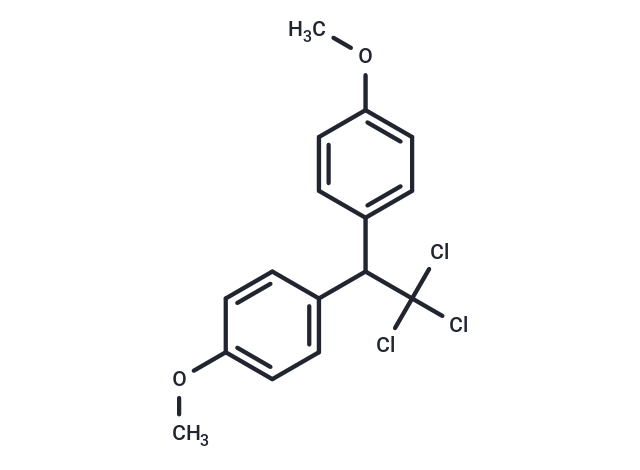
| Pack Size | Price | USA Stock | Global Stock | Quantity |
|---|---|---|---|---|
| 25 mg | $29 | In Stock | - | |
| 50 mg | Preferential | In Stock | - | |
| 1 mL x 10 mM (in DMSO) | $29 | In Stock | In Stock |
| Description | Methoxychlor, an organochlorine pesticide, is thought to be an endocrine disrupter that affects Ca2 homeostasis and cell viability in different cell models. |
| In vitro | In HA59T cells, methoxychlor induced a [Ca2?]i rise by inducing Ca2? entry via protein kinase C-sensitive Ca2?-permeable channels, without causing Ca2? release from stores. Methoxychlor also induced apoptosis that was independent of [Ca2?]i rises. |
| Cell Research | Fura-2, a Ca2?-sensitive fluorescent dye, was applied to measure [Ca2?]i. Methoxychlor at concentrations of 0.1-1 μM caused a [Ca2?]i rise in a concentration-dependent manner. Removal of external Ca2? abolished methoxychlor's effect. Methoxychlor-induced Ca2? influx was confirmed by Mn2?-induced quench of fura-2 fluorescence. Methoxychlor-induced Ca2? entry was inhibited by nifedipine, econazole, SK&F96365, and protein kinase C modulators. Methoxychlor killed cells at concentrations of 10-130 μM in a concentration-dependent fashion. Chelation of cytosolic Ca2? with 1,2-bis(2-aminophenoxy) ethane-N,N,N',N'-tetraacetic acid/AM (BAPTA/AM) did not prevent methoxychlor's cytotoxicity. Methoxychlor (10 and 50 μM) induced apoptosis concentration-dependently as determined by using Annexin V/propidium iodide staining |
| Molecular Weight | 345.65 |
| Formula | C16H15Cl3O2 |
| Cas No. | 72-43-5 |
| Smiles | COc1ccc(cc1)C(c1ccc(OC)cc1)C(Cl)(Cl)Cl |
| Relative Density. | 1.4 g/cm3 |
| Storage | Powder: -20°C for 3 years | In solvent: -80°C for 1 year Shipping with blue ice/Shipping at ambient temperature. | ||||||||||||||||||||||||||||||
| Solubility Information | DMSO: 22.5 mg/mL (65.09 mM), Sonication is recommended.  | ||||||||||||||||||||||||||||||
Solution Preparation Table | |||||||||||||||||||||||||||||||
DMSO
Note : The dilution table applies only to solid products. For liquid products, please calculate the stock solution based on the stated concentration and/or density. | |||||||||||||||||||||||||||||||
 For example, if the intended dosage is 10 mg/kg for animals weighing 20 g , with a dosing volume of 100 μL per animal, and a total of 10 animals are to be administered, using a formulation of
  10% DMSO+ 40% PEG300+ 5% Tween 80+ 45% Saline/PBS/ddH2O , the resulting working solution concentration would be 2 mg/mL.
Dissolve 2 mg of the compound in 100 μL DMSO to obtain a stock solution at a concentration of 20 mg/mL . If the required concentration exceeds the compound's known solubility, please contact us for technical support before proceeding.
1) Add 100 μL of the DMSO stock solution to 400 µL PEG300 and mix thoroughly until the solution becomes clear.
2) Add 50 µL Tween 80 and mix well until fully clarified.
3) Add 450 µL Saline,PBS or ddH2O and mix thoroughly until a homogeneous solution is obtained.
| Size | Quantity | Unit Price | Amount | Operation |
|---|
 Feedback
 Hello! How can I help you today?
Copyright © 2015-2026 TargetMol Chemicals Inc. All Rights Reserved.
