


Shopping Cart
Remove All Your shopping cart is currently empty

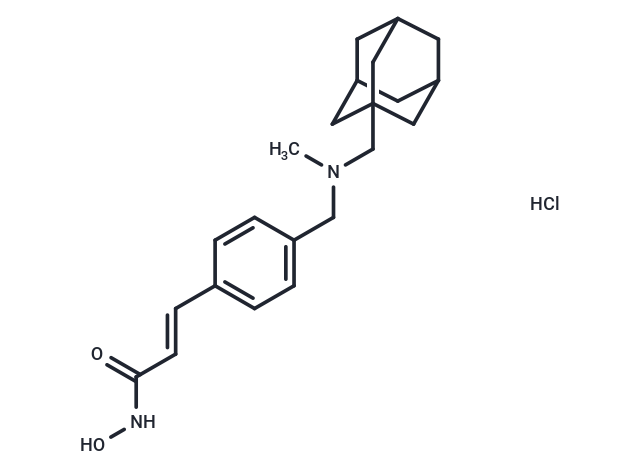
Synonyms: Martinostat hydrochloride(1629052-58-9 free base)
| Pack Size | Price | USA Stock | Global Stock | Quantity |
|---|---|---|---|---|
| 1 mg | $45 | - | In Stock | |
| 5 mg | $98 | - | In Stock | |
| 10 mg | $157 | - | In Stock | |
| 25 mg | $298 | - | In Stock | |
| 50 mg | $489 | - | In Stock | |
| 100 mg | $788 | - | In Stock | |
| 1 mL x 10 mM (in DMSO) | $109 | - | In Stock |
| Description | Martinostat hydrochloride is a potent and selective histone deacetylase (HDAC) inhibitor with nanomolar affinity toward Class I HDACs (HDAC1, HDAC2, HDAC3) and the Class IIb isoform HDAC6, exerting its pharmacological effects by blocking enzymatic deacetylation and consequently increasing global histone and non-histone protein acetylation, thereby modulating transcriptional programs and disrupting key survival pathways in pathological cells; Martinostat demonstrates exceptional brain penetrance compared with other hydroxamate HDAC inhibitors, enabling high-quality neuroepigenetic PET imaging with [11C]-labeled tracers to characterize altered HDAC availability in neurodegenerative disorders such as Alzheimer’s disease, while oncology studies show that Martinostat suppresses proliferation, induces apoptosis, and enhances the activity of tyrosine kinase inhibitors in both imatinib-sensitive and imatinib-resistant chronic myeloid leukemia models, highlighting its therapeutic potential for overcoming drug resistance. |
| Synonyms | Martinostat hydrochloride(1629052-58-9 free base) |
| Molecular Weight | 390.95 |
| Formula | C22H31ClN2O2 |
| Smiles | ONC(/C=C/C(C=C1)=CC=C1CN(C)CC23CC4CC(CC(C4)C3)C2)=O.Cl |
| Relative Density. | no data available |
| Storage | Powder: -20°C for 3 years | In solvent: -80°C for 1 year Shipping with blue ice/Shipping at ambient temperature. | |||||||||||||||||||||||||||||||||||
| Solubility Information | DMSO: 100 mg/mL (255.79 mM), Sonication is recommended. | |||||||||||||||||||||||||||||||||||
Solution Preparation Table | ||||||||||||||||||||||||||||||||||||
DMSO
Note : The dilution table applies only to solid products. For liquid products, please calculate the stock solution based on the stated concentration and/or density. | ||||||||||||||||||||||||||||||||||||
 For example, if the intended dosage is 10 mg/kg for animals weighing 20 g , with a dosing volume of 100 μL per animal, and a total of 10 animals are to be administered, using a formulation of
  10% DMSO+ 40% PEG300+ 5% Tween 80+ 45% Saline/PBS/ddH2O , the resulting working solution concentration would be 2 mg/mL.
Dissolve 2 mg of the compound in 100 μL DMSO to obtain a stock solution at a concentration of 20 mg/mL . If the required concentration exceeds the compound's known solubility, please contact us for technical support before proceeding.
1) Add 100 μL of the DMSO stock solution to 400 µL PEG300 and mix thoroughly until the solution becomes clear.
2) Add 50 µL Tween 80 and mix well until fully clarified.
3) Add 450 µL Saline,PBS or ddH2O and mix thoroughly until a homogeneous solution is obtained.
| Size | Quantity | Unit Price | Amount | Operation |
|---|
 Feedback
 Hello! How can I help you today?
Copyright © 2015-2026 TargetMol Chemicals Inc. All Rights Reserved.
