


Shopping Cart
Remove All Your shopping cart is currently empty


Synonyms: HOE 34580 xHCl
| Pack Size | Price | USA Stock | Global Stock | Quantity |
|---|---|---|---|---|
| 2 mg | $50 | In Stock | In Stock | |
| 5 mg | $56 | In Stock | In Stock | |
| 10 mg | $82 | In Stock | In Stock | |
| 25 mg | $148 | In Stock | In Stock | |
| 50 mg | $205 | In Stock | In Stock | |
| 100 mg | $302 | In Stock | In Stock |
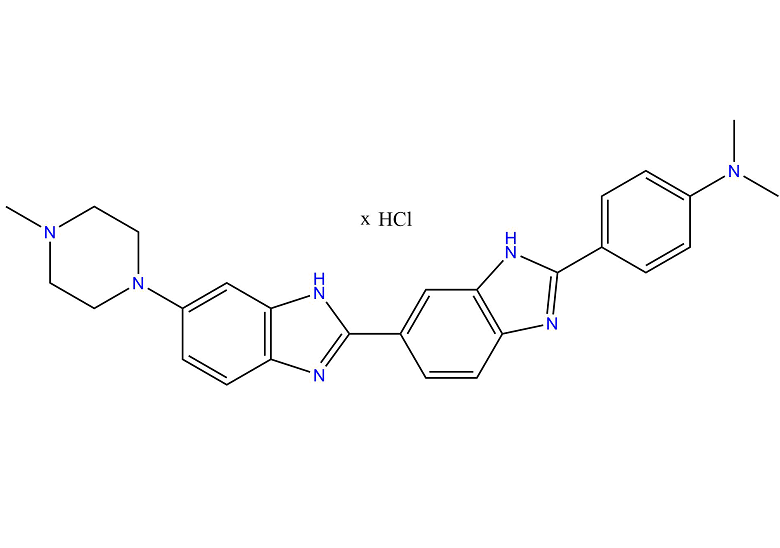
| Description | Hoechst 34580 xHCl(23555-00-2(free base) is a cell-permeable fluorescent dye, is used for staining DNA and nuclei. |
| In vitro | Hoechst 34580 is a good candidate for treating Alzheimer’s disease by inhibiting Aβ formation. 50 μM Aβ42 solutions co-incubated with 100, 25, 12.5, 3.125, 0.78, and 0.1, 0.01 μM Hoechst 34580 at 37 °C for 70 h. Hoechst 34580 can inhibit the aggregation of Aβ42 in a dose-dependent manner. The IC50 is obtained by measuring the concentration of Hoechst 34580 while maintaining the Aβ42 concentration which gave 0.86±0.05 μM for Hoechst 34580. |
| Synonyms | HOE 34580 xHCl |
| Cell Research | Instructions I. Solution preparation 1. Stock solution: Dissolve Hoechst 34580 in DMSO to prepare a 1mg/ml stock solution. Note: The stock solution should be kept away from light and stored at -20°C after aliquoting to avoid repeated freezing and thawing to maintain the activity of the dye. 2. Working solution: Dilute the stock solution to the final concentration (usually 1–10 µg/mL) before the experiment. Note: It is recommended to use a suitable pure DMEM medium or PBS (without phenol red) for dilution to ensure the best staining effect. II. Operation steps 1. Cell preparation: Adherent cells: After culturing cells to an appropriate density, wash 1–2 times with PBS buffer to remove the culture medium residue. Suspended cells: Collect cells directly, centrifuge and discard the supernatant, and resuspend with PBS. 2. Staining reaction: 1) Resuspend cells or incubate adherent cells with Hoechst 34580 working solution to ensure sufficient mixing. 2) The staining concentration is usually 1–10 µg/mL, and incubate at 37°C in the dark for 10–30 minutes. 3. Washing steps: After staining, wash the cells 2–3 times with PBS buffer to remove unbound dye. 3. Detection and analysis Fluorescence detection: Use a fluorescence microscope or flow cytometer to detect the fluorescent signal in the cells. Hoechst 34580 has a high affinity for DNA and can specifically bind to the cell nucleus, showing bright blue fluorescence. Recommended detection parameters: Excitation wavelength: 355–360 nm Emission wavelength: 465–480 nm 4. Data analysis: Observe and take fluorescent images to analyze the nuclear staining intensity or cell cycle distribution. Positive and negative control groups can be combined for comparison to verify the experimental results. The above information is based on published literature. Experimental procedures should be appropriately modified to meet specific research demands. |
| Formula | C27H29N7.xHCl |
| Relative Density. | no data available |
| Storage | Keep away from direct sunlight Powder: -20°C for 3 years | In solvent: -80°C for 1 year Shipping with blue ice/Shipping at ambient temperature. |
| Solubility Information | DMSO: 11 mg/mL, Sonication is recommended.  |
 For example, if the intended dosage is 10 mg/kg for animals weighing 20 g , with a dosing volume of 100 μL per animal, and a total of 10 animals are to be administered, using a formulation of
  10% DMSO+ 40% PEG300+ 5% Tween 80+ 45% Saline/PBS/ddH2O , the resulting working solution concentration would be 2 mg/mL.
Dissolve 2 mg of the compound in 100 μL DMSO to obtain a stock solution at a concentration of 20 mg/mL . If the required concentration exceeds the compound's known solubility, please contact us for technical support before proceeding.
1) Add 100 μL of the DMSO stock solution to 400 µL PEG300 and mix thoroughly until the solution becomes clear.
2) Add 50 µL Tween 80 and mix well until fully clarified.
3) Add 450 µL Saline,PBS or ddH2O and mix thoroughly until a homogeneous solution is obtained.
| Size | Quantity | Unit Price | Amount | Operation |
|---|
 Feedback
 Hello! How can I help you today?
Copyright © 2015-2026 TargetMol Chemicals Inc. All Rights Reserved.
