Shopping Cart
Remove All
  • TargetMol
    Your shopping cart is currently empty

Glyfosfin

Catalog No. T21306 Copy Product Info
🥰Excellent
Glyfosfin is a DNA cross-linking and alkylating agent with anticancer activity and can also be used to induce kidney stone models.

Glyfosfin

Copy Product Info
🥰Excellent
Catalog No. T21306

Glyfosfin is a DNA cross-linking and alkylating agent with anticancer activity and can also be used to induce kidney stone models.

Glyfosfin
Cas No. 107-22-2
Pack SizePriceUSA StockGlobal StockQuantity
25 mg$1,5206-8 weeks6-8 weeks
50 mg$1,9806-8 weeks6-8 weeks
100 mg$2,5006-8 weeks6-8 weeks
For In stock only · Estimated delivery: USA Stock (1-2 days) Global Stock (5-7 days)
Add to Cart
Add to Quotation
For research use only—not for human use. No sales to individuals. Use as intended only.
Questions
TargetMol
View More

Resource Download

Product Introduction

Bioactivity
Description
Glyfosfin is a DNA cross-linking and alkylating agent with anticancer activity and can also be used to induce kidney stone models.
Disease Modeling Protocol
Kidney stone model
  • Modeling Mechanism:

    Glyfosfin, as a direct precursor to oxalate, is rapidly converted into oxalate in the body, causing a sharp increase in urinary oxalate concentration and resulting in hyperoxaluria. At the same time, it triggers oxidative stress in renal tubular epithelial cells (increased ROS and MDA, decreased SOD) and mitochondrial damage, promoting the nucleation and deposition of calcium oxalate (CaOx) crystals in the renal tubular lumen, accompanied by inflammatory infiltration and kidney damage, ultimately forming calcium oxalate kidney stones.

  • Related Products:

    Glyfosfin (T21306)

  • Modeling Method:

    Experimental Subject:

    Mice, ICR, Male, 25±3g, 6-8 weeks old

    Dosage and Administration Route:

    Glyfosfin, 100 mg/kg, saline, intraperitoneal injection (i.p.)

    Dosing Frequency and Duration Model:

    Once daily for 7 consecutive days

  • Validation:

    1. Pathological gold standard: Under Pizzolato staining and polarized light microscopy, a large number of calcium oxalate crystal deposits were observed in the lumen of the renal tubules; under transmission electron microscopy, mitochondrial swelling and microvilli loss were observed in the renal tubular epithelial cells, and crystal nuclei were formed in the lumen; 2. Functional indicators: Serum creatinine (Cr) and blood urea nitrogen (BUN) were significantly elevated; the calcium and oxalate content in the renal tissue were significantly increased compared with the control group; 3. Oxidative stress: The levels of ROS and MDA in the renal tissue were elevated, the activity of SOD was decreased, and the expression of 4-HNE (a marker of lipid peroxidation) was upregulated.

*Precautions: The animal was sacrificed after the last dose on day 7, and its kidneys were rapidly separated.

*References:Khan SR, Glenton PA. Experimental induction of calcium oxalate nephrolithiasis in mice. J Urol. 2010 Sep;184(3):1189-96.

Chemical Properties
Molecular Weight58.04
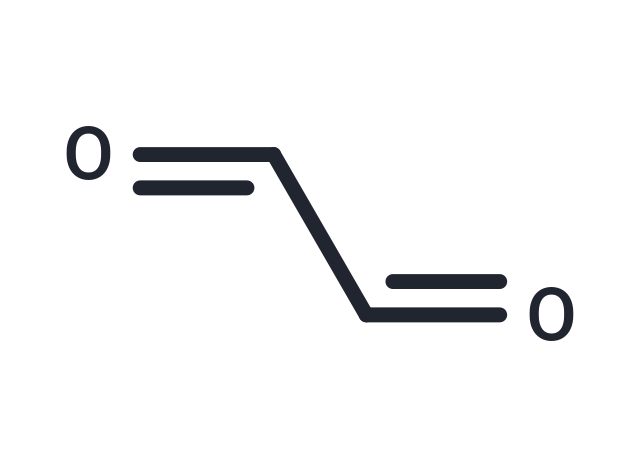
FormulaC2H2O2
Cas No.107-22-2
SmilesO=CC=O
Relative Density.1.265 g/mL at 25°C
Storage & Solubility Information
StoragePowder: -20°C for 3 years | In solvent: -80°C for 1 year | Shipping with blue ice/Shipping at ambient temperature.
Solubility Information
H2O: Insoluble
DMSO: Soluble

Calculator

  • Molarity Calculator
  • Dilution Calculator
  • Reconstitution Calculator
  • Molecular Weight Calculator

In Vivo Formulation Calculator (Clear solution)

Please enter your animal experiment information in the following box and click Calculate to obtain the stock solution preparation method and in vivo formula preparation method:
TargetMol | Animal experiments For example, if the intended dosage is 10 mg/kg for animals weighing 20 g , with a dosing volume of 100 μL per animal, TargetMol | Animal experiments and a total of 10 animals are to be administered, using a formulation of TargetMol | reagent 10% DMSO+ 40% PEG300+ 5% Tween 80+ 45% Saline/PBS/ddH2O , the resulting working solution concentration would be 2 mg/mL.

Stock Solution Preparation:

Dissolve 2 mg of the compound in 100 μL DMSOTargetMol | reagent to obtain a stock solution at a concentration of 20 mg/mL . If the required concentration exceeds the compound's known solubility, please contact us for technical support before proceeding.

Preparation of the In Vivo Formulation:

1) Add 100 μL of the DMSOTargetMol | reagent stock solution to 400 μL PEG300TargetMol | reagent and mix thoroughly until the solution becomes clear.

2) Add 50 μL Tween 80 and mix well until fully clarified.

3) Add 450 μL Saline,PBS or ddH2OTargetMol | reagent and mix thoroughly until a homogeneous solution is obtained.

This example is provided solely to demonstrate the use of the In Vivo Formulation Calculator and does not constitute a recommended formulation for any specific compound. Please select an appropriate dissolution and formulation strategy based on your experimental model and route of administration.
All co-solvents required for this protocol, includingDMSO, PEG300/PEG400, Tween 80, SBE-β-CD, and Corn oil, are available for purchase on the TargetMol website.
1 Enter information below:
mg/kg
g
μL
2 Enter the in vivo formulation:
% DMSO
%
% Tween 80
% Saline/PBS/ddH2O

Dose Conversion

You can also refer to dose conversion for different animals. More Dose Conversion

Tech Support

Please see Inhibitor Handling Instructions for more frequently ask questions. Topics include: how to prepare stock solutions, how to store products, and cautions on cell-based assays & animal experiments, etc

Keywords

Related Tags: buy Glyfosfin | purchase Glyfosfin | Glyfosfin cost | order Glyfosfin | Glyfosfin chemical structure | Glyfosfin formula | Glyfosfin molecular weight