


Shopping Cart
Remove All Your shopping cart is currently empty

Synonyms:
| Pack Size | Price | USA Stock | Global Stock | Quantity |
|---|---|---|---|---|
| 25 mg | $1,520 | 8-10 weeks | 8-10 weeks | |
| 50 mg | $1,980 | 8-10 weeks | 8-10 weeks | |
| 100 mg | $2,500 | 8-10 weeks | 8-10 weeks |
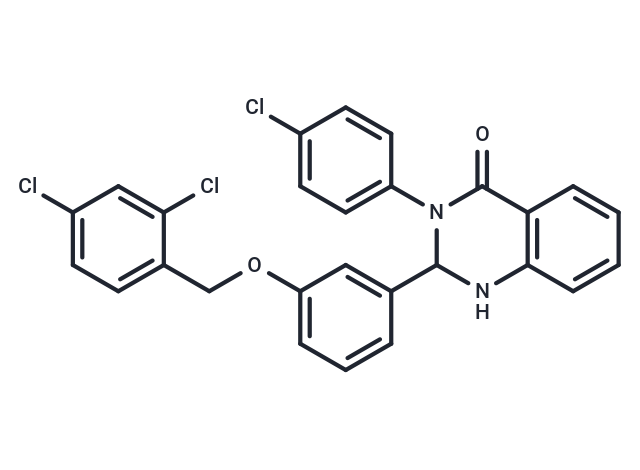
| Description | GL64 is a selective agonist of ADGRD1 with an EC50 of 3.98 μM. It shows low selectivity for the subtypes ADGRD2, ADGRG5, ADGRG6, CELSR1, CELSR2, CELSR3, and ADGRG4. GL64 activates ADGRD1 by mimicking the satchel sequence. It regulates osteoclast maturation through the cAMP-PKA-NFATC1 pathway. Both in vivo and in vitro, GL64 effectively inhibits osteoclastogenesis and prevents bone loss. This compound is suitable for research into osteoclast-related diseases. |
| In vitro | GL64, at a concentration of 10 μM, enhances CRE-luciferase activity in HEK293T cells overexpressing ADGRD1 by more than 1.5 times. It also elevates CRE-luciferase and endogenous adenosine cAMP levels in wild-type MEFs, but does not affect Adgrd1−/− cells. GL64, in the range of 0-100 μM, does not increase CRE-luciferase activity in HEK293T cells overexpressing adhesion GPCRs (such as ADGRD2, ADGRG5, ADGRG6, CELSR1, CELSR2, CELSR3, and ADGRG4) or activate non-adhesion GPCRs (including GPR68, NPFFR1, GPR183, and GPRC5B). In ADGRD1-overexpressing HEK293T cells treated with the satchel peptide, GL64 exhibits weak agonist activity on ADGRD1 (EC50 = 16.89 μM). Notably, GL64 at 10 μM over 6 days inhibits the differentiation of male wild-type bone marrow-derived macrophages (BMMs) into mature osteoclasts, a process unaffected in Adgrd1−/− BMMs. During osteoclast maturation in male mice, GL64 at 10 μM over 6 days downregulates the mRNA expression levels of Dc-stamp, Acp5, and Nfatc1. Additionally, GL64 at 30 μM raises endogenous cAMP levels in male BMMs. With a concentration of 10 μM over 2 days, GL64 reduces NFATC1 nuclear localization in BMMs. |
| In vivo | Administering GL64 at a dosage of 30 mg/kg through intraperitoneal injection once daily for four weeks effectively mitigates excessive osteoclast activity and bone loss in a postmenopausal osteoporosis mouse model induced by ovariectomy (OVX). |
| Molecular Weight | 509.81 |
| Formula | C27H19Cl3N2O2 |
| Cas No. | 488801-10-1 |
| Smiles | O=C1C=2C=CC=CC2NC(C=3C=CC=C(OCC4=CC=C(Cl)C=C4Cl)C3)N1C5=CC=C(Cl)C=C5 |
| Storage | Powder: -20°C for 3 years | In solvent: -80°C for 1 year Shipping with blue ice/Shipping at ambient temperature. |
 For example, if the intended dosage is 10 mg/kg for animals weighing 20 g , with a dosing volume of 100 μL per animal, and a total of 10 animals are to be administered, using a formulation of
  10% DMSO+ 40% PEG300+ 5% Tween 80+ 45% Saline/PBS/ddH2O , the resulting working solution concentration would be 2 mg/mL.
Dissolve 2 mg of the compound in 100 μL DMSO to obtain a stock solution at a concentration of 20 mg/mL . If the required concentration exceeds the compound's known solubility, please contact us for technical support before proceeding.
1) Add 100 μL of the DMSO stock solution to 400 µL PEG300 and mix thoroughly until the solution becomes clear.
2) Add 50 µL Tween 80 and mix well until fully clarified.
3) Add 450 µL Saline,PBS or ddH2O and mix thoroughly until a homogeneous solution is obtained.
| Size | Quantity | Unit Price | Amount | Operation |
|---|
 Feedback
 Hello! How can I help you today?
Copyright © 2015-2026 TargetMol Chemicals Inc. All Rights Reserved.
