


Shopping Cart
Remove All Your shopping cart is currently empty

Synonyms:
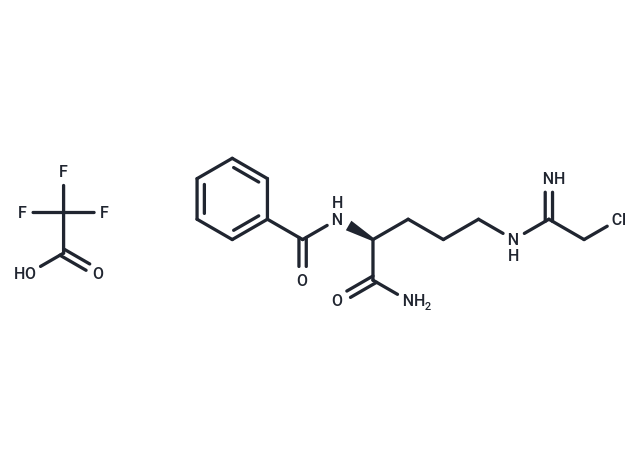
| Pack Size | Price | USA Stock | Global Stock | Quantity |
|---|---|---|---|---|
| 1 mg | $39 | - | In Stock | |
| 5 mg | $91 | - | In Stock | |
| 10 mg | $149 | - | In Stock | |
| 25 mg | $290 | - | In Stock | |
| 1 mL x 10 mM (in DMSO) | $98 | - | In Stock |
| Description | Cl-amidine TFA is an orally active PAD inhibitor with IC₅₀ values of 0.8 μM, 6.2 μM and 5.9 μM for PAD1, PAD3 and PAD4, respectively. This compound can induce cancer cell apoptosis, and also upregulate the expression of miR-16 (miRNA-16, microRNA-16), thereby triggering cell cycle arrest. In addition, Cl-amidine TFA can block the citrullination of histone 3 and the formation of neutrophil extracellular traps, effectively improving the survival rate of mice with sepsis. |
| Targets & IC50 | PAD3:6.2 μM, PAD1:0.8 μM, PAD4:5.9 μM |
| In vitro | Cl-amidine TFA is a bioavailable haloacetamidine-based compound that inhibits all active PAD isozymes with comparable potency, with an inactivation efficiency constant of 13,000 M⁻¹·min⁻¹ for PAD4[1]. When cells are treated with Cl-amidine TFA at concentrations of 0, 5, 10, 15, 20, 25 and 50 μg/mL for 24 hours, it induces apoptosis in TK6 lymphoblastoid cells and HT29 colon cancer cells in a dose-dependent manner; notably, the HT29 colon cancer cell line exhibits relative resistance to apoptosis induced by Cl-amidine[2]. Cl-amidine TFA achieves irreversible inactivation of PADs by covalently modifying the cysteine residue in the PAD active site that is involved in catalytic activity[4]. |
| In vivo | At a dose of 75 mg/kg administered intraperitoneally once daily, Cl-amidine TFA exerts inhibitory and therapeutic effects on dextran sulfate sodium-induced colitis in mice[2]. When administered by oral gavage at doses of 5, 25 and 75 mg/kg once daily, Cl-amidine TFA also significantly reduces the histological scores in a dose-dependent manner[2]. |
| Molecular Weight | 424.8 |
| Formula | C16H20ClF3N4O4 |
| Cas No. | 1043444-18-3 |
| Smiles | C(C(O)=O)(F)(F)F.C(N[C@@H](CCCNC(CCl)=N)C(N)=O)(=O)C1=CC=CC=C1 |
| Relative Density. | no data available |
| Storage | Store under nitrogen Powder: -20°C for 3 years | In solvent: -80°C for 1 year Shipping with blue ice/Shipping at ambient temperature. |
 For example, if the intended dosage is 10 mg/kg for animals weighing 20 g , with a dosing volume of 100 μL per animal, and a total of 10 animals are to be administered, using a formulation of
  10% DMSO+ 40% PEG300+ 5% Tween 80+ 45% Saline/PBS/ddH2O , the resulting working solution concentration would be 2 mg/mL.
Dissolve 2 mg of the compound in 100 μL DMSO to obtain a stock solution at a concentration of 20 mg/mL . If the required concentration exceeds the compound's known solubility, please contact us for technical support before proceeding.
1) Add 100 μL of the DMSO stock solution to 400 µL PEG300 and mix thoroughly until the solution becomes clear.
2) Add 50 µL Tween 80 and mix well until fully clarified.
3) Add 450 µL Saline,PBS or ddH2O and mix thoroughly until a homogeneous solution is obtained.
| Size | Quantity | Unit Price | Amount | Operation |
|---|
 Feedback
 Hello! How can I help you today?
Copyright © 2015-2026 TargetMol Chemicals Inc. All Rights Reserved.
