


Shopping Cart
Remove All Your shopping cart is currently empty


Synonyms: ZK-811752 hydrochloride
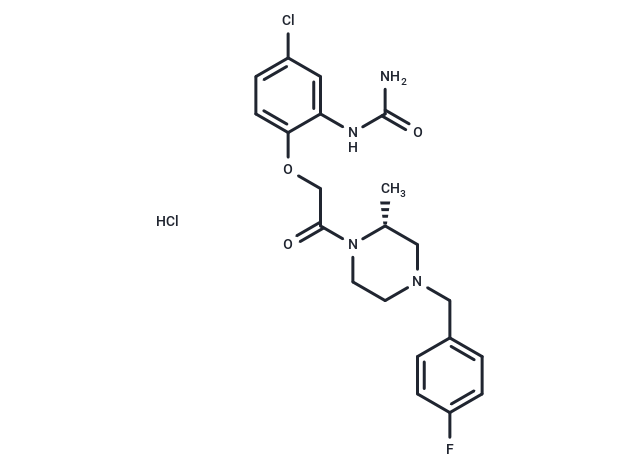

| Description | BX471 hydrochloride (ZK-811752 hydrochloride) is a potent, selective non-peptide CCR1 antagonist with a Ki of 1 nM for human CCR1, exhibiting 250-fold selectivity over CCR2, CCR5, and CXCR4. |
| Targets & IC50 | RANTES-CCR1:2.8 nM (ki), MCP-3-CCR1:5.5 nM (ki), MIP-1α-CCR1:1 nM (ki) |
| In vitro | BX471 is a potent functional antagonist based on its ability to inhibit a number of CCR1-mediated effects including Ca2+ mobilization, increase in extracellular acidification rate, CD11b expression, and leukocyte migration and it is also able to displace 125I-MIP-1α/CCL3 binding to mouse CCR1 in a concentration-dependent manner (Ki: 215 nM). BX471 demonstrates a greater than 10,000-fold selectivity for CCR1 compared with 28 G-protein-coupled receptors [1]. BX471 also inhibits the RANTES-mediated adhesion of T lymphocytes to activated endothelium [4]. BX471 (0.1-10 μM) shows dose-dependent inhibition of RANTES-mediated and shear-resistant adhesion on IL-1β-activated microvascular endothelium in shear flow in isolated blood monocytes. Increasing concentrations of BX471 inhibits the Ca2+ transients induced by MIP-1α/CCL3 in both human and mouse CCR1 (IC50s: 5.8 nM and 198 nM) [2]. |
| In vivo | BX471 demonstrates a marginally significant impact on the quantity of CCR5-positive CD8 cells in peripheral blood and notably decreases FSP1-positive cells in UUO kidneys by 65% compared to the vehicle control, highlighting its efficacy [2]. Administered orally or intravenously at 4 mg/kg, it shows a bioavailability of 60% in dogs, indicating good oral activity. Moreover, BX471 significantly mitigates symptoms in a rat model of experimental allergic encephalomyelitis, which is a model for multiple sclerosis [1], illustrating its potential therapeutic benefits. At a dosage of 20 mg/kg subcutaneously, it reaches a peak plasma concentration of 9 μM within 30 minutes, but this level sharply falls to roughly 0.4 μM after 2 hours, and declines further to 0.1 μM or less from 4 to 8 hours post-administration. In mice, a 10-day treatment with BX471 at 20 mg/kg results in a 55% reduction in interstitial CD45 positive leukocytes, demonstrating its anti-inflammatory properties. Additionally, pretreatment with BX471 effectively reduces macrophage and neutrophil build-up in the kidney following ischemia-reperfusion injury [3], showcasing its potential in protecting renal function from injury-induced inflammation. |
| Synonyms | ZK-811752 hydrochloride |
| Molecular Weight | 471.35 |
| Formula | C21H25Cl2FN4O3 |
| Cas No. | 288262-96-4 |
| Smiles | Cl.C[C@@H]1CN(Cc2ccc(F)cc2)CCN1C(=O)COc1ccc(Cl)cc1NC(N)=O |
| Relative Density. | no data available |
| Storage | Powder: -20°C for 3 years | In solvent: -80°C for 1 year Shipping with blue ice/Shipping at ambient temperature. | |||||||||||||||||||||||||||||||||||
| Solubility Information | DMSO: 150 mg/mL (318.23 mM), Sonication is recommended. | |||||||||||||||||||||||||||||||||||
Solution Preparation Table | ||||||||||||||||||||||||||||||||||||
DMSO
Note : The dilution table applies only to solid products. For liquid products, please calculate the stock solution based on the stated concentration and/or density. | ||||||||||||||||||||||||||||||||||||
 For example, if the intended dosage is 10 mg/kg for animals weighing 20 g , with a dosing volume of 100 μL per animal, and a total of 10 animals are to be administered, using a formulation of
  10% DMSO+ 40% PEG300+ 5% Tween 80+ 45% Saline/PBS/ddH2O , the resulting working solution concentration would be 2 mg/mL.
Dissolve 2 mg of the compound in 100 μL DMSO to obtain a stock solution at a concentration of 20 mg/mL . If the required concentration exceeds the compound's known solubility, please contact us for technical support before proceeding.
1) Add 100 μL of the DMSO stock solution to 400 µL PEG300 and mix thoroughly until the solution becomes clear.
2) Add 50 µL Tween 80 and mix well until fully clarified.
3) Add 450 µL Saline,PBS or ddH2O and mix thoroughly until a homogeneous solution is obtained.
| Size | Quantity | Unit Price | Amount | Operation |
|---|
 Feedback
 Hello! How can I help you today?
Copyright © 2015-2026 TargetMol Chemicals Inc. All Rights Reserved.
