


Shopping Cart
Remove All Your shopping cart is currently empty

Synonyms:
| Pack Size | Price | USA Stock | Global Stock | Quantity |
|---|---|---|---|---|
| 25 mg | $1,520 | 1-2 weeks | 1-2 weeks | |
| 50 mg | $1,980 | 1-2 weeks | 1-2 weeks | |
| 100 mg | $2,500 | 1-2 weeks | 1-2 weeks |
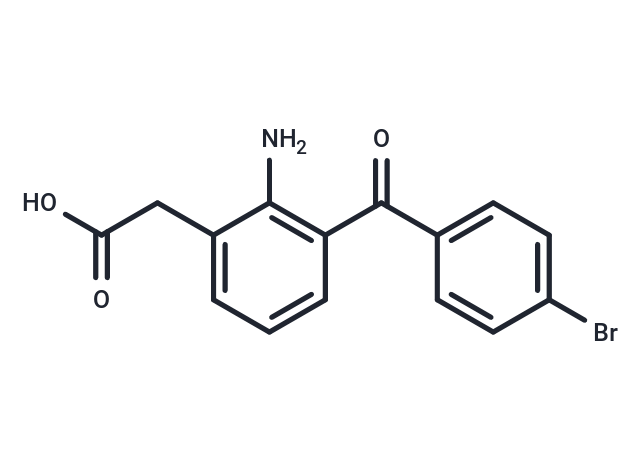
| Description | Bromfenac can be used in the research of ocular inflammation that is a potent and orally active COX inhibitor with IC50 values of 5.56 and 7.45 nM for COX-1 and COX-2, respectively [1]. |
| Targets & IC50 | COX-1 (human):5.56 nM, COX-2 (human):7.45 nM |
| In vitro | Bromfenac, at concentrations ranging from 0 to 80 μg/mL over 24 hours, inhibits the transforming growth factor-β2 (TGF-β2)-induced epithelial-mesenchymal transition (EMT) in HLEC-B3 cells in a dose-dependent manner [2]. Similarly, at a concentration of 80 μg/mL for 48 hours, it suppresses TGF-β2-induced EMT in human anterior capsules, as evidenced by cell viability assays on TGF-β2-treated human anterior capsules, and cell migration assays on HLEC-B3 cells. These assays further confirm that bromfenac effectively prevents the TGF-β2-induced cell migration and over-expression of EMT markers in primary lens epithelial cells (LECs) and HLEC-B3 cells, respectively [2]. |
| In vivo | Bromfenac demonstrates significant anti-inflammatory effects in various concentrations and application methods across animal models. In rats, concentrations as low as 0.1% with 4 hours of pretreatment and 0.32% with 18 hours of pretreatment, applied to the backs, show noteworthy anti-inflammatory activity. A similar dose-related effect is observed when applied to the rats' paws. Notably, a concentration range of 0.032-1.0% applied to guinea pigs' skin exposed to UV light reveals that Bromfenac is 26 times more potent than indomethacin in reducing erythema. Additionally, a consistent dose and time-dependent reduction in paw volume were achieved in rats with applications on the uninjected paw, demonstrating systemic effects. In the context of abdominal constriction responses to acetylcholine in mice, a 0.32% concentration applied to the abdomen effectively blocks these responses. Furthermore, Bromfenac eyedrop instillation at 0.09% concentration, administered twice daily for four weeks, modestly reduces corneal staining in a progressive manner over the treatment period. These findings underscore Bromfenac's broad potential in anti-inflammatory applications across different models and conditions. |
| Molecular Weight | 334.16 |
| Formula | C15H12BrNO3 |
| Cas No. | 91714-94-2 |
| Smiles | NC1=C(C=CC=C1CC(O)=O)C(=O)C1=CC=C(Br)C=C1 |
| Storage | Powder: -20°C for 3 years | In solvent: -80°C for 1 year Shipping with blue ice/Shipping at ambient temperature. |
 For example, if the intended dosage is 10 mg/kg for animals weighing 20 g , with a dosing volume of 100 μL per animal, and a total of 10 animals are to be administered, using a formulation of
  10% DMSO+ 40% PEG300+ 5% Tween 80+ 45% Saline/PBS/ddH2O , the resulting working solution concentration would be 2 mg/mL.
Dissolve 2 mg of the compound in 100 μL DMSO to obtain a stock solution at a concentration of 20 mg/mL . If the required concentration exceeds the compound's known solubility, please contact us for technical support before proceeding.
1) Add 100 μL of the DMSO stock solution to 400 µL PEG300 and mix thoroughly until the solution becomes clear.
2) Add 50 µL Tween 80 and mix well until fully clarified.
3) Add 450 µL Saline,PBS or ddH2O and mix thoroughly until a homogeneous solution is obtained.
| Size | Quantity | Unit Price | Amount | Operation |
|---|
 Feedback
 Hello! How can I help you today?
Copyright © 2015-2026 TargetMol Chemicals Inc. All Rights Reserved.
