


Shopping Cart
Remove All Your shopping cart is currently empty


Synonyms: SM-1213, SM1213, SM 1213
| Pack Size | Price | USA Stock | Global Stock | Quantity |
|---|---|---|---|---|
| 1 mg | $293 | - | In Stock | |
| 5 mg | $722 | - | In Stock | |
| 10 mg | $987 | - | In Stock | |
| 25 mg | $1,520 | - | In Stock | |
| 50 mg | $1,980 | - | In Stock | |
| 100 mg | $2,500 | - | In Stock |
| Description | Amiprilose (SM 1213) has anti-inflammatory activity and inhibits the proliferation of a variety of hyperproliferative cell types.Amiprilose induces lymphokine-induced macrophage activation and may be used in studies of rheumatoid arthritis and psoriasis. |
| In vitro | Low concentrations of Amiprilose hydrochloride (1-100 μg/ml) stimulated proliferation of mouse thymocytes and enhanced IL-1-stimulated proliferative responses in human synovial fibroblasts.[1];In all three models, Amiprilose hydrochloride at concentrations of 0.1% (w/v) or less was not toxic to fibroblasts and keratinocytes and did not interfere with the differentiation of skin equivalents and developing skin equivalents. When tested in skin equivalents, Amiprilose hydrochloride concentrations between 0.1% and 0.5% resulted in altered fibroblast morphology with large intracellular vacuoles, and concentrations above 5% were toxic. In mature skin equivalents, Amiprilose hydrochloride at concentrations of 1% to 10% affected the epidermis in addition to changes in fibroblast morphology. During differentiation, epidermal keratinocytes are also affected when 0.5% Amiprilose hydrochloride is present in developing skin equivalents.[2] |
| In vivo | In 8 consecutive experiments, 90 Louvain (LOU) rats and 91 Sprague-Dawley (SD) rats were immunized with chick type II collagen and administered amiprilose HCl aqueous (1 mg/mL). In LOU rats, the incidence of arthritis was 7/46 (15%) in the amiprilose HCl group compared with 16/44 (36%) in the aqueous group (P less than 0.01). In SD rats, the incidence of arthritis was 28/46 (60%) in the experimental group and 33/45 (73%) in the control group (p greater than NS), but the incidence of arthritis was significantly lower in the experimental group on days 16 and 21 (p less than 0.03). In the LOU assay, amiprilose HCl did not affect antibody titers or delayed hypersensitivity to collagen, nor did it affect the distribution of T cell subsets. At a nontoxic concentration of 1 mg/mL, amiprilose HCl reduced 3H thymidine incorporation in cultured rabbit synovial fibroblasts by 78% and resulted in the presence of numerous intracytoplasmic granules/vacuoles. amiprilose HCl system also reduced prostaglandin E2 levels in rabbit synovial cell supernatant in a dose-related manner by as much as 73% without affecting collagenase activity. collagenase activity.[5] |
| Synonyms | SM-1213, SM1213, SM 1213 |
| Molecular Weight | 305.37 |
| Formula | C14H27NO6 |
| Cas No. | 56824-20-5 |
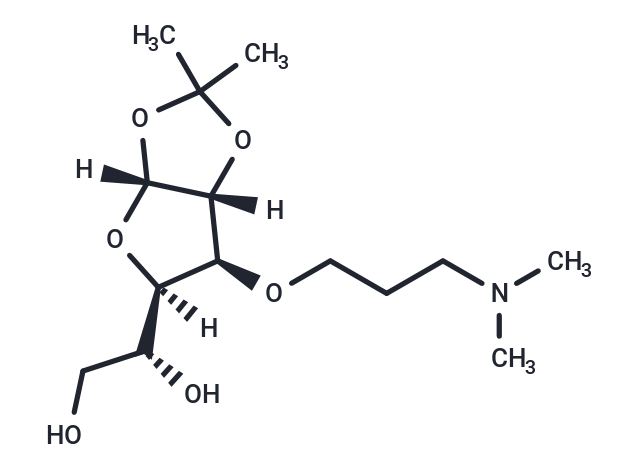
| Smiles | O(CCCN(C)C)[C@@H]1[C@@]2([C@](O[C@@]1([C@@H](CO)O)[H])(OC(C)(C)O2)[H])[H] |
| Relative Density. | 1.21g/cm3 |
| Storage | Pure form: -20°C for 3 years | In solvent: -80°C for 1 year Shipping with blue ice/Shipping at ambient temperature. |
 For example, if the intended dosage is 10 mg/kg for animals weighing 20 g , with a dosing volume of 100 μL per animal, and a total of 10 animals are to be administered, using a formulation of
  10% DMSO+ 40% PEG300+ 5% Tween 80+ 45% Saline/PBS/ddH2O , the resulting working solution concentration would be 2 mg/mL.
Dissolve 2 mg of the compound in 100 μL DMSO to obtain a stock solution at a concentration of 20 mg/mL . If the required concentration exceeds the compound's known solubility, please contact us for technical support before proceeding.
1) Add 100 μL of the DMSO stock solution to 400 µL PEG300 and mix thoroughly until the solution becomes clear.
2) Add 50 µL Tween 80 and mix well until fully clarified.
3) Add 450 µL Saline,PBS or ddH2O and mix thoroughly until a homogeneous solution is obtained.
| Size | Quantity | Unit Price | Amount | Operation |
|---|
 Feedback
 Hello! How can I help you today?
Copyright © 2015-2026 TargetMol Chemicals Inc. All Rights Reserved.
