


Shopping Cart
Remove All Your shopping cart is currently empty


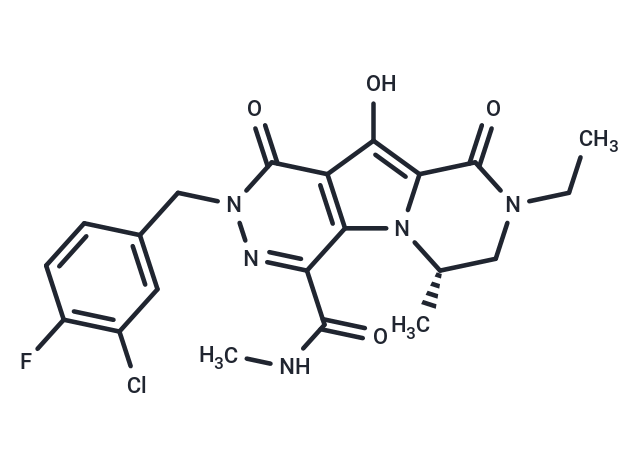
MK-2048 is a potent inhibitor of integrase (IN) and INR263K, with IC50 values of 2.6 nM and 1.5 nM, respectively.
| Pack Size | Price | USA Warehouse | Global Warehouse | Quantity |
|---|---|---|---|---|
| 25 mg | $2,783 | 6-8 weeks | 6-8 weeks | |
| 50 mg | $3,760 | 6-8 weeks | 6-8 weeks | |
| 100 mg | $5,075 | 6-8 weeks | 6-8 weeks | |
| 200 mg | $6,854 | 6-8 weeks | 6-8 weeks |
| Description | MK-2048 is a potent inhibitor of integrase (IN) and INR263K, with IC50 values of 2.6 nM and 1.5 nM, respectively. |
| Targets&IC50 | Integrase (R263K):1.5 nM, Integrase:2.6 nM |
| In vitro | MK-2048 inhibits subtype B and subtype C integrase activities with IC50 of 75 nM and 80 nM, respectively. Disintegration is prevented by high concentrations of MK-2048 to a comparable extent with both subtype B and C enzymes. Mutation at the site of R263K slightly increases integrase susceptibility to MK-2048. G118R translates into a decrease in integrase activity and confers resistance to MK-2048. [2] MK-2048 inhibits S217H intasome with an IC50 of 900 nM. By contrast, MK2048 remains fully active against the N224H intasome with an IC50 of 25 nM. MK2048 displays substantially lower dissociation rates compared with raltegravir, another integrase inhibitor. [3] The subsequent selection of E138K partially restores replication capacity to approximately 13% of wt levels and increased resistance to MK-2048 to approximately 8-fold. MK-2048 is active against viruses resistant to RAL and EVG. Exposure to MK-2048 leads to the selection of G118R as a possible novel resistance mutation after 19 weeks. Continued pressure with MK-2048 subsequently leads to an additional substitution after 29 weeks at position E138K, within the IN gene. Although the G118R mutation alone confers only slight resistance to MK-2048 but not to RAL or EVG, its presence arouses a dramatic reduction in viral replication capacity compared to wild-type NL4-3. E138K both partially restores viral replication capacity and also contributes to increased levels of resistance against MK-2048. [4] |
| Cell Research | A total of 7.5×10⁴ PM1 cells per well are infected with clonal NL4-3 virus containing the integrase mutations G118R, E138K, or G118R and E138K or with wild-type viruses (45 ng p24 virus per well) by spinoculation at 1,200 × g for 2 hours at 37 °C. Cells are washed twice to remove unbound virus and then resuspends in RPMI growth medium alone or containing various concentrations of MK-2048, ranging between 0.0256 nM and 2 μM. Experiments is performed, each in duplicate. Supernatant reverse transcriptase (RT) activity is measured at 72 hours postinfection as an indicator of virus replication. Data are normalized based on uninfected and no-drug controls included in each experiment. Viral replication capacity is determined in PM1 cells using the same methodology as that used to determine EC50s, by comparing levels of supernatant RT activity of each mutant virus to those of wild-type virus in the absence of MK-2048.(Only for Reference) |
| Synonyms | MK2048 |
| Molecular Weight | 461.87 |
| Formula | C21H21ClFN5O4 |
| Cas No. | 869901-69-9 |
| Smiles | C(NC)(=O)C=1C=2N3C(=C(O)C2C(=O)N(CC4=CC(Cl)=C(F)C=C4)N1)C(=O)N(CC)C[C@@H]3C |
| Relative Density. | 1.55 g/cm3 |
| Storage | Powder: -20°C for 3 years | In solvent: -80°C for 1 year | Shipping with blue ice/Shipping at ambient temperature. | ||||||||||||||||||||
| Solubility Information | DMSO: 9 mg/mL (19.49 mM), Sonication is recommended. H2O: <1 mg/mL Ethanol: <1 mg/mL | ||||||||||||||||||||
Solution Preparation Table | |||||||||||||||||||||
DMSO
| |||||||||||||||||||||
 For example, if the intended dosage is 10 mg/kg for animals weighing 20 g , with a dosing volume of 100 μL per animal, and a total of 10 animals are to be administered, using a formulation of
  10% DMSO+ 40% PEG300+ 5% Tween 80+ 45% Saline/PBS/ddH2O , the resulting working solution concentration would be 2 mg/mL.
Dissolve 2 mg of the compound in 100 μL DMSO to obtain a stock solution at a concentration of 20 mg/mL . If the required concentration exceeds the compound's known solubility, please contact us for technical support before proceeding.
1) Add 100 μL of the DMSO stock solution to 400 μL PEG300 and mix thoroughly until the solution becomes clear.
2) Add 50 μL Tween 80 and mix well until fully clarified.
3) Add 450 μL Saline,PBS or ddH2O and mix thoroughly until a homogeneous solution is obtained.

| Size | Quantity | Unit Price | Amount | Operation |
|---|
 Feedback
 Hello! How can I help you today?
Copyright © 2015-2026 TargetMol Chemicals Inc. All Rights Reserved.
