


Shopping Cart
Remove All
  • TargetMol
    Your shopping cart is currently empty

Chrysene

Copy Product Info
🥰Excellent
Catalog No. T14961Cas No. 218-01-9

Chrysene is a high-molecular-weight polycyclic aromatic hydrocarbon (PAH) with strong persistence and carcinogenicity. It is commonly used for establishing liver cancer models.
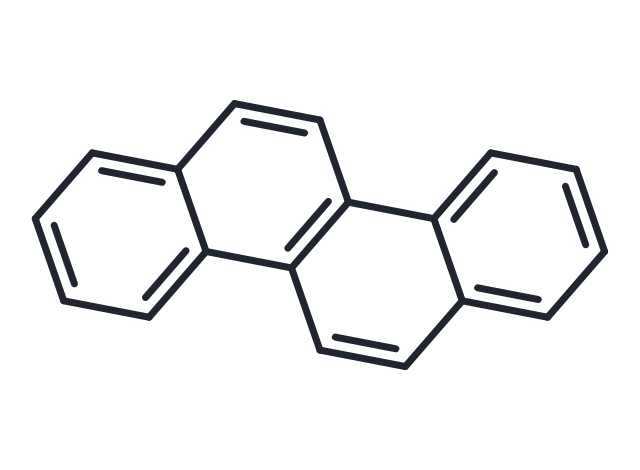
Chrysene

Chrysene

Copy Product Info
🥰Excellent
Purity: 97.04%
Catalog No. T14961Cas No. 218-01-9
Chrysene is a high-molecular-weight polycyclic aromatic hydrocarbon (PAH) with strong persistence and carcinogenicity. It is commonly used for establishing liver cancer models.
Pack SizePriceUSA WarehouseGlobal WarehouseQuantity
500 mg$41In StockIn Stock
Add to Cart
Add to Quotation
In Stock Estimated shipping dateUSA Warehouse[1-2 days] Global Warehouse[5-7 days]
All TargetMol products are for research purposes only and cannot be used for human consumption. We do not provide products or services to individuals. Please comply with the intended use and do not use TargetMol products for any other purpose.
Questions
TargetMol
View More

Batch Information

Select Batch
Purity:97.04%
Appearance:Solid
Color:White
Contact us for more batch information

Resource Download

Product Introduction

Chrysene AI Summary
Chrysene exhibits diverse bioactivities, including competition for the [3H]benzo[a]pyrene-binding site of polycyclic aromatic hydrocarbon binding protein (PBP) from mouse liver, with a Delta Gm value of 17.9. It also acts as a kinetic inhibitor against Trypanosoma cruzi Hypoxanthine Phosphoribosyltransferase (HPRT) with a Ki value of 8980.0 nM. The compound is highly lipophilic, as demonstrated by its octanol-water partition coefficient (LogP) of 5.664, suggesting good absorption in lipid-rich environments and potential bioavailability. Furthermore, Chrysene activates multiple signaling pathways, including the Aryl hydrocarbon Receptor (AhR), the antioxidant response element (ARE), and both the rat and human pregnane X receptor (rPXR and PXR) pathways, highlighting its role as a modulator with varied biological effects..
Note: Summary generated by AI. Data source: ChEMBL
Bioactivity
Description
Chrysene is a high-molecular-weight polycyclic aromatic hydrocarbon (PAH) with strong persistence and carcinogenicity. It is commonly used for establishing liver cancer models.
Disease Modeling Protocol
Liver tumor model
  • Modeling Mechanism:

    Chrysene, a polycyclic aromatic hydrocarbon (PAH) carcinogen, is oxidized in the liver by microsomal mono-oxygenases to form epoxide metabolites (such as K-region epoxide, chrysene 5,6-oxide). These reactive intermediates can bind to hepatocyte DNA to form adducts, inducing gene mutations. Simultaneously, neonatal mouse hepatocytes are in a state of rapid division and are highly sensitive to carcinogens. Furthermore, the low level of epoxide hydrolases in neonatal tissues makes it difficult to rapidly inactivate epoxides, ultimately leading to abnormal hepatocyte proliferation and the formation of liver tumors.

  • Related Products:

    Chrysene (T14961)

  • Modeling Method:

    Experimental Subject:Mice: Newborn Swiss mice aged 0–2 days postnatal (within the first 3 days)

    Dosage and Administration Route:① Core modelling: Chrysene, 100 μg per dose, suspended in polyethylene glycol (PEG) 400, 0.02 ml suspension injected per animal, subcutaneous injection (needle insertion at base of tail, injection site in interscapular region); ② Control treatment: Control group administered equal volume of PEG 400 subcutaneously, with identical timing and frequency to modelling protocol; ③ Housing Management: Following weaning at 21 days of age, males and females housed separately (6 per cage). Fed standard chow (Formulation 86), with free access to water. Bedding comprised a mixture of sawdust and wood shavings. Housing conditions were unmodified (standard laboratory conditions).

    Dosing Frequency and Duration Model:A total of three administrations were conducted on days 0, 1, and 2 post-birth.

  • Validation:

    1. Tumor Incidence: - 70-75 weeks after modeling, the incidence of liver tumors in male mice was significantly increased. In the Chrysene-treated group (Group H), 13 out of 27 surviving male mice developed liver tumors (48.1%), of which 6 had multiple liver tumors. In the control group (Group O), 9 out of 30 male mice developed liver tumors (30%), with only 1 having multiple liver tumors. The difference was statistically significant. 2. Pathological Morphology: - All liver tumors originated from parenchymal cells. Histologically, they ranged from highly differentiated hepatocyte clusters that were difficult to distinguish from normal liver tissue to pleomorphic, invasive, and metastatic tumors. Most tumors were larger than 1 cm in diameter and were visible to the naked eye.

*Precautions:

*References:Grover PL,et,al. The carcinogenicity of polycyclic hydrocarbon epoxides in newborn mice. Br J Cancer. 1975 Feb;31(2):182-8.

Chemical Properties
Molecular Weight228.29
FormulaC18H12
Cas No.218-01-9
SmilesC12=C(C=3C(C=C1)=CC=CC3)C=CC=4C2=CC=CC4
Relative Density.1.274 g/cm3
Storage & Solubility Information
StoragePowder: -20°C for 3 years | In solvent: -80°C for 1 year | Shipping with blue ice/Shipping at ambient temperature.
Solubility Information
DMSO: < 1 mg/mL (insoluble or slightly soluble), Sonication is recommended.

Calculator

  • Molarity Calculator
  • Dilution Calculator
  • Reconstitution Calculator
  • Molecular Weight Calculator

In Vivo Formulation Calculator (Clear solution)

Please enter your animal experiment information in the following box and click Calculate to obtain the stock solution preparation method and in vivo formula preparation method:
TargetMol | Animal experiments For example, if the intended dosage is 10 mg/kg for animals weighing 20 g , with a dosing volume of 100 μL per animal, TargetMol | Animal experiments and a total of 10 animals are to be administered, using a formulation of TargetMol | reagent 10% DMSO+ 40% PEG300+ 5% Tween 80+ 45% Saline/PBS/ddH2O , the resulting working solution concentration would be 2 mg/mL.

Stock Solution Preparation:

Dissolve 2 mg of the compound in 100 μL DMSOTargetMol | reagent to obtain a stock solution at a concentration of 20 mg/mL . If the required concentration exceeds the compound's known solubility, please contact us for technical support before proceeding.

Preparation of the In Vivo Formulation:

1) Add 100 μL of the DMSOTargetMol | reagent stock solution to 400 μL PEG300TargetMol | reagent and mix thoroughly until the solution becomes clear.

2) Add 50 μL Tween 80 and mix well until fully clarified.

3) Add 450 μL Saline,PBS or ddH2OTargetMol | reagent and mix thoroughly until a homogeneous solution is obtained.

This example is provided solely to demonstrate the use of the In Vivo Formulation Calculator and does not constitute a recommended formulation for any specific compound. Please select an appropriate dissolution and formulation strategy based on your experimental model and route of administration.
All co-solvents required for this protocol, includingDMSO, PEG300/PEG400, Tween 80, SBE-β-CD, and Corn oil, are available for purchase on the TargetMol website.
1 Enter information below:
mg/kg
g
μL
2 Enter the in vivo formulation:
% DMSO
%
% Tween 80
% Saline/PBS/ddH2O

Dose Conversion

You can also refer to dose conversion for different animals. More Dose Conversion

Tech Support

Please see Inhibitor Handling Instructions for more frequently ask questions. Topics include: how to prepare stock solutions, how to store products, and cautions on cell-based assays & animal experiments, etc

Keywords

Related Tags: buy Chrysene | purchase Chrysene | Chrysene cost | order Chrysene | Chrysene chemical structure | Chrysene formula | Chrysene molecular weight





