


Shopping Cart
Remove All Your shopping cart is currently empty

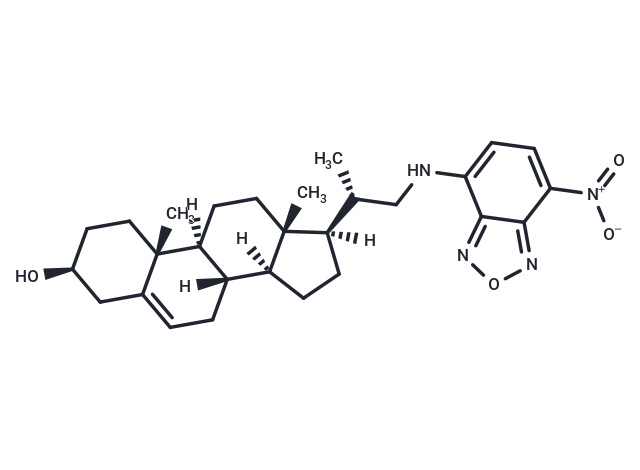
Synonyms: N-(7-nitrobenz-2-oxa-1,3-diazole)-23,24-dinor-5-cholen-22-amine-3beta-ol, Fluoresterol
| Pack Size | Price | USA Stock | Global Stock | Quantity |
|---|---|---|---|---|
| 1 mg | $98 | - | In Stock |
| Description | 22-NBD Cholesterol (Fluoresterol) is a specific fluorescent probe that mimics cholesterol binding properties. It cannot be administered orally and is unable to cross the blood-brain barrier. 22-NBD Cholesterol (Fluoresterol ) specifically binds to cholesterol transport-related proteins such as ABCA1 and ABCG1, and is primarily used in cholesterol metabolism research, particularly for the visualization and quantitative analysis of cholesterol absorption, efflux, intracellular transport efficiency, and reverse cholesterol transport (RCT). The excitation and emission wavelengths of 22-NBD Cholesterol are 472 nm and 540 nm, respectively. Furthermore, 22-NBD Cholesterol can be used to investigate cholesterol metabolism mechanisms in diseases such as hyperlipidemia, atherosclerosis, and non-alcoholic fatty liver disease (NAFLD). |
| In vivo | Method: RAW264.7 macrophages loaded with 22-NBD Cholesterol were intraperitoneally injected into P407-induced hyperlipidemic mice. Blood, liver, bile, and feces were collected 24 hours later, and the fluorescence intensity was measured to evaluate reverse cholesterol transport (RCT). Result: Compared with the control group, P407 promoted the accumulation of labeled cholesterol in the liver. EEDL treatment significantly reduced the levels of 22-NBD Cholesterol in the mouse liver and serum, but had no significant effect on its content in bile. Furthermore, P407 decreased fecal fluorescence intensity, whereas EEDL significantly increased bile acid secretion in feces, indicating that EEDL promotes macrophage-dependent RCT in vivo [1]. |
| Synonyms | N-(7-nitrobenz-2-oxa-1,3-diazole)-23,24-dinor-5-cholen-22-amine-3beta-ol, Fluoresterol |
| Molecular Weight | 494.63 |
| Formula | C28H38N4O4 |
| Cas No. | 78949-95-8 |
| Smiles | C[C@@]12[C@](CC[C@]2([H])[C@H](C)CNC3=CC=C([N+]([O-])=O)C4=NON=C34)([H])[C@@]5([H])[C@@](CC1)([H])[C@@]6(C(C[C@H](CC6)O)=CC5)C |
| Storage | Powder: -20°C for 3 years | In solvent: -80°C for 1 year Shipping with blue ice/Shipping at ambient temperature. | |||||||||||||||
| Solubility Information | DMSO: 3.34 mg/mL (6.75 mM), Sonication is recommended. | |||||||||||||||
Solution Preparation Table | ||||||||||||||||
DMSO
Note : The dilution table applies only to solid products. For liquid products, please calculate the stock solution based on the stated concentration and/or density. | ||||||||||||||||
 For example, if the intended dosage is 10 mg/kg for animals weighing 20 g , with a dosing volume of 100 μL per animal, and a total of 10 animals are to be administered, using a formulation of
  10% DMSO+ 40% PEG300+ 5% Tween 80+ 45% Saline/PBS/ddH2O , the resulting working solution concentration would be 2 mg/mL.
Dissolve 2 mg of the compound in 100 μL DMSO to obtain a stock solution at a concentration of 20 mg/mL . If the required concentration exceeds the compound's known solubility, please contact us for technical support before proceeding.
1) Add 100 μL of the DMSO stock solution to 400 µL PEG300 and mix thoroughly until the solution becomes clear.
2) Add 50 µL Tween 80 and mix well until fully clarified.
3) Add 450 µL Saline,PBS or ddH2O and mix thoroughly until a homogeneous solution is obtained.
| Size | Quantity | Unit Price | Amount | Operation |
|---|
 Feedback
 Hello! How can I help you today?
Copyright © 2015-2026 TargetMol Chemicals Inc. All Rights Reserved.
