


Shopping Cart
Remove All Your shopping cart is currently empty

Synonyms:
| Pack Size | Price | USA Stock | Global Stock | Quantity |
|---|---|---|---|---|
| 10 mg | Inquiry | 8-10 weeks | 8-10 weeks | |
| 50 mg | Inquiry | 8-10 weeks | 8-10 weeks |
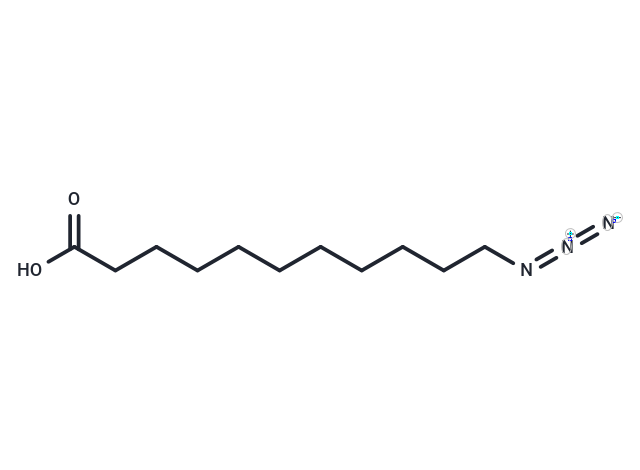
| Description | 11-Azidoundecanoic acid, a click chemistry reagent with an azide group, serves as a hydrophobic bioconjugation linker amenable to further modification via Staudinger ligation or Click chemistry. This compound is recognized as a substrate by lipoic acid ligase (LpIA) for labeling purposes [1] [2]. Additionally, 11-Azidoundecanoic acid can participate in copper-catalyzed azide-alkyne cycloaddition (CuAAc) with alkyne-bearing molecules and engage in strain-promoted alkyne-azide cycloaddition (SPAAC) with molecules featuring DBCO or BCN groups. |
| In vitro | The microbial lipoic acid ligase (LplA) specifically attaches an alkyl azide to an engineered LplA acceptor peptide (LAP), which then selectively reacts with cyclooctyne conjugates, linking various probes. This method facilitates broad application in biochemical and imaging analyses of cell surface proteins, employing small fluorophores coupled through a concise peptide tag. |
| Molecular Weight | 227.308 |
| Formula | C11H21N3O2 |
| Cas No. | 118162-45-1 |
| Smiles | OC(=O)CCCCCCCCCCN=[N+]=[N-] |
| Storage | Powder: -20°C for 3 years | In solvent: -80°C for 1 year Shipping with blue ice/Shipping at ambient temperature. |
 For example, if the intended dosage is 10 mg/kg for animals weighing 20 g , with a dosing volume of 100 μL per animal, and a total of 10 animals are to be administered, using a formulation of
  10% DMSO+ 40% PEG300+ 5% Tween 80+ 45% Saline/PBS/ddH2O , the resulting working solution concentration would be 2 mg/mL.
Dissolve 2 mg of the compound in 100 μL DMSO to obtain a stock solution at a concentration of 20 mg/mL . If the required concentration exceeds the compound's known solubility, please contact us for technical support before proceeding.
1) Add 100 μL of the DMSO stock solution to 400 µL PEG300 and mix thoroughly until the solution becomes clear.
2) Add 50 µL Tween 80 and mix well until fully clarified.
3) Add 450 µL Saline,PBS or ddH2O and mix thoroughly until a homogeneous solution is obtained.
| Size | Quantity | Unit Price | Amount | Operation |
|---|
 Feedback
 Hello! How can I help you today?
Copyright © 2015-2026 TargetMol Chemicals Inc. All Rights Reserved.
