

Shopping Cart
- Remove All
 Your shopping cart is currently empty
FGFR3 Protein, Human, Recombinant (alpha IIIb, His) is expressed in HEK293 mammalian cells with His tag. The predicted molecular weight is 40 kDa and the accession number is P22607-2.
| Pack Size | Price | Availability | Quantity |
|---|---|---|---|
| 200 μg | $583 | In Stock |
| Biological Activity | Activity testing is in progress. It is theoretically active, but we cannot guarantee it. If you require protein activity, we recommend choosing the eukaryotic expression version first. |
| Description | FGFR3 Protein, Human, Recombinant (alpha IIIb, His) is expressed in HEK293 mammalian cells with His tag. The predicted molecular weight is 40 kDa and the accession number is P22607-2. |
| Species | Human |
| Expression System | HEK293 Cells |
| Tag | C-His |
| Accession Number | P22607-2 |
| Synonyms | JTK4,HSFGFR3EX,fibroblast growth factor receptor 3,FGFR3 α(IIIb),CEK2,CD333,ACH |
| Construction | A DNA sequence encoding the human FGFR3(alpha(IIIb)) (NP_001156685.1) (Met1-Gly377) was expressed with a polyhistidine tag at the C-terminus. Predicted N terminal: Glu 23 |
| Protein Purity | > 95 % as determined by SDS-PAGE. 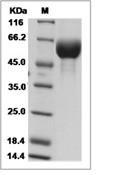 |
| Molecular Weight | 40 kDa (predicted); 64.5 kDa (reducing conditions) |
| Endotoxin | < 1.0 EU/μg of the protein as determined by the LAL method. |
| Formulation | Lyophilized from a solution filtered through a 0.22 μm filter, containing PBS, pH 7.4. Typically, a mixture containing 5% to 8% trehalose, mannitol, and 0.01% Tween 80 is incorporated as a protective agent before lyophilization. |
| Reconstitution | A Certificate of Analysis (CoA) containing reconstitution instructions is included with the products. Please refer to the CoA for detailed information. |
| Stability & Storage | It is recommended to store recombinant proteins at -20°C to -80°C for future use. Lyophilized powders can be stably stored for over 12 months, while liquid products can be stored for 6-12 months at -80°C. For reconstituted protein solutions, the solution can be stored at -20°C to -80°C for at least 3 months. Please avoid multiple freeze-thaw cycles and store products in aliquots. |
| Shipping | In general, Lyophilized powders are shipping with blue ice. |
| Research Background | FGFR3, also known as CD333, is a member of the fibroblast growth factor receptor (FGFR) family, with its amino acid sequence being highly conserved between members and among divergent species. FGFR family members differ from one another in their ligand affinities and tissue distribution. FGFRs are transmembrane catalytic receptors that have intracellular tyrosine kinase activity. Mutations in FGFR genes are the cause of several human developmental disorders characterized by skeletal abnormalities such as achondroplasia, and upregulation of FGFR expression may lead to cell transformation and cancer. FGFR3, a full-length representative protein would consist of an extracellular region, composed of three immunoglobulin-like domains, a single hydrophobic membrane-spanning segment and a cytoplasmic tyrosine kinase domain. The extracellular portion of FGFR3 interacts with fibroblast growth factors, setting in motion a cascade of downstream signals, ultimately influencing mitogenesis and differentiation. FGFR3 binds acidic and basic fibroblast growth hormone and plays a role in bone development and maintenance. Mutations in FGFR3 gene lead to craniosynostosis and multiple types of skeletal dysplasia. Three alternatively spliced transcript variants that encode different protein isoforms have been described. CD333 is the receptor for acidic and basic fibroblast growth factors.Cancer ImmunotherapyImmune CheckpointImmunotherapyTargeted Therapy |
 Feedback
 Hello! How can I help you today?

Copyright © 2015-2025 TargetMol Chemicals Inc. All Rights Reserved.