


Shopping Cart
Remove All Your shopping cart is currently empty

Synonyms:
| Pack Size | Price | USA Stock | Global Stock | Quantity |
|---|---|---|---|---|
| 1 mg | $74 | Inquiry | Inquiry | |
| 5 mg | $179 | Inquiry | Inquiry | |
| 10 mg | $289 | Inquiry | Inquiry | |
| 25 mg | $569 | Inquiry | Inquiry | |
| 50 mg | $892 | Inquiry | Inquiry | |
| 100 mg | $1,490 | Inquiry | Inquiry |
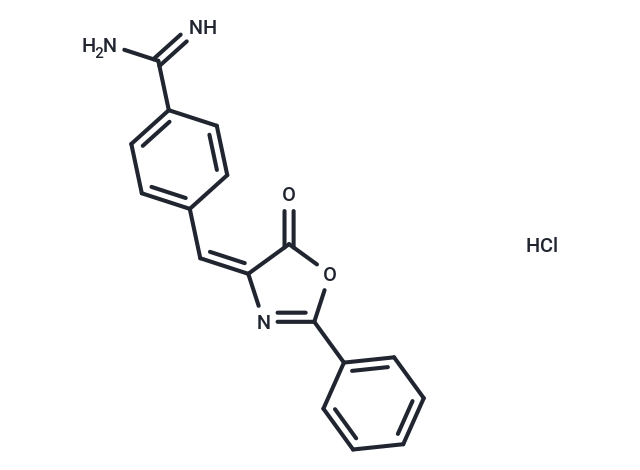
| Description | UK122 hydrochloride is a potent and selective inhibitor of urokinase-type plasminogen activator (uPA), exhibiting an IC50 value of 0.2 μM. UK122 hydrochloride demonstrates minimal inhibitory activity against tissue-type plasminogen activator (tPA), plasmin, thrombin, and trypsin, with IC50 values greater than 100 μM for all. As a 4-oxazolidinone analog, UK122 hydrochloride inhibits cancer cell migration and invasion. The selectivity profile of UK122 hydrochloride supports the application of UK122 hydrochloride in research focused on protease biology, extracellular matrix remodeling, tumor cell invasion, and metastatic mechanisms. |
| In vitro | Method: UK122 parent compound was tested in an indirect cell-free human urokinase-type plasminogen activator assay based on uPA-mediated plasminogen activation and chromogenic-substrate cleavage. Tissue-type plasminogen activator, plasmin, thrombin and trypsin were included as a selectivity panel. Rresult: UK122 inhibited human uPA with an IC50 of 0.2 μM. The IC50 values against tissue-type plasminogen activator, plasmin, thrombin and trypsin were all greater than 100 μM, indicating more than 500-fold biochemical selectivity for uPA.[1] Method: CFPAC-1 human pancreatic adenocarcinoma cells were exposed to UK122 parent compound. Cell growth and morphology were assessed after treatment for up to 48 h; fibronectin-associated radial migration and Matrigel-coated Boyden-chamber invasion were evaluated after 24 h. Migration and invasion experiments included treatment at 100 μM. Rresult: UK122 showed a cell-growth IC50 greater than 100 μM and did not markedly alter cellular morphology at 100 μM. At 100 μM, it inhibited CFPAC-1 cell migration by approximately 80% and Matrigel invasion by approximately 68%.[1] Method: Stable endoglin-knockdown HTR-8/SVneo human extravillous trophoblast cells, which exhibited increased uPA expression and motility, were treated with 100 μM UK122 and assessed in a cell-migration assay. Rresult: Treatment with 100 μM UK122 markedly inhibited the increased migration of endoglin-knockdown HTR-8/SVneo cells, supporting the involvement of uPA activity in the enhanced motile phenotype. [2] Method: Mouse TSC2-null tumor cells were serum-starved in DMEM containing 0.1% BSA for 24 h and then exposed to 20 nM rapamycin or vehicle for an additional 18 h. Cells were detached, washed and resuspended in medium with or without UK122 before transwell migration and Matrigel-invasion assays. Each condition included three wells and three microscopic fields per well. Rresult: UK122 abolished the rapamycin-induced increases in migration and invasion of TSC2-null tumor cells, supporting dependence of the rapamycin-enhanced invasive phenotype on uPA catalytic activity.[3] |
| In vivo | Method: Eight-week-old male C57BL/6J mice received 2% dextran sulfate sodium in drinking water for 7 days to induce colitis. UK122 was dissolved in DMSO and saline and administered intraperitoneally at 2 or 4 mg/kg once daily from day 1 to day 7; vehicle controls were included. Eighteen mice were used per treatment group and animals were sacrificed on day 8. Rresult: UK122 dose-dependently reduced colitis severity. At 4 mg/kg, the disease-activity index decreased from 6.00±0.40 to 3.21±0.50 (p=0.0008), and the histological score decreased from 18.21±2.91 to 9.00±1.81 (p=0.0157). Colorectal RANTES decreased from 111.64±35.80 to 25.49±3.86 (p=0.0143).[4] |
| Molecular Weight | 327.77 |
| Formula | C17H14ClN3O2 |
| Smiles | O=C(O1)/C(N=C1C2=CC=CC=C2)=C\C3=CC=C(C(N)=N)C=C3.Cl |
| Relative Density. | no data available |
| Storage | Powder: -20°C for 3 years | In solvent: -80°C for 1 year Shipping with blue ice/Shipping at ambient temperature. |
 For example, if the intended dosage is 10 mg/kg for animals weighing 20 g , with a dosing volume of 100 μL per animal, and a total of 10 animals are to be administered, using a formulation of
  10% DMSO+ 40% PEG300+ 5% Tween 80+ 45% Saline/PBS/ddH2O , the resulting working solution concentration would be 2 mg/mL.
Dissolve 2 mg of the compound in 100 μL DMSO to obtain a stock solution at a concentration of 20 mg/mL . If the required concentration exceeds the compound's known solubility, please contact us for technical support before proceeding.
1) Add 100 μL of the DMSO stock solution to 400 µL PEG300 and mix thoroughly until the solution becomes clear.
2) Add 50 µL Tween 80 and mix well until fully clarified.
3) Add 450 µL Saline,PBS or ddH2O and mix thoroughly until a homogeneous solution is obtained.
| Size | Quantity | Unit Price | Amount | Operation |
|---|
 Feedback
 Hello! How can I help you today?
Copyright © 2015-2026 TargetMol Chemicals Inc. All Rights Reserved.
