


Shopping Cart
Remove All Your shopping cart is currently empty

Synonyms: 3,4-Dihydroxybenzeneacrylic acid
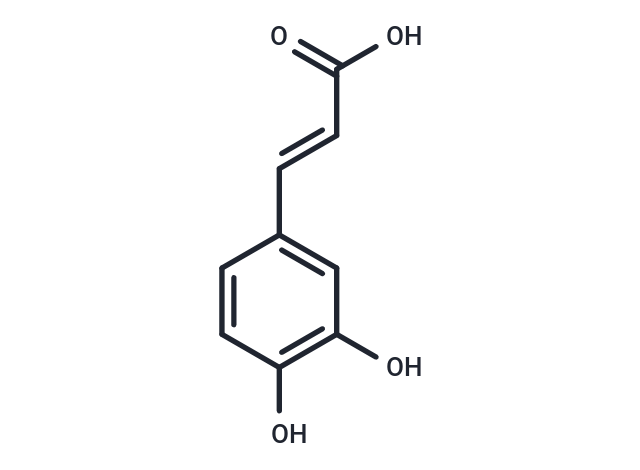
| Pack Size | Price | USA Stock | Global Stock | Quantity |
|---|---|---|---|---|
| 25 mg | $30 | - | In Stock | |
| 50 mg | $37 | - | In Stock | |
| 100 mg | $54 | - | In Stock | |
| 500 mg | $128 | - | In Stock | |
| 1 g | $189 | - | In Stock | |
| 1 mL x 10 mM (in DMSO) | $59 | - | In Stock |
| Description | Trans-caffeic acid (3,4-Dihydroxybenzeneacrylic acid) can be used as a highly sensitive fluorescent probe for the detection of laccase in food and can also stimulate the growth of germ tissue. |
| In vitro | Trans-caffeic acid exhibited antiproliferative effects in human breast cancer cell lines MDA-MB-231 and MCF-7. After treatment with 5, 10, 25, 50, and 100 μM for 24, 48, and 72 hours, MTT assays showed time- and dose-dependent inhibition. At 50 μM for 48 hours, Trans-caffeic acid significantly induced cell cycle arrest and apoptosis, accompanied by elevated ROS levels and reduced mitochondrial membrane potential, suggesting involvement of oxidative stress and mitochondrial pathways[1]. |
| In vivo | In BALB/c nude mice bearing MDA-MB-231 xenograft tumors, Trans-caffeic acid was administered intraperitoneally at 25 mg/kg once daily for 21 days. The treatment significantly reduced tumor volume compared to control without observable toxicity. Tumor tissues showed increased Bax and decreased Bcl-2 expression, indicating mitochondrial pathway–mediated apoptosis[1]. |
| Synonyms | 3,4-Dihydroxybenzeneacrylic acid |
| Molecular Weight | 180.16 |
| Formula | C9H8O4 |
| Cas No. | 501-16-6 |
| Smiles | C(=C/C(O)=O)\C1=CC(O)=C(O)C=C1 |
| Relative Density. | 1.31g/cm3 |
| Storage | Powder: -20°C for 3 years | In solvent: -80°C for 1 year Shipping with blue ice/Shipping at ambient temperature. | |||||||||||||||||||||||||||||||||||
| Solubility Information | DMSO: 80 mg/mL (444.05 mM), Sonication is recommended. | |||||||||||||||||||||||||||||||||||
Solution Preparation Table | ||||||||||||||||||||||||||||||||||||
DMSO
Note : The dilution table applies only to solid products. For liquid products, please calculate the stock solution based on the stated concentration and/or density. | ||||||||||||||||||||||||||||||||||||
 For example, if the intended dosage is 10 mg/kg for animals weighing 20 g , with a dosing volume of 100 μL per animal, and a total of 10 animals are to be administered, using a formulation of
  10% DMSO+ 40% PEG300+ 5% Tween 80+ 45% Saline/PBS/ddH2O , the resulting working solution concentration would be 2 mg/mL.
Dissolve 2 mg of the compound in 100 μL DMSO to obtain a stock solution at a concentration of 20 mg/mL . If the required concentration exceeds the compound's known solubility, please contact us for technical support before proceeding.
1) Add 100 μL of the DMSO stock solution to 400 µL PEG300 and mix thoroughly until the solution becomes clear.
2) Add 50 µL Tween 80 and mix well until fully clarified.
3) Add 450 µL Saline,PBS or ddH2O and mix thoroughly until a homogeneous solution is obtained.
| Size | Quantity | Unit Price | Amount | Operation |
|---|
 Feedback
 Hello! How can I help you today?
Copyright © 2015-2026 TargetMol Chemicals Inc. All Rights Reserved.
