


Shopping Cart
Remove All Your shopping cart is currently empty

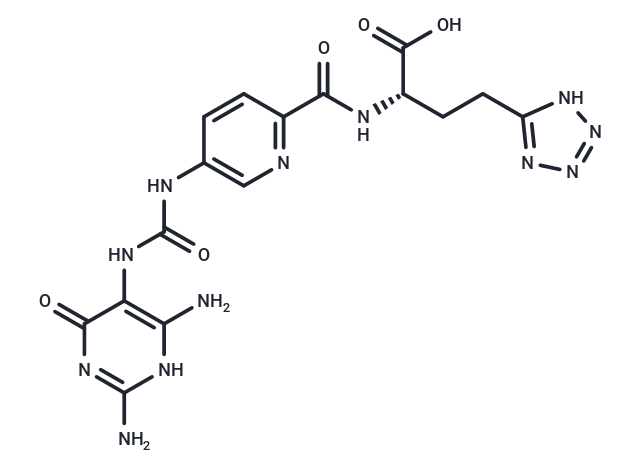
Synonyms: TH-9028
| Pack Size | Price | USA Stock | Global Stock | Quantity |
|---|---|---|---|---|
| 1 mg | $148 | - | In Stock | |
| 5 mg | $373 | - | In Stock | |
| 10 mg | $588 | - | In Stock | |
| 25 mg | $1,190 | - | In Stock | |
| 50 mg | $1,890 | - | In Stock | |
| 100 mg | $2,970 | - | In Stock |
| Description | TH9028 is an inhibitor targeting MTHFD1, MTHFD2, and MTHFD2L, with IC50 values against the human-derived targets of 0.5 nM (MTHFD1), 11 nM (MTHFD2), and 27 nM (MTHFD2L), respectively. This compound binds to the substrate-binding region of the target enzymes, forming hydrogen bonds and other interactions with key amino acid residues, while also inducing conformational changes in the loop 1 region of the enzyme. Functionally, TH9028 slows down the progression of replication forks, induces replication stress, causes cell cycle arrest at the S phase, promotes apoptosis, inhibits thymidine synthesis, and leads to the misincorporation of uracil into DNA. In acute myeloid leukemia and T-ALL cells, TH9028 exhibits antiproliferative activity, while its effects on non-transformed cells are relatively weak. Therefore, TH9028 can be used in research related to acute myeloid leukemia. |
| Targets & IC50 | MTHFD2 (human):7.97 nM, MTHFD1:0.5 nM, MTHFD2:11 nM, MTHFD2L:27 nM |
| In vitro | Method: Human acute myeloid leukemia cells were treated with TH9028. Biochemical assays were used to determine its inhibitory activity against MTHFD2 (IC50). Cellular effects were assessed by measuring replication fork speed, replication stress, cell cycle arrest, and apoptosis markers. Result: TH9028 exhibited potent inhibition against MTHFD2 with an IC50 of 11 nM. It also inhibited MTHFD1 and MTHFD2L with IC50 values of 0.5 nM and 27 nM, respectively, indicating non-selective inhibition. TH9028 treatment led to reduced replication fork speed, increased replication stress, S-phase arrest, and apoptosis in acute myeloid leukemia cells [1]. Method: Human acute myeloid leukemia HL-60 cells, human acute T-lymphoblastic leukemia Jurkat cells, and non-tumorigenic lymphoblastoid cell lines LCL-534 and LCL-889 were treated with TH9028 for 96 h. Cell viability assays were used to evaluate anti-proliferative effects. Result: TH9028 exhibited potent anti-proliferative efficacy in AML cells and Jurkat cells, but had a reduced effect on the viability of non-tumorigenic LCL cells, demonstrating selective toxicity towards MTHFD2-expressing cancer cells [2]. Method: Human acute myeloid leukemia HL-60 cells were treated with TH9028 (50 nM) for 96 h. Apoptosis was detected using Annexin-V/PI double staining combined with flow cytometry. Result: TH9028 significantly induced late apoptosis (Annexin-V and PI double positive) in HL-60 cells [2]. Method: Human acute myeloid leukemia HL-60 cells and THP-1 cells were treated with TH9028 (50 nM) for 24 h. Replication fork speed was measured using a DNA fiber assay. Result: TH9028 treatment significantly reduced replication fork speed in HL-60 and THP-1 cells, indicating the induction of replication stress [2]. |
| In vivo | Method: An acute myeloid leukemia xenograft mouse model was used. TH9028 was administered to evaluate tumor growth inhibition and related pharmacodynamic endpoints. Result: TH9028 inhibited tumor growth in an acute myeloid leukemia mouse model and exerted its antitumor effect by inducing thymidine depletion and replication stress [1]. Method: NOG mice bearing HL-60 xenograft tumors established via tail vein injection were treated with TH9028 (30 mg/kg, twice daily). Low-folate diet and standard diet groups were included. Overall survival of mice was assessed using Kaplan-Meier survival curves. Result: Under low-folate diet conditions, treatment with TH9028 (30 mg/kg) significantly prolonged the overall survival of tumor-bearing mice compared with the vehicle control group (P = 0.001) [2]. |
| Synonyms | TH-9028 |
| Molecular Weight | 458.39 |
| Formula | C16H18N12O5 |
| Cas No. | 2379556-15-5 |
| Smiles | N(C(NC1=C(N)NC(N)=NC1=O)=O)C=2C=CC(C(N[C@@H](CCC=3NN=NN3)C(O)=O)=O)=NC2 |
| Storage | Powder: -20°C for 3 years | In solvent: -80°C for 1 year Shipping with blue ice/Shipping at ambient temperature. |
 For example, if the intended dosage is 10 mg/kg for animals weighing 20 g , with a dosing volume of 100 μL per animal, and a total of 10 animals are to be administered, using a formulation of
  10% DMSO+ 40% PEG300+ 5% Tween 80+ 45% Saline/PBS/ddH2O , the resulting working solution concentration would be 2 mg/mL.
Dissolve 2 mg of the compound in 100 μL DMSO to obtain a stock solution at a concentration of 20 mg/mL . If the required concentration exceeds the compound's known solubility, please contact us for technical support before proceeding.
1) Add 100 μL of the DMSO stock solution to 400 µL PEG300 and mix thoroughly until the solution becomes clear.
2) Add 50 µL Tween 80 and mix well until fully clarified.
3) Add 450 µL Saline,PBS or ddH2O and mix thoroughly until a homogeneous solution is obtained.
| Size | Quantity | Unit Price | Amount | Operation |
|---|
 Feedback
 Hello! How can I help you today?
Copyright © 2015-2026 TargetMol Chemicals Inc. All Rights Reserved.
