


Shopping Cart
Remove All Your shopping cart is currently empty

Synonyms:
| Pack Size | Price | USA Stock | Global Stock | Quantity |
|---|---|---|---|---|
| 10 mg | Inquiry | Inquiry | Inquiry | |
| 50 mg | Inquiry | Inquiry | Inquiry |
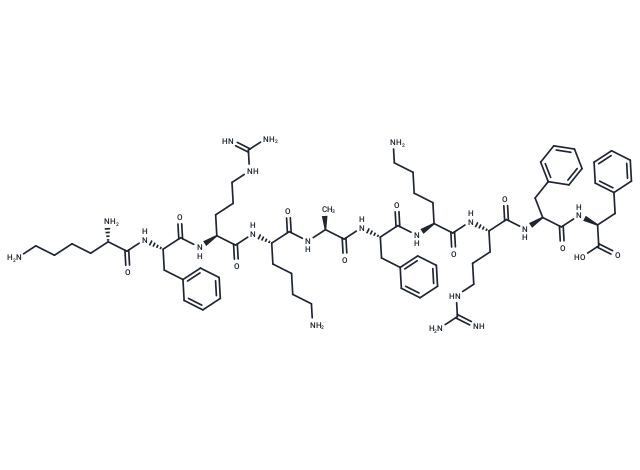
| Description | RP-182 is a synthetic immunomodulatory peptide that exerts antitumor effects by targeting the mannose receptor CD206 on the surface of tumor-associated macrophages (TAM) with a binding affinity (Kd) of 8 μM. It induces a conformational change in the CD206 receptor, which activates NF-κB signaling and phagocytosis in TAM with high CD206 expression. RP-182 serves a dual function by activating the canonical NF-κB signaling pathway, leading to TNFα secretion and autocrine activation of TNF receptor 1 (TNFR1), which subsequently results in caspase 8 activation and apoptosis. This compound is studied in the contexts of pancreatic cancer and melanoma. |
| In vitro | RP-182 is a compound that enhances its cytotoxic effect against CD206 high M2-like macrophages through the MyD88/NF-κB pathway, with an IC50 of 17.6 μM, when used in concentrations ranging from 1 nM to 1 mM over 48 hours. Additionally, at a concentration of 0.1 μM for 2 to 24 hours, RP-182 internalizes CD206, activates NF-κB, and increases IRF7 phosphorylation in M2 bone marrow-derived macrophages polarized with IL-4. Furthermore, RP-182 at concentrations of 3-30 μM for 24 hours raises the levels of inflammatory factors secreted by macrophages, indicating an immune reprogramming effect. |
| In vivo | Administered intraperitoneally at 20 mg/kg every other day for 2 weeks, RP-182 significantly inhibits tumor growth in B16 melanoma and KP16 pancreatic models while enhancing immunogenicity in mice. Moreover, a daily intraperitoneal injection of RP-182 at 20 mg/kg over 18 days markedly alleviates pulmonary fibrosis in mice. |
| Molecular Weight | 1374.68 |
| Formula | C69H103N19O11 |
| Cas No. | 1895883-60-9 |
| Smiles | [C@@H](CC1=CC=CC=C1)(NC([C@@H](NC([C@@H](NC([C@H](CC2=CC=CC=C2)NC([C@@H](NC([C@@H](NC([C@@H](NC([C@H](CC3=CC=CC=C3)NC([C@H](CCCCN)N)=O)=O)CCCNC(=N)N)=O)CCCCN)=O)C)=O)=O)CCCCN)=O)CCCNC(=N)N)=O)C(N[C@@H](CC4=CC=CC=C4)C(O)=O)=O |
| Sequence | Lys-Phe-Arg-Lys-Ala-Phe-Lys-Arg-Phe-Phe |
| Sequence Short | KFRKAFKRFF |
| Storage | Keep away from moisture Powder: -20°C for 3 years | In solvent: -80°C for 1 year Shipping with blue ice/Shipping at ambient temperature. |
 For example, if the intended dosage is 10 mg/kg for animals weighing 20 g , with a dosing volume of 100 μL per animal, and a total of 10 animals are to be administered, using a formulation of
  10% DMSO+ 40% PEG300+ 5% Tween 80+ 45% Saline/PBS/ddH2O , the resulting working solution concentration would be 2 mg/mL.
Dissolve 2 mg of the compound in 100 μL DMSO to obtain a stock solution at a concentration of 20 mg/mL . If the required concentration exceeds the compound's known solubility, please contact us for technical support before proceeding.
1) Add 100 μL of the DMSO stock solution to 400 µL PEG300 and mix thoroughly until the solution becomes clear.
2) Add 50 µL Tween 80 and mix well until fully clarified.
3) Add 450 µL Saline,PBS or ddH2O and mix thoroughly until a homogeneous solution is obtained.
| Size | Quantity | Unit Price | Amount | Operation |
|---|
 Feedback
 Hello! How can I help you today?
Copyright © 2015-2026 TargetMol Chemicals Inc. All Rights Reserved.
