


Shopping Cart
Remove All Your shopping cart is currently empty

Synonyms:
| Pack Size | Price | USA Stock | Global Stock | Quantity |
|---|---|---|---|---|
| 1 mg | $39 | - | In Stock | |
| 5 mg | $112 | - | In Stock | |
| 10 mg | $165 | - | In Stock | |
| 25 mg | $275 | - | In Stock | |
| 50 mg | $392 | - | In Stock | |
| 100 mg | $533 | - | In Stock |
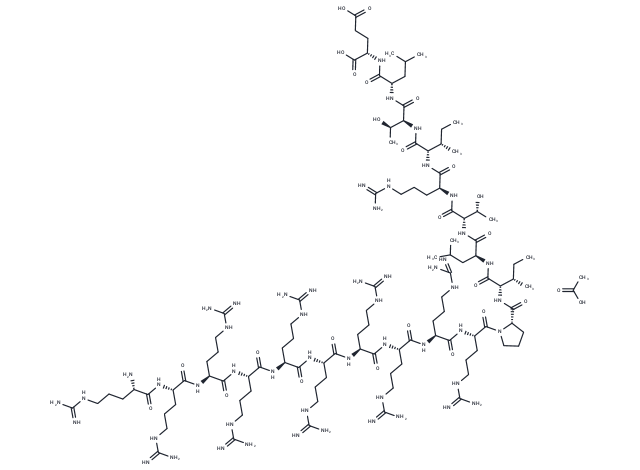
| Description | ReACp53 acetate could inhibit p53 amyloid formation and rescue p53 function in cancer cell lines. |
| In vitro | ReACp53 acetate penetrates into HGSOC primary cancer cells and converts mutant p53 from a punctate state into soluble WT-like p53. ReACp53 acetate also induces cancer cell death, cell cycle arrest and results in p53 degradation. ReACp53 acetate specifically affects cell viability and proliferation of cancer cells bearing mutant p53 but not wild type when grown as organoids[1]. |
| In vivo | Only mutant p53-bearing tumors in the ReACp53 acetate-treated mice cohorts are 80-90% smaller in weight than the control cohort, confirming the ability of ReACp53 acetate to limit tumor proliferation and shrink tumors. A significant reduction of Ki67 positive cells is evident in ReACp53 acetate-treated OVCAR3 xenografts, indicative of a reduced proliferative index. Similar results are observed in the minimal residual disease model. In the paradigm, administration of ReACp53 acetate results in a significant increase in p21 and MDM2 transcription in OVCAR3 but not MCF7 xenografts. A significantly increased population is also found in G0/G1 phase, supporting proliferative arrest upon ReACp53 acetate administration in vivo[1]. |
| Molecular Weight | 2677.18 |
| Formula | C110H210N52O26 |
| Smiles | CC[C@@H]([C@H](NC([C@@H]1CCCN1C([C@@H](NC([C@@H](NC([C@@H](NC([C@@H](NC([C@@H](NC([C@@H](NC([C@@H](NC([C@@H](NC([C@@H](NC([C@@H](N)CCCNC(N)=N)=O)CCCNC(N)=N)=O)CCCNC(N)=N)=O)CCCNC(N)=N)=O)CCCNC(N)=N)=O)CCCNC(N)=N)=O)CCCNC(N)=N)=O)CCCNC(N)=N)=O)CCCNC(N)=N)=O)CCCNC(N)=N)=O)=O)C(N[C@H](C(N[C@H](C(N[C@H](C(N[C@H](C(N[C@H](C(N[C@H](C(N[C@H](C(O)=O)CCC(O)=O)=O)CC(C)C)=O)[C@H](O)C)=O)[C@H](CC)C)=O)CCCNC(N)=N)=O)[C@H](O)C)=O)CC(C)C)=O)C.CC(O)=O |
| Relative Density. | no data available |
| Sequence | H-Arg-Arg-Arg-Arg-Arg-Arg-Arg-Arg-Arg-Arg-Pro-Ile-Leu-Thr-Arg-Ile-Thr-Leu-Glu-OH |
| Sequence Short | RRRRRRRRRRPILTRITLE |
| Storage | Store at low temperature,Keep away from moisture Powder: -20°C for 3 years | In solvent: -80°C for 1 year Shipping with blue ice/Shipping at ambient temperature. | ||||||||||
| Solubility Information | H2O: 9 mg/mL (3.36 mM), Sonication is recommended.  | ||||||||||
Solution Preparation Table | |||||||||||
H2O
Note : The dilution table applies only to solid products. For liquid products, please calculate the stock solution based on the stated concentration and/or density. | |||||||||||
 For example, if the intended dosage is 10 mg/kg for animals weighing 20 g , with a dosing volume of 100 μL per animal, and a total of 10 animals are to be administered, using a formulation of
  10% DMSO+ 40% PEG300+ 5% Tween 80+ 45% Saline/PBS/ddH2O , the resulting working solution concentration would be 2 mg/mL.
Dissolve 2 mg of the compound in 100 μL DMSO to obtain a stock solution at a concentration of 20 mg/mL . If the required concentration exceeds the compound's known solubility, please contact us for technical support before proceeding.
1) Add 100 μL of the DMSO stock solution to 400 µL PEG300 and mix thoroughly until the solution becomes clear.
2) Add 50 µL Tween 80 and mix well until fully clarified.
3) Add 450 µL Saline,PBS or ddH2O and mix thoroughly until a homogeneous solution is obtained.
| Size | Quantity | Unit Price | Amount | Operation |
|---|
 Feedback
 Hello! How can I help you today?
Copyright © 2015-2026 TargetMol Chemicals Inc. All Rights Reserved.
