


Shopping Cart
Remove All Your shopping cart is currently empty
Synonyms: tumor necrosis factor (ligand) superfamily, member 11, Trance, RANKL, OPGL, OPG, ODF, Ly109l
| Pack Size | Price | USA Stock | Global Stock | Quantity |
|---|---|---|---|---|
| 5 µg | $48 | - | In Stock | |
| 10 µg | $76 | 7-10 days | 7-10 days | |
| 20 µg | $122 | 7-10 days | 7-10 days | |
| 50 µg | $235 | In Stock | In Stock | |
| 100 µg | $421 | 7-10 days | 7-10 days | |
| 200 µg | $793 | 7-10 days | 7-10 days | |
| 500 µg | $1,890 | 7-10 days | 7-10 days |
| Bioactivity | Immobilized mouse Fc-TNFSF11 at 10 μg/ml (100 μl/well) can bind biotinylated human TNFRSF11B-His , The EC50 of biotinylated human TNFRSF11B-His is 0.07-0.17 μg/ml. |
| Description | RANKL/TNFSF11/CD254 Protein, Mouse, Recombinant (hFc) is expressed in HEK293 mammalian cells with hFc tag. The predicted molecular weight is 56 kDa and the accession number is AAC40113.1. |
| Species | Mouse |
| Expression System | HEK293 Cells |
| Tag | N-hFc |
| Accession Number | AAC40113.1 |
| Construction | A DNA sequence encoding the extracellular domain of mouse TNFSF11 (AAC40113.1) (Arg 72-Asp 316) was fused with the Fc region of human IgG1 at the N-terminus. Predicted N terminal: Glu |
| Protein Purity | > 87 % as determined by SDS-PAGE 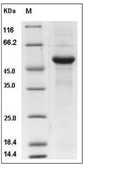 |
| Endotoxin | < 1.0 EU/μg of the protein as determined by the LAL method. |
| Formulation | Lyophilized from a solution filtered through a 0.22 μm filter, containing PBS, pH 7.4. Typically, a mixture containing 5% to 8% trehalose, mannitol, and 0.01% Tween 80 is incorporated as a protective agent before lyophilization. |
| Reconstitution | Reconstituted with sterile deionized water to 0.25 mg/mL. Reconstitution conditions may vary depending on the lot. |
| Synonyms | tumor necrosis factor (ligand) superfamily, member 11, Trance, RANKL, OPGL, OPG, ODF, Ly109l |
| Research Background | Tumor necrosis factor ligand superfamily member 11, also known as Receptor activator of nuclear factor kappa-B ligand, Osteoprotegerin ligand, TNFSF11, RANKL, TRANCE, OPGL and CD254, is a single-pass type II membrane protein that belongs to the tumor necrosis factor family. The receptor activator of nuclear factor-kappaB ligand (RANKL), its cognate receptor RANK, and its natural decoy receptor osteoprotegerin have been identified as the final effector molecules of osteoclastic bone resorption. RANK and RANKL are key regulators of bone remodeling and regulate T cell/dendritic cell communications, and lymph node formation. Moreover, RANKL and RANK are expressed in mammary gland epithelial cells and control the development of a lactating mammary gland during pregnancy. Genetically, RANKL and RANK are essential for the development and activation of osteoclasts and bone loss in response to virtually all triggers tested. Inhibition of RANKL function via the natural decoy receptor osteoprotegerin (OPG, TNFRSF11B) prevents bone loss in postmenopausal osteoporosis and cancer metastases. Importantly, RANKL appears to be the pathogenetic principle that causes bone and cartilage destruction in arthritis. RANK-RANKL signaling not only activates a variety of downstream signaling pathways required for osteoclast development, but crosstalk with other signaling pathways also fine-tunes bone homeostasis both in normal physiology and disease. In addition, RANKL and RANK have essential roles in lymph node formation, establishment of the thymic microenvironment, and development of a lactating mammary gland during pregnancy.Cancer ImmunotherapyImmune CheckpointImmunotherapyTargeted Therapy |
| Molecular Weight | 56 kDa (predicted); 50 kDa (reducing conditions) |
| Shipping | In general, lyophilized powders are shipped with blue ice, while solutions are shipped with dry ice. |
| Storage | It is recommended to store recombinant proteins at -20°C to -80°C for future use. Lyophilized powders can be stably stored for over 12 months, while liquid products can be stored for 6-12 months at -80°C. For reconstituted protein solutions, the solution can be stored at -20°C to -80°C for at least 3 months. Please avoid multiple freeze-thaw cycles and store products in aliquots. |
| Size | Quantity | Unit Price | Amount | Operation |
|---|
 Feedback
 Hello! How can I help you today?
Copyright © 2015-2026 TargetMol Chemicals Inc. All Rights Reserved.
