


Shopping Cart
Remove All Your shopping cart is currently empty

Synonyms:
| Pack Size | Price | USA Stock | Global Stock | Quantity |
|---|---|---|---|---|
| 1 mg | $110 | - | In Stock | |
| 5 mg | $270 | - | In Stock | |
| 10 mg | $510 | - | In Stock | |
| 25 mg | $863 | - | In Stock | |
| 50 mg | $1,130 | - | In Stock | |
| 100 mg | $1,530 | - | In Stock |
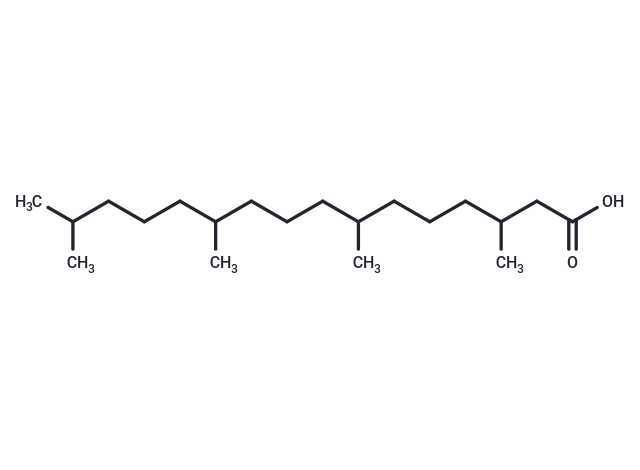
| Description | Pristanic acid is an endogenous branched fatty acid produced by α -oxidation of phytanic acid, which is further metabolized by β -oxidation in peroxisome. As a metabolite of fatty acids, Pristanic acid can be used as a ligand to activate PPARα, thus regulating the expression of genes related to lipid metabolism and energy homeostasis. Its metabolic abnormalities are related to a variety of peroxisome-related diseases, including Zellweger syndrome, α -methyl acyl-coenzyme A racemase deficiency, and infantile Refsum disease. |
| In vitro | In cell proliferation assays using multiple cancer cell lines, Phytanic acid acted as an endogenous toxic metabolite and induced significant apoptosis and cell cycle arrest [1]. |
| In vivo | In tumor-bearing mouse models, systemic administration of Phytanic acid resulted in a decrease in tumor burden [1]. |
| Molecular Weight | 312.53 |
| Formula | C20H40O2 |
| Cas No. | 14721-66-5 |
| Smiles | CC(CCCC(CCCC(CCCC(C)C)C)C)CC(O)=O |
| Storage | Store at low temperature Powder: -20°C for 3 years | In solvent: -80°C for 1 year Shipping with blue ice/Shipping at ambient temperature. |
 For example, if the intended dosage is 10 mg/kg for animals weighing 20 g , with a dosing volume of 100 μL per animal, and a total of 10 animals are to be administered, using a formulation of
  10% DMSO+ 40% PEG300+ 5% Tween 80+ 45% Saline/PBS/ddH2O , the resulting working solution concentration would be 2 mg/mL.
Dissolve 2 mg of the compound in 100 μL DMSO to obtain a stock solution at a concentration of 20 mg/mL . If the required concentration exceeds the compound's known solubility, please contact us for technical support before proceeding.
1) Add 100 μL of the DMSO stock solution to 400 µL PEG300 and mix thoroughly until the solution becomes clear.
2) Add 50 µL Tween 80 and mix well until fully clarified.
3) Add 450 µL Saline,PBS or ddH2O and mix thoroughly until a homogeneous solution is obtained.
| Size | Quantity | Unit Price | Amount | Operation |
|---|
 Feedback
 Hello! How can I help you today?
Copyright © 2015-2026 TargetMol Chemicals Inc. All Rights Reserved.
