


Shopping Cart
Remove All Your shopping cart is currently empty

Synonyms:
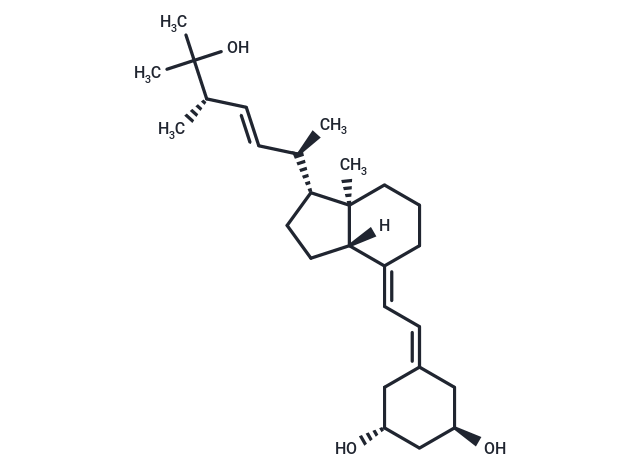
| Pack Size | Price | USA Stock | Global Stock | Quantity |
|---|---|---|---|---|
| 1 mg | $147 | In Stock | In Stock | |
| 5 mg | $463 | In Stock | In Stock | |
| 10 mg | $745 | In Stock | In Stock | |
| 25 mg | $1,170 | In Stock | In Stock | |
| 50 mg | $1,650 | In Stock | In Stock | |
| 100 mg | $2,330 | - | In Stock |
| Description | Paricalcitol is a selective vitamin D receptor agonist and a vitamin D analog. Paricalcitol potently inhibits the synthesis and secretion of parathyroid hormone (PTH) and is commonly used in studies of secondary hyperparathyroidism in patients with chronic kidney disease. |
| In vitro | Methods: Human umbilical vein endothelial cells (HUVECs) were pretreated with different concentrations of Paricalcitol (50–500 nM) for 24 hours. The medium was then replaced and 100 µM H₂O₂ was added for 3 hours. Cell viability was assessed using the MTT assay. Results: At a concentration of 500 nM, post-injury treatment with Paricalcitol significantly increased cell viability.[1] |
| In vivo | Methods: To validate the role of Paricalcitol in CPPD-induced acute kidney injury (AKI), a single intraperitoneal dose of Paricalcitol (0.3 μg/kg) was administered to C57BL/6 mice. Three days later, CPPD (20 mg/kg) was administered intraperitoneally to induce infectious AKI. Results: Paricalcitol pretreatment significantly elevated levels of GSH, SOD, GPX4, CAT, and T-AOC, enhancing renal antioxidant defense. [2] Methods: To investigate the effects of Paricalcitol on intimal hyperplasia and stenosis, female Wistar Kyoto rats underwent femoral artery wire-induced endarterectomy (left side) with right-side sham surgery as control. Intraperitoneal administration of Paricalcitol (750 ng/kg) commenced immediately postoperatively, administered every other day for 2 weeks. Results: The Paricalcitol group showed a trend toward reduced intima-media ratio (0.17) and stenosis rate (28.3%), though neither reached statistical significance. [3] Methods: Male Sprague-Dawley rats underwent four-vessel occlusion (10 min) to establish a global cerebral ischemia model. Paricalcitol (1 μg/kg) was administered intraperitoneally at 5 min, 1 day, 2 days, and 3 days post-ischemia, with observation continuing until day 4 post-ischemia. Results: The 4-day survival rate was 100% (8/8) in the Paricalcitol group and 62.5% (5/8) in the control group. [4] |
| Animal Research | After TAC or sham surgery, a subset of the mice is treated with paricalcitol which activates the VDR, at a final dose of 300 ng/kg/day. Paricalcitol is dissolved in a 95% propylene glycol and 5% ethyl alcohol solution. Mice were intraperitoneally injected with paricalcitol (or vehicle only) three times per week on Monday, Wednesday, and Friday for five consecutive weeks. An established anti-hypertrophic and anti-fibrotic treatment, namely the angiotensin II receptor blocker (ARB) losartan is also included. Previous experiments have shown it is feasible and efficacious to dissolve losartan in the drinking water at a concentration of 30 mg/kg/day; mice are treated for five consecutive weeks. So, in total eight groups are studied. Sham (n=10), TAC (n=10), Sham + losartan (Sham-los, n=10), TAC + losartan (TAC-los, n=10), Sham + paricalcitol (Sham-pari, n=10), TAC + paricalcitol (TAC-pari, n=10), Sham + paricalcitol + losartan (Sham-combi, n=10) and TAC + paricalcitol + losartan (TAC-combi, n=10) [2]. |
| Molecular Weight | 416.64 |
| Formula | C27H44O3 |
| Cas No. | 131918-61-1 |
| Smiles | [H][C@@]12CC[C@H]([C@H](C)\C=C\[C@H](C)C(C)(C)O)[C@@]1(C)CCC\C2=C/C=C1C[C@@H](O)C[C@H](O)C1 |
| Relative Density. | 1.121 g/cm3 |
| Storage | Powder: -20°C for 3 years Shipping with blue ice/Shipping at ambient temperature. | ||||||||||||||||||||||||||||||||||||||||
| Solubility Information | H2O: Insoluble Ethanol: 12 mg/mL (28.8 mM), Sonication is recommended. DMSO: 140 mg/mL (336.02 mM), Sonication is recommended.  | ||||||||||||||||||||||||||||||||||||||||
| In Vivo Formulation | 10% DMSO+90% Saline: < 10 mg/mL (24 mM), Lower concentrations may be soluble, but exact solubility limit is unknown. 10% DMSO+90% Corn Oil: 3.3 mg/mL (7.92 mM), Sonication is recommended. 10% DMSO+40% PEG300+5% Tween 80+45% Saline: 10 mg/mL (24 mM), Suspension. Please add the solvents sequentially, clarifying the solution as much as possible before adding the next one. Dissolve by heating and/or sonication if necessary. Working solution is recommended to be prepared and used immediately. The formulation provided above is for reference purposes only. In vivo formulations may vary and should be modified based on specific experimental conditions. | ||||||||||||||||||||||||||||||||||||||||
Solution Preparation Table | |||||||||||||||||||||||||||||||||||||||||
Ethanol/DMSO
DMSO
Note : The dilution table applies only to solid products. For liquid products, please calculate the stock solution based on the stated concentration and/or density. | |||||||||||||||||||||||||||||||||||||||||
 For example, if the intended dosage is 10 mg/kg for animals weighing 20 g , with a dosing volume of 100 μL per animal, and a total of 10 animals are to be administered, using a formulation of
  10% DMSO+ 40% PEG300+ 5% Tween 80+ 45% Saline/PBS/ddH2O , the resulting working solution concentration would be 2 mg/mL.
Dissolve 2 mg of the compound in 100 μL DMSO to obtain a stock solution at a concentration of 20 mg/mL . If the required concentration exceeds the compound's known solubility, please contact us for technical support before proceeding.
1) Add 100 μL of the DMSO stock solution to 400 µL PEG300 and mix thoroughly until the solution becomes clear.
2) Add 50 µL Tween 80 and mix well until fully clarified.
3) Add 450 µL Saline,PBS or ddH2O and mix thoroughly until a homogeneous solution is obtained.
| Size | Quantity | Unit Price | Amount | Operation |
|---|
 Feedback
 Hello! How can I help you today?
Copyright © 2015-2026 TargetMol Chemicals Inc. All Rights Reserved.
