Shopping Cart
Remove All
  • TargetMol
    Your shopping cart is currently empty

Okadaic acid ammonium salt

Copy Product Info
😃Good
Catalog No. T39183Cas No. 175522-42-6

Okadaic acid ammonium salt is a marine toxin that acts as an inhibitor of protein phosphatases (PP), with the highest affinity for PP2A (IC50 = 0.1–0.3 nM), while also inhibiting PP1, PP3, PP4, and PP5, but not PP2C. By increasing the phosphorylation of various proteins, it functions as a tumor promoter and induces tau protein phosphorylation, commonly used to establish Alzheimer's disease models.

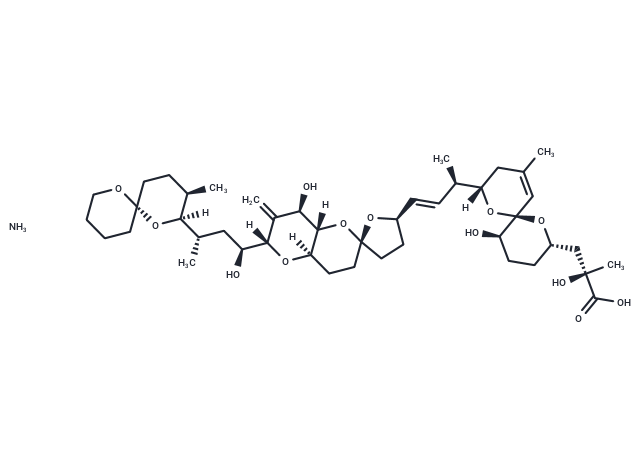
Okadaic acid ammonium salt

Okadaic acid ammonium salt

Copy Product Info
😃Good
Catalog No. T39183Cas No. 175522-42-6
Okadaic acid ammonium salt is a marine toxin that acts as an inhibitor of protein phosphatases (PP), with the highest affinity for PP2A (IC50 = 0.1–0.3 nM), while also inhibiting PP1, PP3, PP4, and PP5, but not PP2C. By increasing the phosphorylation of various proteins, it functions as a tumor promoter and induces tau protein phosphorylation, commonly used to establish Alzheimer's disease models.
Pack SizePriceUSA WarehouseGlobal WarehouseQuantity
25 mg$1,520InquiryInquiry
Add to Cart
Add to Quotation
In Stock Estimated shipping dateUSA Warehouse[1-2 days] Global Warehouse[5-7 days]
All TargetMol products are for research purposes only and cannot be used for human consumption. We do not provide products or services to individuals. Please comply with the intended use and do not use TargetMol products for any other purpose.
Questions
TargetMol
View More

Resource Download

Product Introduction

Bioactivity
Description
Okadaic acid ammonium salt is a marine toxin that acts as an inhibitor of protein phosphatases (PP), with the highest affinity for PP2A (IC50 = 0.1–0.3 nM), while also inhibiting PP1, PP3, PP4, and PP5, but not PP2C. By increasing the phosphorylation of various proteins, it functions as a tumor promoter and induces tau protein phosphorylation, commonly used to establish Alzheimer's disease models.
Targets&IC50
PP4:0.1 nM (IC50), PP1:15-50 nM (IC50), PP3:3.7-4 nM (IC50), PP2B:4000 nM (IC50), PP2A:0.1-0.3 nM (IC50), PP5:3.5 nM (IC50), PP7:>1000 nM (IC50)
In vitro
Okadaic acid ammonium salt at concentrations ranging from 0-100 nM and exposure times of either 24 or 48 hours has been shown to inhibit the proliferation of AGS, MNK-45, and Caco 2 cell lines[3]. Moreover, at a specific concentration of 10 nM and an incubation period of 8 hours, this compound enhances Drp1 phosphorylation and mitochondrial fission in rat cortical neurons[4]. These findings are supported by a Cell Proliferation Assay conducted on the aforementioned cell lines, with the results clearly indicating a suppression in their proliferation rates under the specified conditions[3].
In vivo
When administered unilaterally to the lateral amygdala in female wild-type C57BL/6 mice aged 6 to 8 months, okadaic acid ammonium salt at a dosage of 100 μM induces Tau phosphorylation and protein aggregation in anatomically distinct regions of the brain 24 hours after injection.
Disease Modeling Protocol
Skin cancer model
  • Modeling Mechanism:

    Okadaic acid ammonium salt is a non-TPA tumor promoter that does not bind to TPA receptors or activate protein kinase C (PKC). It promotes polyamine synthesis and cell proliferation by specifically inducing increased activity of ornithine decarboxylase (OrnDCase) and histidine decarboxylase (HisDCase). When combined with the carcinogen 7,12-dimethylbenzo[a]anthracene (DMBA) to initiate gene mutations, it accelerates the clonal expansion of mutant cells, ultimately inducing tumors such as skin papilloma and squamous cell carcinoma.

  • Related Products:

    Okadaic acid ammonium salt (T39183)

  • Modeling Method:

    Experimental Subject:

    Mouse, CD-1, Female, 8 weeks old

    Dosage and Administration Route:

    ① Initiation: 100 μg DMBA, dissolved in 0.1 mL acetone, dorsal dermal application;
    ② Promotion: 10 μg okadaic acid dissolved in 0.1 mL acetone, applied topically to dorsal skin

    Dosing Frequency and Duration Model:

    Initiation: single dose; Promotion: twice-weekly application for 30 weeks

  • Validation:

    Clinical phenotype: Tumor incidence reached 93% at week 16, and the average number of tumors per mouse was 2.6 at week 30; only 6.7% (1/15 mice) of mice in the DMBA or OA alone group developed tumors; in the positive control (DMBA+teleocidin) group, all mice developed tumors at week 15, with an average of 6.8 tumors per mouse; Histological markers: 92.3% of the 39 tumors were papillomas, 5.1% were squamous cell carcinomas, and 2.6% were sarcomas, similar to the proportions of tumor types induced by TPA-type promoters; Molecular markers: Skin OrnDCase activity peaked 4 hours after OA application (1.38 nmol CO₂/mg protein/30 min), and HisDCase activity significantly increased 13 hours later (143 pmol CO₂/mg protein/hour), and OrnDCase induction could be inhibited by 13-cis-retinoic acid; Specificity verification: OA (≤100 μM) does not inhibit the specific binding of [³H] TPA to skin particle components, and does not activate in vitro PKC at ≤1.2 μM, confirming it as a non-TPA type tumor promoter.

*Precautions: All mice were euthanized after the experiment.

*References:Suganuma M,et,al. Okadaic acid: an additional non-phorbol-12-tetradecanoate-13-acetate-type tumor promoter. Proc Natl Acad Sci U S A. 1988 Mar;85(6):1768-71.

Chemical Properties
Molecular Weight822.046
FormulaC44H71NO13
Cas No.175522-42-6
SmilesN.[H][C@]1(CC(C)=C[C@@]2(O[C@H](C[C@@](C)(O)C(O)=O)CC[C@H]2O)O1)[C@H](C)\C=C\[C@H]1CC[C@@]2(CC[C@@]3([H])O[C@]([H])([C@@H](O)C[C@H](C)[C@@]4([H])O[C@@]5(CCCCO5)CC[C@H]4C)C(=C)[C@@H](O)[C@]3([H])O2)O1 |c:4|
Relative Density.no data available
Storage & Solubility Information
StoragePowder: -20°C for 3 years | In solvent: -80°C for 1 year | Shipping with blue ice/Shipping at ambient temperature.

Calculator

  • Molarity Calculator
  • Dilution Calculator
  • Reconstitution Calculator
  • Molecular Weight Calculator

In Vivo Formulation Calculator (Clear solution)

Please enter your animal experiment information in the following box and click Calculate to obtain the stock solution preparation method and in vivo formula preparation method:
TargetMol | Animal experiments For example, if the intended dosage is 10 mg/kg for animals weighing 20 g , with a dosing volume of 100 μL per animal, TargetMol | Animal experiments and a total of 10 animals are to be administered, using a formulation of TargetMol | reagent 10% DMSO+ 40% PEG300+ 5% Tween 80+ 45% Saline/PBS/ddH2O , the resulting working solution concentration would be 2 mg/mL.

Stock Solution Preparation:

Dissolve 2 mg of the compound in 100 μL DMSOTargetMol | reagent to obtain a stock solution at a concentration of 20 mg/mL . If the required concentration exceeds the compound's known solubility, please contact us for technical support before proceeding.

Preparation of the In Vivo Formulation:

1) Add 100 μL of the DMSOTargetMol | reagent stock solution to 400 μL PEG300TargetMol | reagent and mix thoroughly until the solution becomes clear.

2) Add 50 μL Tween 80 and mix well until fully clarified.

3) Add 450 μL Saline,PBS or ddH2OTargetMol | reagent and mix thoroughly until a homogeneous solution is obtained.

This example is provided solely to demonstrate the use of the In Vivo Formulation Calculator and does not constitute a recommended formulation for any specific compound. Please select an appropriate dissolution and formulation strategy based on your experimental model and route of administration.
All co-solvents required for this protocol, includingDMSO, PEG300/PEG400, Tween 80, SBE-β-CD, and Corn oil, are available for purchase on the TargetMol website.
1 Enter information below:
mg/kg
g
μL
2 Enter the in vivo formulation:
% DMSO
%
% Tween 80
% Saline/PBS/ddH2O

Dose Conversion

You can also refer to dose conversion for different animals. More Dose Conversion

Tech Support

Please see Inhibitor Handling Instructions for more frequently ask questions. Topics include: how to prepare stock solutions, how to store products, and cautions on cell-based assays & animal experiments, etc

Keywords

Related Tags: buy Okadaic acid ammonium salt | purchase Okadaic acid ammonium salt | Okadaic acid ammonium salt cost | order Okadaic acid ammonium salt | Okadaic acid ammonium salt chemical structure | Okadaic acid ammonium salt in vivo | Okadaic acid ammonium salt in vitro | Okadaic acid ammonium salt formula | Okadaic acid ammonium salt molecular weight